Ch. 1free to read
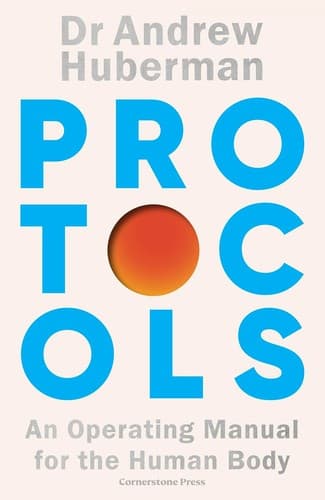
Protocols
What It’s About
At nineteen, on the Fourth of July he and his friends fought the men robbing a friend's house, Andrew Huberman decided to change his life. That led to a Stanford professorship, the Huberman Lab podcast, and this book. Across seven areas, he shows how to improve your sleep, energy, focus, and emotional balance. Start with free tools like morning sunlight or a calming breathing technique, and only then add supplements.
Read a Sample
Protocols: Summary
It's July 4, 1994. A nineteen-year-old skateboarder shows up at a barbecue with his friends and finds the house being robbed. Without a second thought, they go straight at the robbers, and it turns into an ugly fight. When the police arrive, they arrest the burglars instead of the boys, and they even congratulate him before driving off. He just feels sick. All at once he sees, with total clarity, that his life is going nowhere, and the praise doesn't feel like anything to celebrate. It feels more like a consolation prize for losers. That boy is Andrew Huberman, the author of Protocols, and that weekend he decides he can't go on living this way.
From then on, he studies like a man possessed. He sits at his desk in two-hour blocks and won't get up even to use the bathroom. After three of those cycles he lets himself nap, and then he does three more. His friends nickname him "Dart," because on his rare nights out he'd slip away from the party at midnight without saying goodbye, just to protect his sleep. In college, a single line from Professor Harry Carlisle settled what he wanted to do with his life. Carlisle asked the class to think about what it is to try to move, think or feel a certain way. What if the neurons that effort depends on simply aren't there, or are broken? Years of stubborn self-experimentation eventually made him a Stanford professor, then gave us the Huberman Lab podcast, and now this book. It packs three decades of neuroscience and personal stumbles into steps you can start tomorrow morning. As one of his colleagues once neatly put it, "better living through chemistry still requires better living." No single pill can stand in for movement, sleep and stress management.