Ch. 1free to read
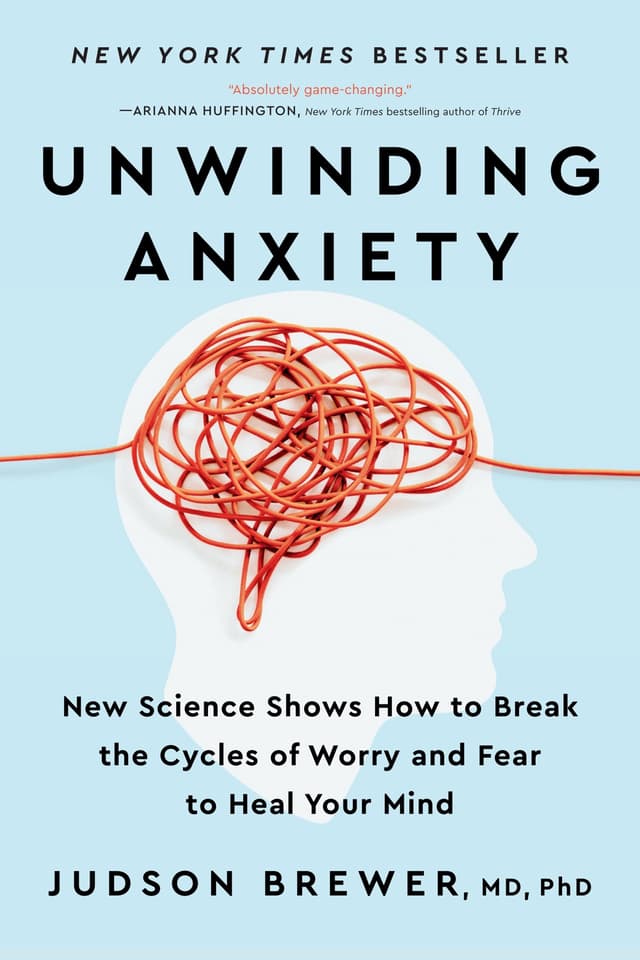
Unwinding Anxiety
What It’s About
Why anxiety is a habit, and how to break it. Brown psychiatrist Judson Brewer combines neuroscience, mindfulness research, and 20 years of clinical work to map the worry loop and the curiosity-based intervention that disarms it. Built on data from his clinical trials. The most rigorous book on chronic anxiety published in the last decade.
Three Key Ideas
Anxiety as a Learned Habit
Anxiety is not a condition you have but a reward-based behavior loop the brain learned because worrying once delivered a sense of control.
Why Willpower Always Fails
The prefrontal cortex that powers willpower goes offline under stress, leaving the fast, habit-running limbic system completely in charge.
Updating Reward Value Through Curiosity
Paying close attention to how anxiety actually feels in the body causes the brain to revise the habit's reward value downward over repeated practice.
Read a Sample
Anxiety is a learned habit
Dave is a cardiologist. He sees heart patients all day, holds lives in his hands, and by every external measure is doing fine. But there is something happening every evening that he cannot explain and cannot stop.
He gets home, opens the refrigerator, and takes out a bottle of white wine. He doesn't sit down and pour a glass intentionally. He doesn't think: I deserve this, or I need to unwind. He just opens it, and an hour later he's looking at a bottle that is half empty. This happens on nights before surgery. It happens even when he has promised himself it won't. He has tried the "just one glass" rule. He has tried willpower, journaling, exercise, meditation apps, cognitive behavioral therapy. All of it collapses somewhere around the third glass.
By the time Dave shows up in Judson Brewer's office at Brown University, he has tried everything a well-informed, intelligent professional can think of. He is not an alcoholic in any clinical sense. He is a cardiologist who is anxious, and wine has become the thing that makes the anxiety go quiet for a while. The drinking is not the problem. It is the solution, and that distinction is the entire book in miniature.
In the first twenty minutes of their conversation, Dave says something that Brewer has heard from nearly every patient with anxiety, regardless of what form it takes. "I know it's bad. I know it doesn't actually help. And I still can't stop."
Brewer, who is a psychiatrist, a neuroscientist, and the director of research and innovation at Brown's Mindfulness Center, has spent twenty years studying why that sentence is so universally true, and what can actually be done about it. His answer is not another productivity framework. It is not about willpower or positive thinking or breathwork. It is about how the brain actually learns, and how you can use that learning mechanism to unlearn the habit of anxiety, the same way the brain created it.
Dave's wine habit is not a character flaw. It is a textbook reward-based learning loop. Trigger: the ambient stress of a day full of high-stakes decisions. Behavior: pour wine. Reward: the anxiety quiets for a while. The brain notices: this works. It files it. And next time the trigger arrives, the behavior is ready and waiting, faster than any conscious intention can intercept it.
The wine is standing in for the anxiety. Treat the wine, and the anxiety will find another exit. Treat the anxiety as a habit, and everything downstream changes.
That is what Brewer spent a decade figuring out how to actually do.
Who It’s For
- Anyone who has tried willpower, therapy, or meditation apps for anxiety and found that nothing sticks.
- Anyone who suspects their worrying, late-night scrolling, or comfort eating is driven by anxiety rather than genuine need.
- Anyone who wants a neuroscience-grounded explanation of why anxiety keeps returning after every attempt to manage it.
- Anyone who works in a high-pressure professional environment and notices anxiety quietly eroding their focus and decision-making.
About the Author: Judson Brewer
Judson Brewer is a physician, psychiatrist, and neuroscientist at Brown University's Warren Alpert Medical School, where he directs research at the Mindfulness Center. His background is in addiction medicine, and his clinical work focuses on using mindfulness-based approaches to treat habitual behaviors including smoking, binge eating, and anxiety.
His 2011 randomized trial on smoking cessation produced quit rates five times higher than the then-gold-standard treatment from the American Lung Association. He founded MindSciences to develop app-based clinical interventions, and his TED talk on breaking bad habits has been viewed more than eighteen million times. Unwinding Anxiety was published in 2021.