 English
 Magyar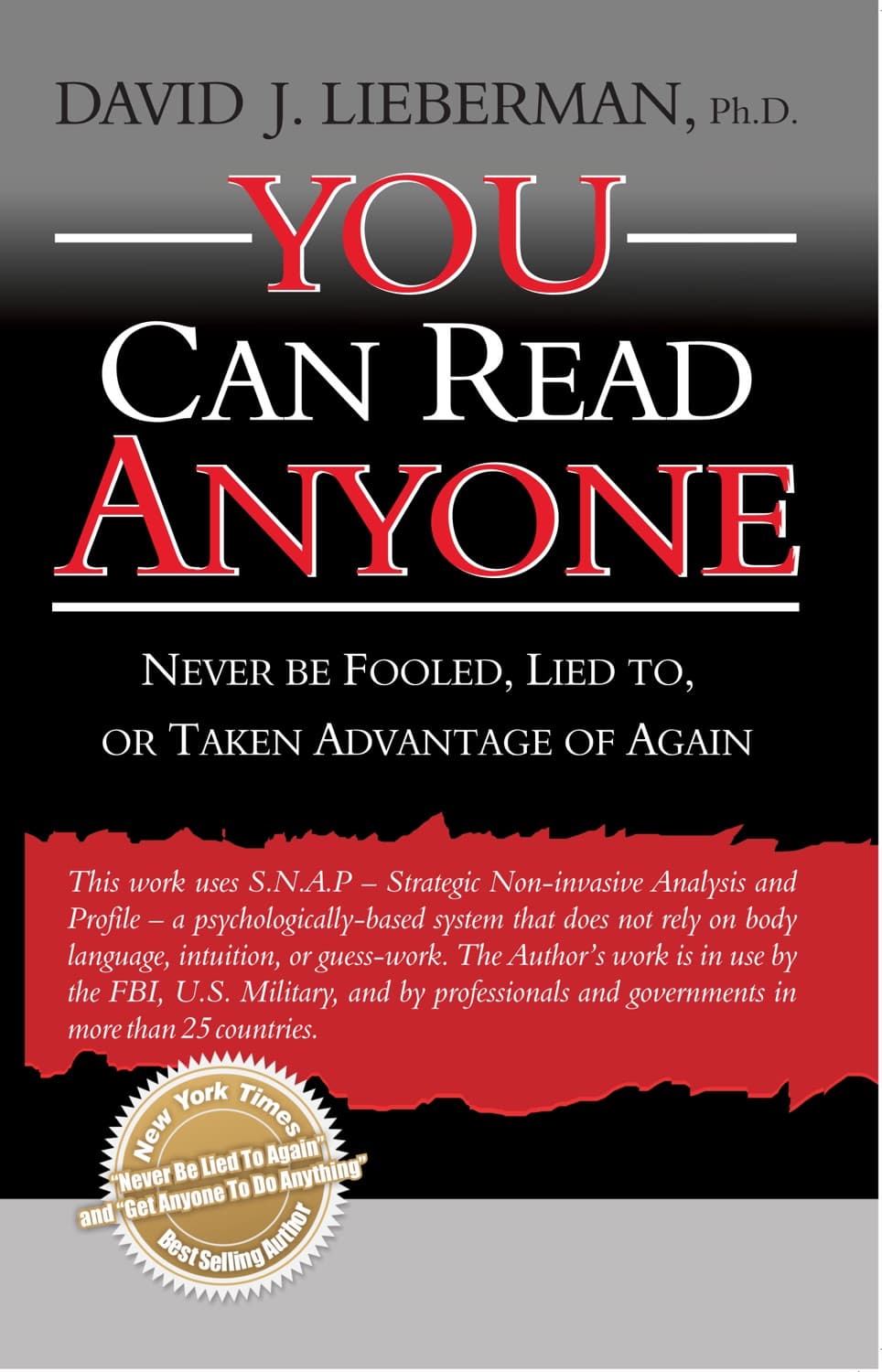
You Can Read Anyone
Dr. David J. Lieberman
Free download · 500+ book summaries
What is You Can Read Anyone about?
Seven techniques for figuring out what someone is thinking when they will not say it. Clinical psychologist David Lieberman built a set of practical questioning and observation drills used by FBI agents, prosecutors, and clinicians. Direct, evidence-based, and unusually concrete for a behavior-reading book.
Key ideas of You Can Read Anyone
Indirect Questions Surface Truth
Asking a suspect for advice about their own potential misdeed reveals guilt through avoidance and innocent engagement through genuine interest.
Confidence and Self-Esteem Diverge
A person can be highly skilled and confident in one area while having deeply low self-esteem, and mistaking the two will lead you to wrong conclusions.
Reality Shifts Expose Real Interest
Lowering someone's odds of getting what they want reveals whether their engagement is genuine, because real interest produces visible anxiety, not calm.
Read an excerpt from the summary
You Can Read Anyone
*David J. Lieberman, Ph.D. (2007)*
A sales manager and the missing supplies
Picture this scene from the opening chapter of Lieberman's book. A sales manager named Tom suspects that one of his salespeople, Jill, has been quietly walking off with office supplies. Pens, toner, paper. Nothing huge, but enough to notice. He has two bad options. He can confront her directly, which puts her on the defensive and ruins the relationship if he is wrong. Or he can ignore it and lose more inventory. Lieberman offers a third path.
Tom calls Jill into his office and says, in a tone of mild puzzlement, "Jill, I'm wondering if you could help me with something. It's come to my attention that someone in the sales department has been taking home office supplies for personal use. Do you have any idea how we can put a stop to this?" Then he watches her.
If Jill is innocent, she leans in. She is interested. She offers ideas. She might even feel flattered that Tom asked her opinion. If Jill is the one taking the supplies, something different happens. Her body language shifts. She becomes uneasy. She tries to change the subject. She may volunteer, unprompted, that she would never do anything like that. Lieberman's point is sharp. Innocent people engage with the topic. Guilty people, the moment they hear the topic, want to be somewhere else.
This is the entire spirit of *You Can Read Anyone*. Lieberman is not selling vague body-language tricks. He is selling little verbal experiments. You set up a question or a scenario that does not accuse anyone of anything, then you watch the reaction. The signal is in the gap between what a normal person would do and what your subject actually does.
Like it?
Continue in the appWho is it for?
- Anyone who needs to tell whether a colleague, candidate, or client is being straight with them.
- Anyone who wants practical scripts for high-stakes conversations in hiring, sales, or negotiation.
- Anyone who wants to recognize emotional manipulation before it changes their decisions.
- Anyone who has ever wished they could read a partner or coworker's true attitude without asking directly.
About the author: Dr. David J. Lieberman
David J. Lieberman holds a Ph.D. in psychology and has worked as a behavioral consultant for organizations including the FBI and the Department of the Navy. He is the author of multiple books on influence and behavior reading, including the New York Times bestsellers Get Anyone to Do Anything and Never Be Lied to Again.
His techniques draw on established research by Paul Ekman on microexpressions, Robert Hare on psychopathy, and Gavin de Becker on threat assessment. He has appeared on more than 200 television and radio programs and his methods have been used in law enforcement and intelligence training.
Read it in 44 minutes
The summary of You Can Read Anyone and 500+ more books await in the BookBase app.