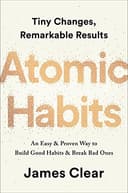
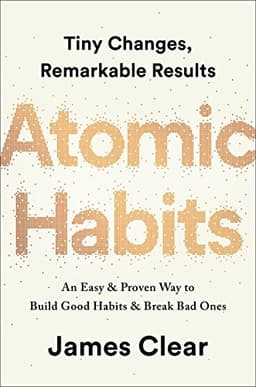

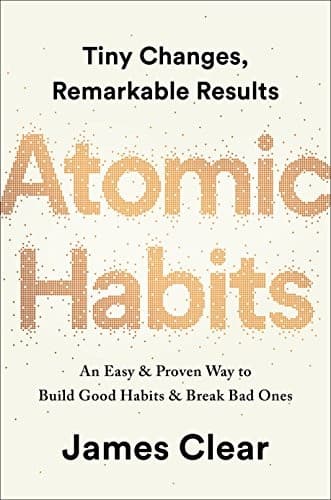
Atomic Habits
In 2002, on the last day of his sophomore year of high school, James Clear was standing in the batter's box during a baseball game when a classmate accidentally let go of a bat mid-swing. The bat smashed into his face at full force. His nose was crushed into a distorted U-shape. Both eye sockets shattered. His skull fractured in multiple places. He was airlifted to the hospital and placed into a medically induced coma.
When he woke up, he could barely breathe on his own. He had lost much of his ability to smell. He suffered double vision for weeks. He could not drive a car for nine months. His recovery was brutal. Just sitting upright in bed was a victory. Returning to anything close to normal life felt impossibly far away.
For a young athlete who had dreamed of playing college baseball, this kind of injury could have been the end of the story. And honestly, nobody would have blamed him for giving up. But Clear decided to treat his recovery differently. He could not control the severity of the injury. He could control the small actions he took each day. He could control whether he showed up to physical therapy. Whether he got a good night of sleep. Whether he studied hard enough to keep his grades up while everything else was falling apart. He started stacking tiny, almost laughably small improvements. Getting to bed on time. Keeping his room clean. Doing a little more in rehab than the day before. None of these things felt like progress. None of them felt like they mattered.
But they did.
It took six years. Six years of quiet, unglamorous work. Six years of stacking small habits on top of each other, each one barely noticeable on its own. And at the end of those six years, James Clear was named to the ESPN Academic All-America Team as one of the top male student-athletes in the country. He earned a spot on the starting lineup at Denison University and was selected as the team's top male athlete. He had gone from a hospital bed to a national honor roll, not through any single act of brilliance, but through the accumulated power of showing up, day after day, and getting slightly better each time.
Not because of one dramatic moment of transformation. Because of thousands of small ones.
That story became the seed for what would eventually become one of the best-selling nonfiction books of the 21st century. Clear's argument is not complicated. It is not flashy. It is simply this: you do not rise to the level of your goals. You fall to the level of your systems. And the most effective system for changing your life is not a radical overhaul. It is a tiny shift repeated consistently, day after day, until the compound interest of self-improvement delivers results that shock everyone, including you.
The Surprising Power of 1% Better
If you got one percent better every day for a year, you would end up roughly 37 times better by the time you were done. If you got one percent worse every day, you would shrink down to nearly zero. This is the math of habits. It is not intuitive, because the human brain struggles to think in exponential curves. We expect progress to be linear. We expect effort in, results out, immediately, like a vending machine. But that is not how compounding works.
Consider the story of Dave Brailsford and British Cycling. When Brailsford took over as performance director of the British cycling team in 2003, the program was a national embarrassment. In nearly a century of competition, British riders had won just a single Olympic gold medal. No British cyclist had ever won the Tour de France. The team was so bad that one of the top bike manufacturers in Europe refused to sell them bikes, worried it would hurt the brand.
Brailsford's strategy sounded almost absurd. He called it "the aggregation of marginal gains." His idea was simple: search for a tiny one percent improvement in everything you do. The team redesigned the bike seats to make them more comfortable. They rubbed alcohol on the tires for a better grip. They tested different fabrics in a wind tunnel to find the most aerodynamic racing suits. They asked riders to wear electrically heated overshorts to maintain ideal muscle temperature while riding. They hired a surgeon to teach every rider the best way to wash their hands, to reduce the chance of catching a cold. They even figured out which type of pillow and mattress led to the best night of sleep and brought them to hotels.
Individually, none of these changes mattered. Together, they produced one of the most dominant runs in the history of competitive sports. Within five years, the British cycling team won 60 percent of the available gold medals at the 2008 Beijing Olympics. Over the next decade, they won 178 world championships, 66 Olympic or Paralympic gold medals, and five Tour de France victories.
One percent at a time.
The British Cycling story is not about cycling. It is about the power of aggregation. No single change Brailsford made would have turned the team around on its own. Better hand-washing does not win Olympic gold medals. Heated overshorts do not win the Tour de France. But when you combine hundreds of small improvements, the total effect is enormous. This is the core mathematics of Atomic Habits. Small things, done consistently, compound into something that looks like a miracle from the outside. From the inside, it was just one more paper clip, one more degree, one more tiny adjustment.
But here is the part most people miss. The early stages of compounding feel like nothing. Clear uses an analogy that is hard to forget. Imagine an ice cube sitting on a table in a cold room. The temperature is twenty-five degrees Fahrenheit. You start slowly heating the room. Twenty-six degrees. Twenty-seven. Twenty-eight. The ice cube just sits there. Nothing happens. Twenty-nine. Thirty. Thirty-one. Still nothing. Then you hit thirty-two degrees, and the ice begins to melt. One degree made all the difference. But was it really just that one degree? Of course not. It was the entire journey from twenty-five to thirty-two. All the work that came before was not wasted. It was stored.
Clear calls this the Plateau of Latent Potential. It is the valley of disappointment between when you expect results and when results actually arrive. Most people quit during this phase. They put in effort for days, weeks, sometimes months, and see no visible change. So they conclude the effort was pointless and move on to the next thing. They break the very compounding cycle that was about to pay off.
This is why habits are more important than goals. Goals are about the result you want. Habits are about the system that delivers the result. Winners and losers often have the same goals. Every Olympic athlete wants the gold medal. What separates them is the system of daily habits that actually gets them to the podium.
Clear identifies four specific problems with goal-oriented thinking. First, winners and losers have the same goals, so the goal itself cannot be what distinguishes them. Second, achieving a goal is only a momentary change. Clean your room once and it will be messy again in a week if you do not change the habits that created the mess. Third, goals restrict your happiness. You tell yourself you will be happy once you reach the goal, which means you are postponing satisfaction until some future date that may never come. And fourth, goals are at odds with long-term progress. Once you cross the finish line, there is no reason to keep running. People who train for a marathon often stop exercising the week after the race.
Systems thinking flips all of this. When you fall in love with the process rather than the product, you do not have to wait to give yourself permission to be happy. You can be satisfied anytime your system is running. And the system never ends, which means the progress never stops.