 English
 Magyar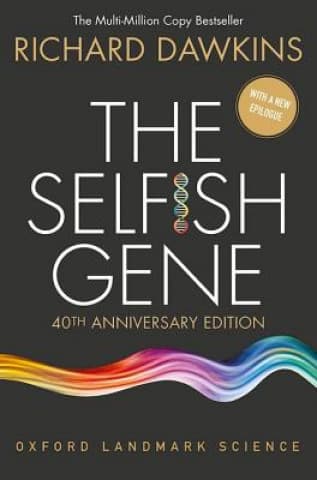
The Selfish Gene
Richard Dawkins
Free download · 500+ book summaries
What is The Selfish Gene about?
The selfish gene theory differs from Darwin's theory in that it considers genes, rather than species, as the unit of selection. Dawkins' book is one of the great advancements of neo-Darwinism, asserting that we are all survival machines, and our role is to preserve the selfish molecules called genes.
Key ideas of The Selfish Gene
Genes as the Unit of Selection
Evolution operates at the level of the gene, not the organism or species, making us vehicles built to carry and propagate our genes.
Kin Altruism and Relatedness
Animals help relatives because shared genes spread when the benefit to kin, weighted by relatedness, outweighs the cost to the helper.
Evolutionarily Stable Strategies
Stable behavioral patterns in populations emerge from game theory, not group planning, because no single defecting strategy can invade and replace them.
Read an excerpt from the summary
A Question That Took Three Billion Years to Ask
For roughly three billion years, life on Earth went about its business without anyone knowing why. Bacteria split. Plants reached for the sun. Animals chased each other and ate each other and bred. Then one species, on one planet, finally noticed the pattern. His name was Charles Darwin, and the year was 1859. The zoologist G. G. Simpson put it bluntly: any attempt to answer the question "why are we here?" before Darwin was worthless, and we are better off ignoring it completely.
Richard Dawkins picks up where Darwin left off, but with a twist. The unit of selection, he argues, is not the organism, not the species, not even the population. It is the gene. We are the vehicles. Genes are the passengers. And every leg, eye, instinct, and impulse you have was built by ancestors of those genes to keep them traveling.
Here is the trick to making the rest of the book click. Imagine genes that have survived for millions of years in a fiercely competitive world. Dawkins compares them to Chicago gangsters who have outlived the prohibition era — the very fact that they are still here tells you something about their character. You can guess, just from their longevity, that they are ruthless and good at it. Successful genes will be selfish. Not selfish in the sense that they sit around plotting; selfish in the sense that any gene which behaved otherwise was outcompeted long ago and is no longer with us. Selfishness here is a statistical residue, not a personality.
This matters because most popular biology before Dawkins assumed evolution was working for the good of the species, or the group, or some abstract collective. Lorenz, Ardrey, Eibl-Eibesfeldt — all of them, in different ways, slipped this assumption into their popular books. A BBC zoologist on Australian spiders said baby spiders die "for the survival of the species." A Nuffield biology guide for schoolchildren explained that animals sometimes commit suicide "to ensure the survival of the species." Dawkins calls this what it is: a gem of a circular argument. If groups of altruists really did exist, one selfish individual landing in their midst would have more children than anyone else, and within a few generations the altruists would be gone. Group selection is slow. Individual selection is fast. Evolution is blind to the future.
Like it?
Continue in the appWho is it for?
- Anyone who wants to understand why natural selection favors cooperation, self-sacrifice, and deception at the same time.
- Anyone who is curious about the biological roots of human behavior, from parental love to sexual rivalry.
- Anyone who enjoys science writing that builds a rigorous argument step by step from first principles.
- Anyone who wants to understand where the concept of the meme came from and what it actually means.
About the author: Richard Dawkins
Richard Dawkins is a British evolutionary biologist and science writer who spent most of his academic career at Oxford University, where he held the position of Professor for Public Understanding of Science. He is one of the most influential popularizers of Darwinian evolution of the twentieth century.
The Selfish Gene, first published in 1976, was his debut book and introduced the gene-centered view of evolution to a wide audience. He went on to write several other widely read books on evolution and science, including The Extended Phenotype and The Blind Watchmaker.
Read it in 47 minutes
The summary of The Selfish Gene and 500+ more books await in the BookBase app.