 English
 Magyar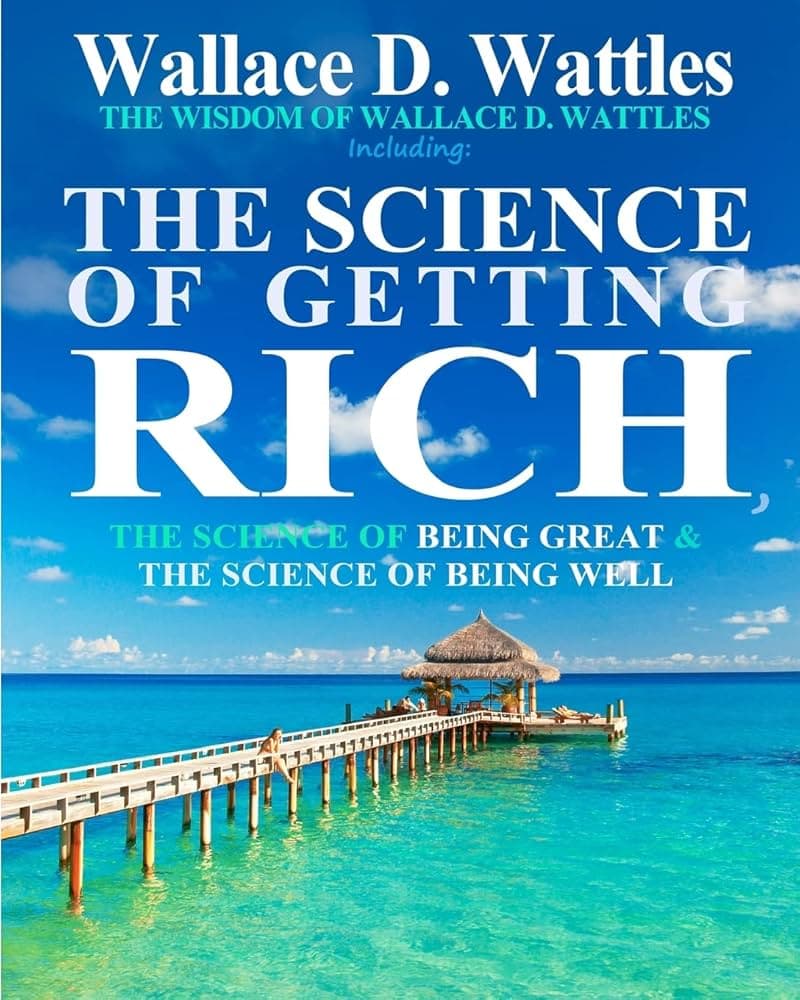
The Science of Getting Rich
Wallanced D. Wattles
Free download · 500+ book summaries
What is The Science of Getting Rich about?
This book is pragmatic, not philosophical; a practical handbook, not a theoretical treatise. It is intended for men and women who have the most urgent need for money; those who want to get rich first and philosophize later. It is for those who have not yet found the time, tools, or opportunity to deeply immerse themselves in the study of metaphysics, but who want results and are willing to base their actions on the conclusions of science, without delving into all the processes that led to those conclusions.
Key ideas of The Science of Getting Rich
Creative vs. Competitive Thinking
People who focus on creating new value rather than fighting for a fixed share of existing wealth build more durable, satisfying prosperity.
Gratitude as a Practical Engine
Sustained, deliberate gratitude keeps attention fixed on abundance, generates faith, and is the core mechanism Wattles says drives results.
Act Now in the Present Environment
You cannot act in the past or future, so applying the method means taking clear, purposeful action where you are today, not waiting for better conditions.
Read an excerpt from the summary
Wallace D. Wattles published a small book in 1910 that promised something almost embarrassing in its boldness: that becoming wealthy follows laws as exact as algebra, and anyone who learns those laws and applies them cannot fail. He called this method the Certain Way, and he meant it literally. Not a good way, not one approach among many, but the way. An iron path with the cool inevitability of a mathematical proof.
It is a strange book. Read with a modern eye, parts of it look like vintage metaphysics. Other parts look like the seed of every manifestation video your aunt has ever shared on Facebook. Both impressions are correct. The Science of Getting Rich is the document that gave Napoleon Hill his vocabulary in nineteen thirty-seven's Think and Grow Rich, gave Rhonda Byrne her premise for The Secret in two thousand and six, and gave a century of personal-development authors a thesis they have been recycling ever since. To read Wattles is to find yourself standing at the source of a long river.
Wattles himself was not a tycoon. He spent most of his life teaching, writing, and quietly applying his own method in the years before he died in nineteen eleven, the year after the book came out. He treats the work, in his Preface, as "pragmatical, not philosophical; a practical manual, not a treatise upon theories." His standard of proof, he says, is the most aggressive one available: if every person who does what the book tells them to do gets rich, that is positive proof until someone goes through the process and fails.
What follows is a chapter-by-chapter walk through the book — the philosophy beneath it, the system it actually prescribes, and an honest assessment of where it holds up and where it does not.
Like it?
Continue in the appWho is it for?
- Anyone who feels guilty about wanting more money and needs permission to pursue wealth without shame.
- Anyone who wants a foundational text behind books like Think and Grow Rich and The Secret.
- Anyone who is waiting for the right conditions before starting and needs a push to act in the present.
- Anyone who wants a short, direct read on the mindset and habits that underpin personal financial growth.
About the author: Wallanced D. Wattles
Wallace D. Wattles (1860-1911) was an American New Thought author who spent much of his life in relative obscurity, writing and teaching before gaining lasting recognition for this book. He was deeply influenced by the New Thought movement and drew on a wide tradition of idealist philosophy, from Emerson back through Hegel and Spinoza, applying their ideas to the practical pursuit of prosperity.
He published The Science of Getting Rich in 1910, the year before he died. Despite his short window of recognition, the book became one of the most widely cited works in the personal development genre and served as a direct source for Napoleon Hill's Think and Grow Rich (1937) and Rhonda Byrne's The Secret (2006).
Read it in 52 minutes
The summary of The Science of Getting Rich and 500+ more books await in the BookBase app.