 English
 Magyar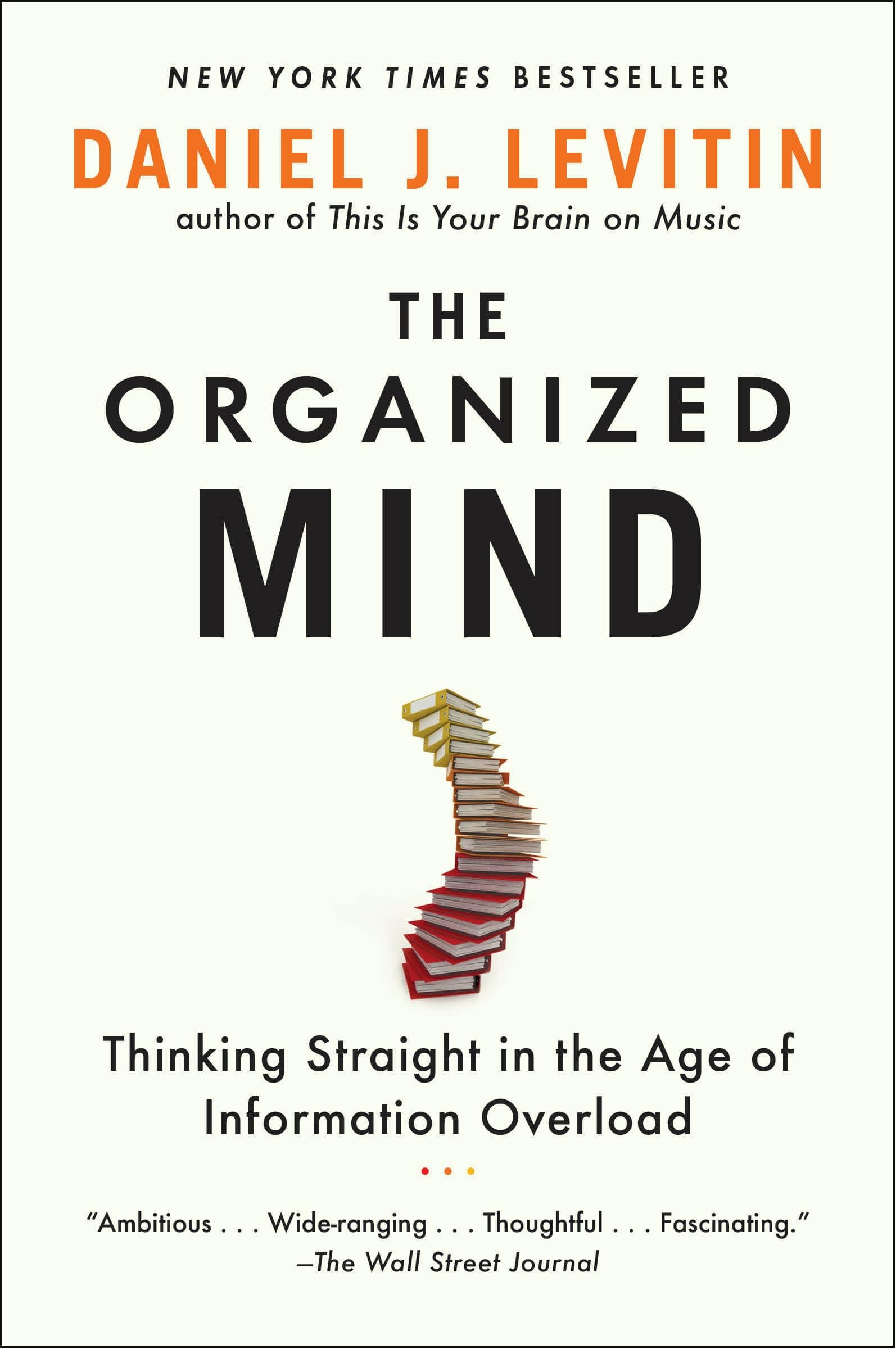
The Organized Mind
Daniel J. Levitin
Free download · 500+ book summaries
What is The Organized Mind about?
The Organized Mind offers an insightful explanation of how our brain handles incoming information — a process that is especially important in the age of information overload. It also provides practical guidance on how to cope with the multitude of decisions we face in daily life. By learning well-thought-out strategies to help organize our lives, we can become more productive and efficient in every task.
Key ideas of The Organized Mind
Externalize to Free Your Brain
Shifting storage from your mind to the physical world, through notes, designated places, and systems, is the core principle of an organized life.
Attention Is Finite and Costly
Every decision and every context switch drains the same limited cognitive pool, making focus and satisficing critical daily disciplines.
Memory Is Reconstructive, Not Recorded
Human memory rewrites itself each time it is recalled, making external systems more reliable than trusting your own recollection.
Read an excerpt from the summary
The Organized Mind by Daniel J. Levitin
A nineteen-year-old named Ioana once stood frozen in the pen aisle of an American drugstore, paralyzed. She had grown up in Ceaușescu's Romania, where pens came in three varieties, and now she was staring at fifty. She did not know which one she needed for her biology class. She was bright, top of her class, and unable to buy a pen.
Daniel Levitin found her there, and Ioana became the opening case in his book about why the modern brain is exhausted. Not because we are weaker than our ancestors. Because we are asking our brains to do something they were never engineered to do: hold, sort, and decide between staggering amounts of information, all day, every day, without any of the helpers our grandparents had. The travel agents, the librarians, the secretaries, the salesclerks who used to think about a tiny slice of the world on our behalf are gone. Now we do all of it ourselves, badly, while wondering why we cannot find our keys.
The book's argument is one sentence long, and Levitin states it outright: the most fundamental principle of the organized mind is to shift the burden of organizing from our brains to the external world. Everything else, the neuroscience, the case studies, the practical fixes, flows from that idea. We are not built for storage. We are built for survival. And survival, for the first time in human history, looks like sorting forty thousand grocery products and answering two hundred emails before lunch.
Introduction: The Brain Wasn't Built for This
Writing was invented around three thousand BCE in Sumerian Uruk, and it was not invented for poetry. It was invented for sales receipts. The first humans to externalize their memories were merchants who could no longer track inventory in their heads. Clay tablets, papyrus, calendars, filing cabinets, computers, phones. Every step has been the same step. Push the storage problem outside the skull.
Like it?
Continue in the appWho is it for?
- Anyone who feels overwhelmed by the volume of decisions and information they face each day.
- Anyone who struggles with focus, forgetfulness, or the sense that their mind is always full.
- Anyone who wants neuroscience-backed reasons to finally build better organizational habits.
- Anyone who manages a demanding workload and needs practical strategies to protect their attention and time.
About the author: Daniel J. Levitin
Daniel J. Levitin is a neuroscientist, cognitive psychologist, and former record producer. He is a professor at McGill University, where his research focuses on the neuroscience of music, memory, and attention. He trained under Amos Tversky and Lee Ross at Stanford, giving him a rigorous grounding in how the brain misjudges evidence and makes decisions.
Levitin is also the author of This Is Your Brain on Music, a bestselling exploration of how the mind processes music. His work spans both the laboratory and popular writing, and he brings that combination of scientific precision and accessible storytelling to The Organized Mind.
Read it in 45 minutes
The summary of The Organized Mind and 500+ more books await in the BookBase app.