 English
 Magyar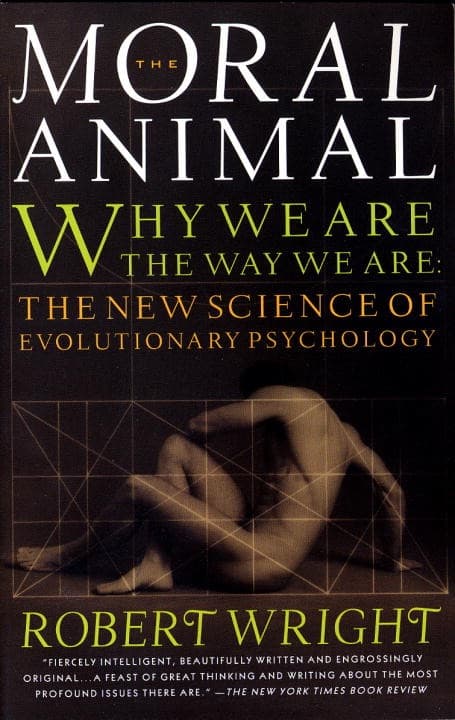
The Moral Animal
Robert Wright
Free download · 500+ book summaries
What is The Moral Animal about?
Does your conscience guide you, or does your DNA? Robert Wright traces the hidden logic behind love, betrayal, and morality through Darwin's own life and journals. He reveals that generosity often masks hidden calculation, that loyalty serves biological interests, and that our deepest convictions may be sophisticated illusions. Learn why you really do what you do, and discover the only freedom worth having: choosing good while fully awake to your selfish nature.
Key ideas of The Moral Animal
Biology Behind Moral Feelings
Our emotions like love, jealousy, and guilt evolved as tools for gene propagation, not as guides to objective right and wrong.
Self-Deception as Strategy
The brain functions like a lawyer that argues whatever serves our interests, and we often believe our own self-serving stories to sell them more convincingly.
Conscious Choice Over Instinct
Understanding our selfish evolutionary inheritance is the necessary first step toward genuinely choosing good rather than merely rationalizing it.
Read an excerpt from the summary
The Moral Animal — Summary
The kind little boy who knew he was being watched
One afternoon, one of Charles Darwin's little boys, two-year-old Doddy, handed his sister Annie his last bite of gingerbread. Then he cried out, loudly enough for everyone in the room to hear, "Oh kind Doddy, kind Doddy!" The scene is sweet. But if you look a moment longer, something slips out from behind the kindness. The child did not just give. The child gave in a way that let the grown-ups see how good he was. The gift and the advertisement arrived in a single motion.
That is exactly why Darwin wrote it down. In the last decades of his life one question haunted him: are our finest qualities, generosity, conscience, love, really as pure as they feel? Or is there always a quiet calculation behind them, one we know nothing about? Doddy was not lying. He really did hand over the cake. It was just that, all the while, his genes were at work, and he had no idea.
Robert Wright's book, The Moral Animal, is about that quiet calculation. It chases answers to three big questions. Why do we love, grow jealous, and cheat in exactly the ways we do? Where does conscience come from, and who does it really work for? And once we understand what kind of machinery moves us, does that knowledge set us free, or just leave us disillusioned? The guiding thread throughout is the same man: Darwin himself, whose diaries, loves, and torments Wright dissects like a case study. Because if evolutionary psychology can explain even the gentlest, most decent Victorian gentleman, then maybe it can explain you too.
The quiet revolution you never heard about
Like it?
Continue in the appWho is it for?
- Anyone who wants to understand why jealousy, attraction, and loyalty feel so automatic and so hard to reason away.
- Anyone who is curious about why lasting relationships require conscious commitment rather than sustained romantic feeling.
- Anyone who has wondered whether human generosity and conscience are as pure as they seem from the inside.
- Anyone who finds evolutionary biology fascinating and wants to see it applied to everyday human psychology and behavior.
About the author: Robert Wright
Robert Wright is an American journalist and author who has spent his career writing about science, evolutionary psychology, and moral philosophy for a general audience. He has contributed to publications including The New Republic and Time, and has taught at Princeton University and the University of Pennsylvania.
Wright is best known for his books applying Darwinian thinking to human nature and society. His work consistently aims to draw practical and ethical conclusions from biology rather than treating evolution as a purely academic subject.
Read it in 51 minutes
The summary of The Moral Animal and 500+ more books await in the BookBase app.