 English
 Magyar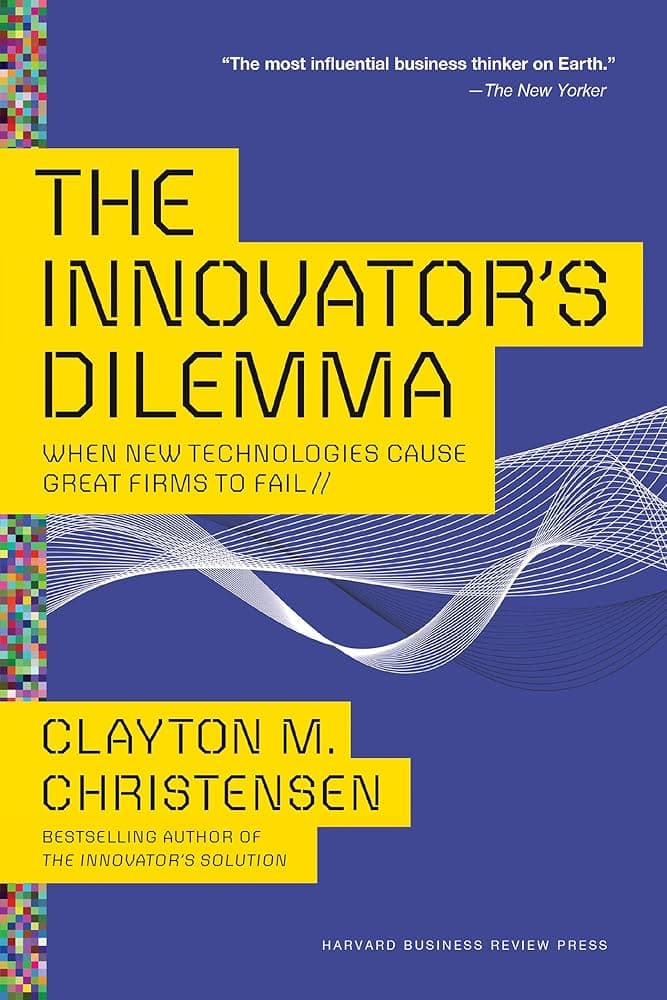
The Innovators Dilemma
Clayton Christensen
Free download · 500+ book summaries
What is The Innovators Dilemma about?
The Innovator's Dilemma explains why so many well-established companies fail when confronted with the emerging markets they created.
Key ideas of The Innovators Dilemma
The Innovator's Dilemma Defined
Well-managed companies fail not from incompetence but from rationally serving their best customers while disruptive competitors build footholds in overlooked markets.
Disruptive vs. Sustaining Innovation
Disruptive innovations start cheaper and inferior on mainstream metrics but improve faster than demand, eventually overtaking established products from below.
Value Networks Trap Incumbents
A firm's cost structure, customer base, and resource allocation rules collectively pull it upmarket and make low-margin emerging markets invisible until it is too late.
Read an excerpt from the summary
The Uncomfortable Idea You Cannot Unsee
Here is a sentence that should bother anyone who runs a company, advises one, or works for one. The well-managed firms that died in the past forty years did not die from sloppiness. They died from doing exactly what every business school, every consultant, and every shareholder told them to do.
Clayton Christensen, a professor at Harvard Business School who spent years inside the hard disk drive industry trying to figure out why its champions kept getting destroyed by its rookies, built his entire career on that uncomfortable claim. He called it the innovator's dilemma. Doing the right thing turns out to be the wrong thing, and the more disciplined you are about the right thing, the faster the wrong thing kills you.
Take Sears Roebuck. In its prime it accounted for more than two percent of all retail sales in the United States. It invented modern supply chain management, catalogue retailing, and credit cards. In 1964, Fortune magazine described it as an extraordinary powerhouse of a company where everyone simply did the right thing easily and naturally. The exact moment Fortune wrote those words, Sears was missing discount retailing and letting Visa and Mastercard walk off with the credit card business. Three decades later its merchandise group was hemorrhaging more than a billion dollars a year.
Or Digital Equipment Corporation. In 1986, Business Week wrote that taking on DEC was like standing in front of a moving train. DEC had created the minicomputer industry and was crushing its rivals. A few years later, DEC was a triage patient, the desktop personal computer had eaten its lunch, and the company was on its way to being absorbed into Compaq.
Like it?
Continue in the appWho is it for?
- Anyone who leads or advises a business that faces competition from cheaper, simpler, or smaller rivals.
- Anyone who wants to understand why dominant companies repeatedly fail at the very moment their management looks strongest.
- Anyone working in product strategy or venture capital who needs a rigorous framework for spotting disruptive threats early.
- Anyone building a startup that must compete against a well-resourced incumbent and wants to know which battles are winnable.
About the author: Clayton Christensen
Clayton Christensen was a professor at Harvard Business School and one of the most influential business thinkers of the late twentieth and early twenty-first centuries. He spent years studying the hard disk drive industry before developing the theory of disruptive innovation, which became the foundation of his academic and advisory work.
Beyond this book, Christensen applied the same framework to healthcare, education, and management consulting, and he advised companies and governments worldwide. He is widely credited with giving practitioners a vocabulary and a diagnostic process for one of the most common and least understood patterns in competitive markets.
Read it in 48 minutes
The summary of The Innovators Dilemma and 500+ more books await in the BookBase app.