 English
 Magyar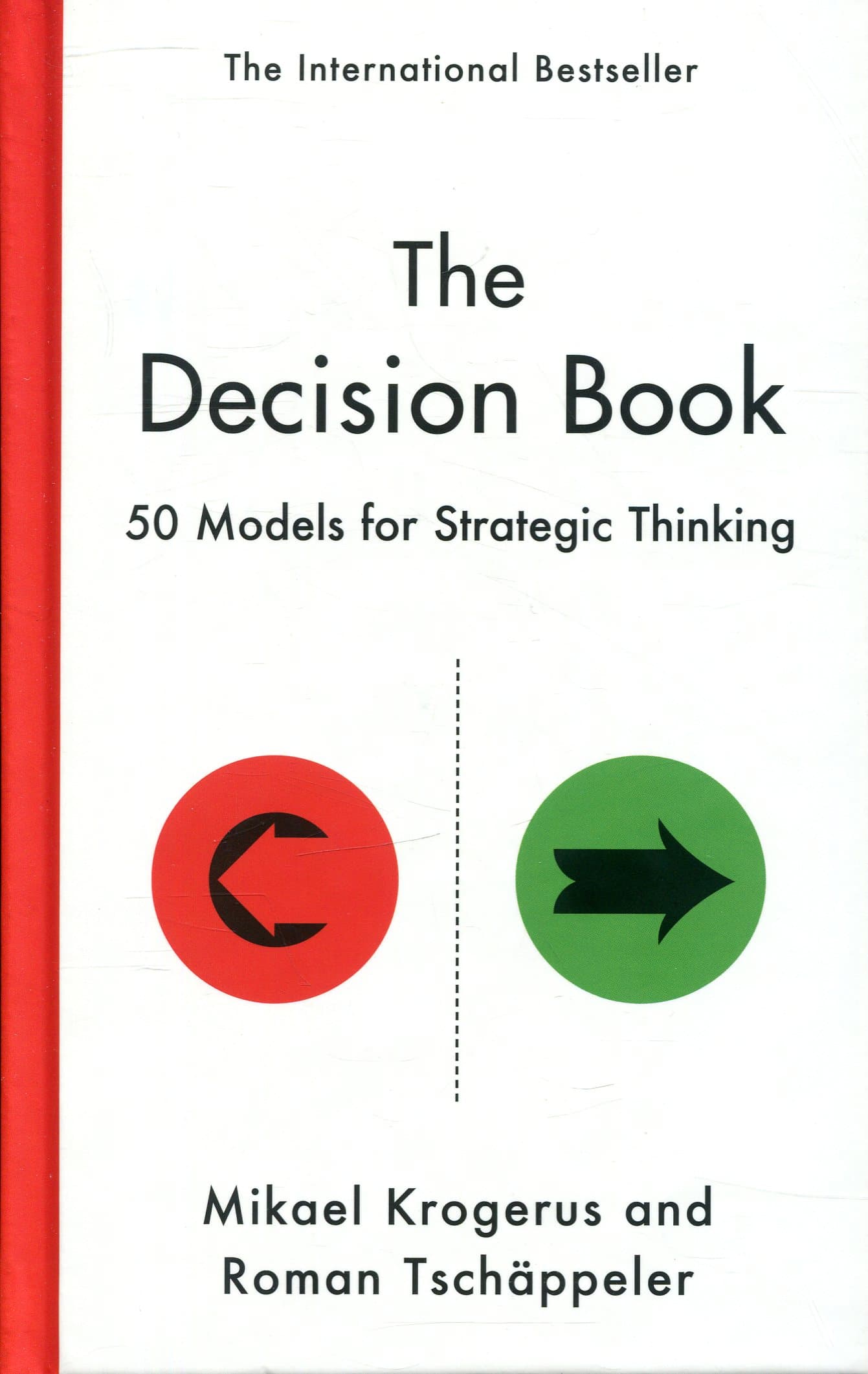
The Decision Book
Mikael Krogerus, Roman Tschäppeler
Free download · 500+ book summaries
What is The Decision Book about?
The Decision Book offers 50 different ways to develop our own strategies, enabling us to make independent, logical decisions.
Key ideas of The Decision Book
Frames Shape Decisions
Choosing the right mental model matters more than calculating the right answer, because the frame determines which variables you can even see.
Fifty Portable Thinking Tools
The book assembles classic models from management, psychology, and game theory into a compact kit for everyday personal and professional decisions.
Models Need Feedback to Work
Peter Drucker's discipline of writing down predictions and comparing them to outcomes is what turns borrowed frameworks into reliable personal judgment.
Read an excerpt from the summary
Two friends in Switzerland expected to sell five hundred copies of their decision handbook. Mikael Krogerus and Roman Tschäppeler had graduated together from a Danish leadership school called Kaospilot in 2003, and they kept hitting the same wall in their own lives — small choices were paralyzing them. Should I take this job. Should I confront this friend. Should I buy this car. They figured if a book gave them a vocabulary of fifty thinking tools, the daily grind of choice would get easier. The print run was modest. The expectation was modest. The thing sold over a million copies in twenty languages.
The reason it caught on, I suspect, isn't that the models are revolutionary. Most of them are decades old, lifted from management literature, social psychology, and game theory. What Krogerus and Tschäppeler did was assemble them into a portable kit and admit, on the first page, what the kit actually is. A model isn't an answer, they write. It's a method of asking questions. It simplifies. It summarizes. It visualizes. It strips a messy situation down to two or three axes you can actually argue about. The rest of the book is a tour through fifty of these distillations, organized into four moves — improving yourself, understanding yourself, understanding others, and improving others — with a closing essay on how decisions will work in an age of algorithms.
I want to walk through the most useful ones, with the stories Krogerus tells about where each model came from and what it costs you when you misuse it. The book is short and the models are short, but the throughline is worth holding onto: the question you ask determines the answers you can see, so picking the right frame matters more than calculating the right answer to the wrong one.
Like it?
Continue in the appWho is it for?
- Anyone who feels paralyzed by everyday choices and wants a structured way to think through them.
- Anyone who leads teams and needs practical tools for setting goals, giving feedback, and resolving conflict.
- Anyone who wants to understand their own blind spots and decision-making biases more clearly.
- Anyone who prefers a concise, visual reference over a long theoretical business book.
About the author: Mikael Krogerus, Roman Tschäppeler
Mikael Krogerus and Roman Tschäppeler are Swiss authors and communication consultants who met at Kaospilot, a Danish leadership school, graduating in 2003. They wrote The Decision Book after finding that a shared vocabulary of thinking tools helped them navigate the choices they were getting stuck on in their own lives.
Their debut sold over a million copies across twenty languages, well beyond the five hundred copies they originally expected to shift. Together they have continued to write practical, visually driven books on communication and self-management.
Read it in 49 minutes
The summary of The Decision Book and 500+ more books await in the BookBase app.