 English
 Magyar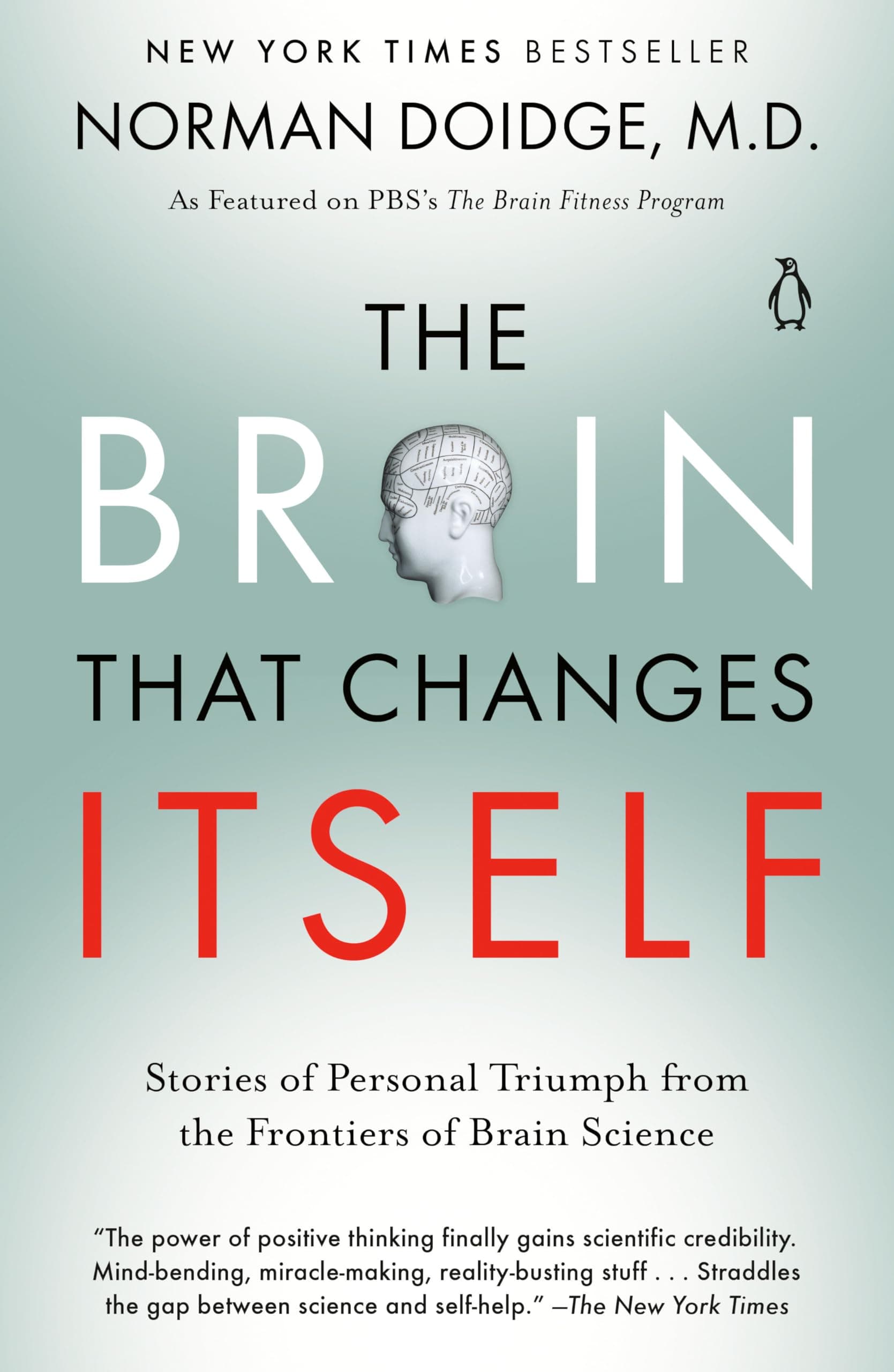
The Brain That Changes Itself
Norman Doidge
Free download · 500+ book summaries
What is The Brain That Changes Itself about?
The book The Brain That Changes Itself uncovers pioneering research on neuroplasticity and shares the fascinating stories of individuals who, by harnessing the brain's ability to adapt, healed from previously incurable diseases.
Key ideas of The Brain That Changes Itself
The Brain Can Rewire Itself
The adult brain reorganizes its maps and recruits alternative pathways throughout life, not only during childhood as scientists long assumed.
Repetition Shapes the Brain
Every repeated behavior, good or bad, physically deepens neural circuits, making deliberate practice the most direct way to change lasting habits.
Learned Nonuse and Recovery
Much of what looks like permanent neurological loss is the brain giving up after repeated failure, and targeted retraining can restore lost function.
Read an excerpt from the summary
A Woman Who Could Not Stop Falling
In 1997, a forty-year-old sales rep named Cheryl Schiltz was prescribed a routine antibiotic after a hysterectomy. The dose ran far above what her body could safely clear. The drug, gentamicin, wiped out almost the entirety of her vestibular system — the inner-ear apparatus that tells the brain which way is up. For the next five years, Cheryl lived inside a sensation that the floor was tipping out from under her at every moment. She described it as falling into an infinite abyss. She lost her job. She lived on a thousand dollars a month in disability. Doctors told her nothing could be done, because every neuroscience textbook said the same thing: when the brain's wiring goes, it stays gone.
Norman Doidge's book, published in 2007, is about why those textbooks were wrong. It is the popular work that more or less single-handedly pulled the word "neuroplasticity" into the kitchen-table vocabulary of curious readers, and it did so by stitching together patient stories and lab science from a small clique of researchers Doidge calls neuroplasticians — clinicians and scientists who spent decades arguing, often against their own field, that the adult brain can rewire itself, regrow function, and rearrange its maps long after childhood is over.
The man who fixed Cheryl was Paul Bach-y-Rita, a rumpled neuroscientist who wore five-dollar Salvation Army suits and drove a rusted twelve-year-old car. He spoke five languages and liked to say things like "We see with our brains, not with our eyes." His team built a hard hat with an accelerometer wired to a flat plastic strip studded with one hundred and forty-four electrodes. Cheryl placed the strip on her tongue. The electrodes mapped her head position into tiny electrical pulses she described as champagne bubbles. She closed her eyes. For the first time in five years, she stood still.
Like it?
Continue in the appWho is it for?
- Anyone who has been told a neurological condition, stroke, or learning difficulty cannot improve.
- Anyone who wants to understand how habits, addictions, and compulsions form at the level of brain biology.
- Anyone curious about why deliberate practice and mental training produce measurable physical changes in the brain.
- Anyone interested in how psychotherapy, physical rehabilitation, or cognitive exercises can produce lasting, structural change.
About the author: Norman Doidge
Norman Doidge is a Canadian psychiatrist, psychoanalyst, and author based in Toronto and New York. He trained at the University of Toronto and Columbia University and has worked as a clinician and researcher in both cities.
Doidge is known for translating complex neuroscience into accessible narrative. His work bridges clinical psychoanalysis and laboratory brain science, and he writes for both professional and general audiences.
Read it in 44 minutes
The summary of The Brain That Changes Itself and 500+ more books await in the BookBase app.