 English
 Magyar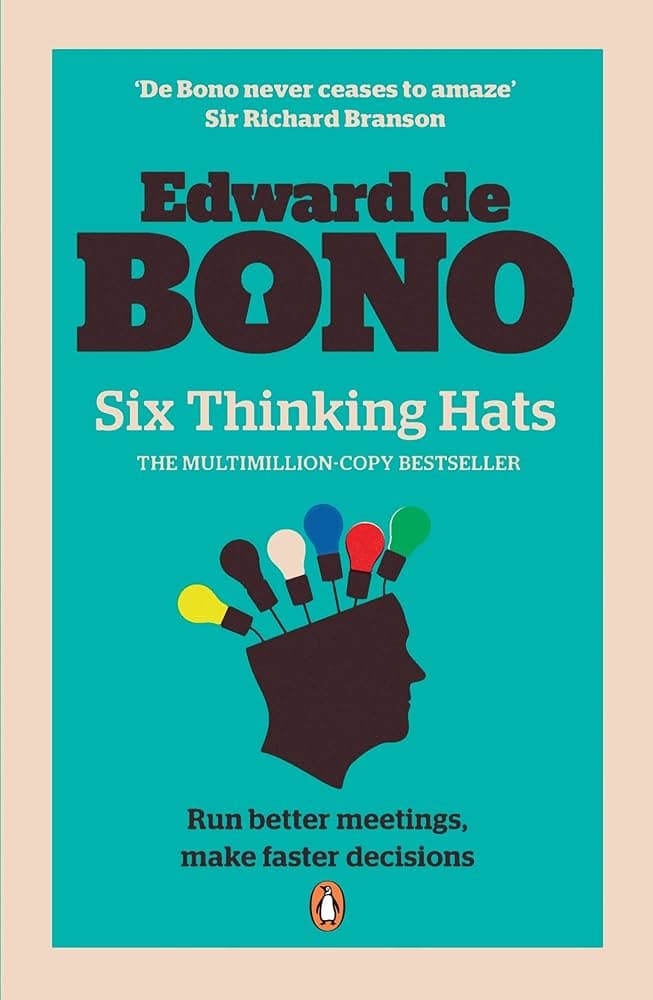
The 6 Thinking Hats
Edward De Bono
Free download · 500+ book summaries
What is The 6 Thinking Hats about?
Instead of the widely accepted Western-style thinking—originating from Greek civilization and based on arguments and judgment—de Bono introduced so-called "lateral thinking," an approach to problem-solving that utilizes creativity and non-obvious reasoning.
Key ideas of The 6 Thinking Hats
Parallel Thinking Over Argument
When a group focuses in one direction at the same time, disagreement collapses and the best ideas in the room can finally surface.
Six Modes, One at a Time
Each hat assigns a single thinking role, so the mind handles emotion, facts, optimism, caution, creativity, and process without mixing them up.
Creativity as a Learnable Skill
The green hat treats creative thinking as a trained capacity anyone can develop, not a personality trait reserved for certain people.
Read an excerpt from the summary
How Your Mind Got Tangled
Picture the last meeting where a real decision had to be made. Someone laid out a proposal. Within thirty seconds, three things happened at once. One person defended the idea on logical grounds. Another felt a flicker of irritation and started searching for a reason it would fail. A third was already imagining how the budget might stretch. Nobody admitted to the emotion driving them. Everybody believed they were being rational. An hour later, the group had circled the same point four times, two careers were quietly bruised, and the loudest voice had won.
Edward De Bono spent his life studying that scene. His diagnosis was simple. The main difficulty of thinking, he wrote, is confusion. We try to feel, judge, gather facts, predict consequences, and dream up alternatives all in the same breath. The mind, asked to do five jobs at once, does none of them well. We mistake the resulting tangle for serious deliberation.
The 6 Thinking Hats, first published in 1985, is De Bono's answer. The idea sounds almost embarrassingly simple. There are six distinct modes the mind can work in. Wear one at a time. Switch deliberately. Get the whole group to wear the same one at the same moment. De Bono claimed this small change in habit might be the most important shift in human thinking in twenty-three centuries.
That sentence makes most people smirk. The smirk usually fades when they see the numbers. A multinational called ABB went from thirty-day project debates to two-day debates. An IBM laboratory cut meeting time to a quarter. A trainer named Jens Arup walked onto a Norwegian Statoil oil rig, where downtime was costing roughly a hundred thousand dollars a day, and solved the problem in twelve minutes. A study of three hundred senior British civil servants reported a 493 percent jump in thinking productivity. Siemens trained nearly four hundred internal facilitators. NASA, IBM, DuPont, NTT, Shell, BP, and Federal Express all adopted the method.
Like it?
Continue in the appWho is it for?
- Anyone who spends hours in meetings where the loudest voice tends to win.
- Anyone who wants a practical method for separating facts, feelings, and judgment in group decisions.
- Anyone who leads teams and needs a shared language for structured, productive discussion.
- Anyone who struggles to generate new ideas or break out of habitual critical thinking.
About the author: Edward De Bono
Edward De Bono was a Maltese physician, psychologist, and author who spent his career developing practical frameworks for thinking. He coined the term lateral thinking in 1967, a coinage the Oxford English Dictionary credits to him, and went on to write dozens of books on creativity, problem-solving, and decision-making.
His methods were adopted by corporations including IBM, NASA, Boeing, and Siemens, and by schools and government bodies around the world. De Bono argued that thinking is a skill that can be taught and improved, and he built an international consulting and training practice around that conviction.
Read it in 46 minutes
The summary of The 6 Thinking Hats and 500+ more books await in the BookBase app.