 English
 Magyar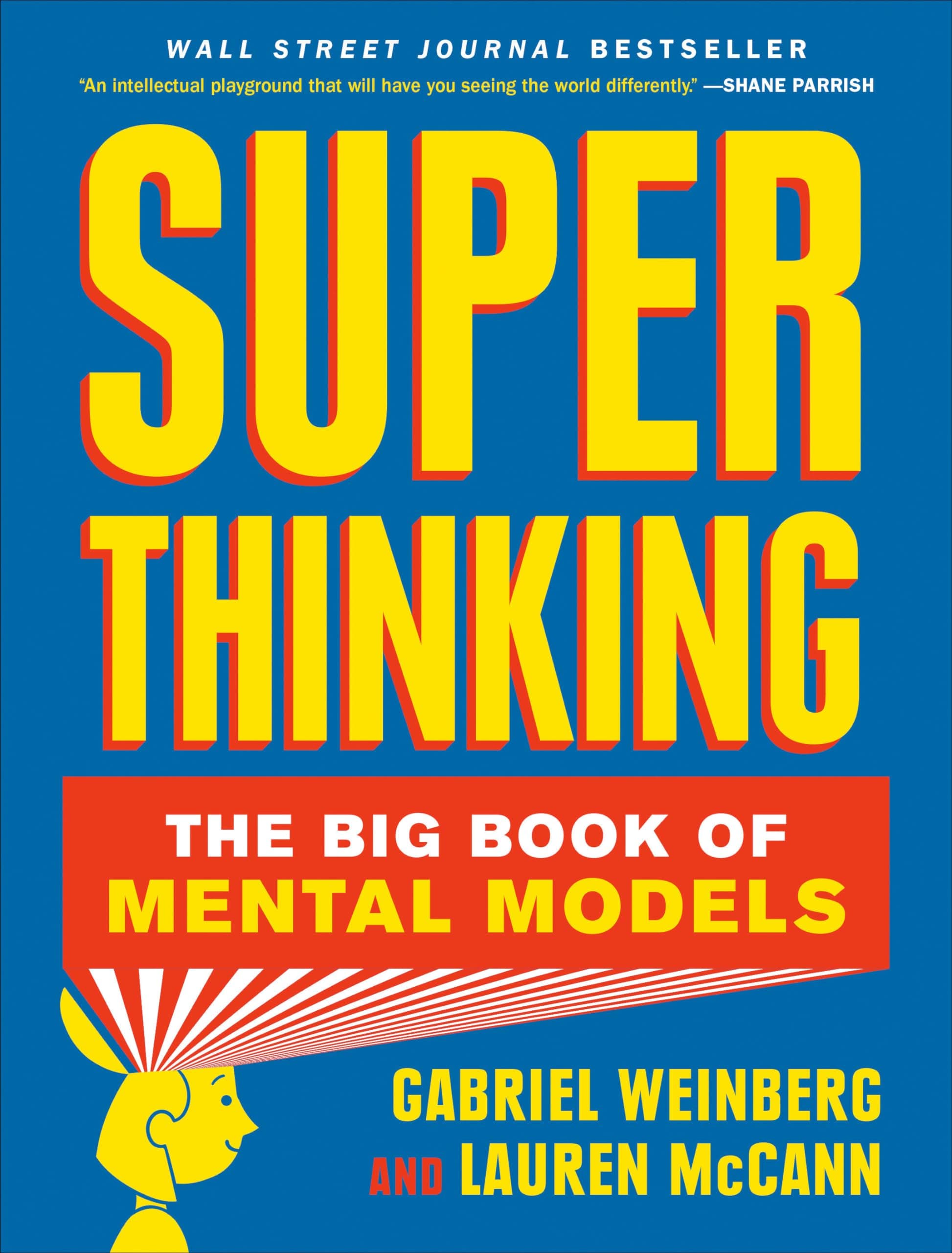
Super Thinking
Gabriel Weinberg
Free download · 500+ book summaries
What is Super Thinking about?
Super Thinking teaches you how to make the most of the world's wisdom. Instead of relying solely on facts, it shows you how to apply mental models in everyday life and highlights the benefits of doing so.
Key ideas of Super Thinking
Mental Models as Reusable Tools
Learning a single mental model gives you a pattern you can apply across fields, from business to science to everyday decisions.
Being Wrong Less Often
The goal is not to be right more often but to systematically reduce errors through inversion, first-principles thinking, and honest feedback.
Bias and Decision-Making Traps
Cognitive biases like availability bias, the sunk-cost fallacy, and groupthink distort choices, and recognizing them is the first step to countering them.
Read an excerpt from the summary
Introduction: The Latticework of Mental Models
In 1994, the investor Charlie Munger stood in front of a business-school audience at the University of Southern California and offered a piece of advice that sounds almost too plain to be useful. "You can't really know anything," he said, "if you just remember isolated facts and try and bang 'em back. If the facts don't hang together on a latticework of theory, you don't have them in a usable form." His fix was to build that latticework out of mental models, and to steal them from every field you can reach. "When I urge a multidisciplinary approach," he later told a Stanford audience, "I'm really asking you to ignore jurisdictional boundaries."
That instruction is the seed of *Super Thinking*. Gabriel Weinberg, the founder of the search engine DuckDuckGo, and Lauren McCann, a research statistician, define a mental model as a recurring concept that helps you explain, predict, or approach a situation. Once you have truly absorbed one, it hands you a reusable picture you can apply the next time something similar shows up. Munger guessed that "80 or 90 important models will carry about 90 percent of the freight" in making you a wise person, and the book sets out to assemble that toolkit, drawing on physics, biology, economics, statistics, and psychology.
A few models are so broadly useful that they slip free of the field that produced them. The authors call these "super models." Consider critical mass, a term from physics for the threshold amount of material needed to sustain a nuclear chain reaction. The same idea explains why a quiet party suddenly comes alive, why a product tips into popularity, and why a ride-hailing service stalls in a new city until it finally has enough drivers to be reliable. Learn the model once, and you can use it almost anywhere. That habit of borrowing across borders is what the authors mean by "super thinking."
Like it?
Continue in the appWho is it for?
- Anyone who wants a structured way to make better decisions at work and in life.
- Anyone who feels overwhelmed by complexity and wants a toolkit of proven thinking frameworks.
- Anyone who leads teams and needs to spot unintended consequences and conflict patterns early.
- Anyone who is curious about how ideas from physics, economics, and statistics apply to everyday problems.
About the author: Gabriel Weinberg
Gabriel Weinberg is the founder and CEO of DuckDuckGo, the privacy-focused search engine. He built DuckDuckGo on the principle that people should not be tracked while searching the web, and scaled it into one of the most widely used alternative search engines.
Lauren McCann, his co-author, is a research statistician with experience in clinical research. Together they draw on Weinberg's background as an entrepreneur and McCann's quantitative training to make the mental models practical and grounded in real examples.
Read it in 46 minutes
The summary of Super Thinking and 500+ more books await in the BookBase app.