 English
 Magyar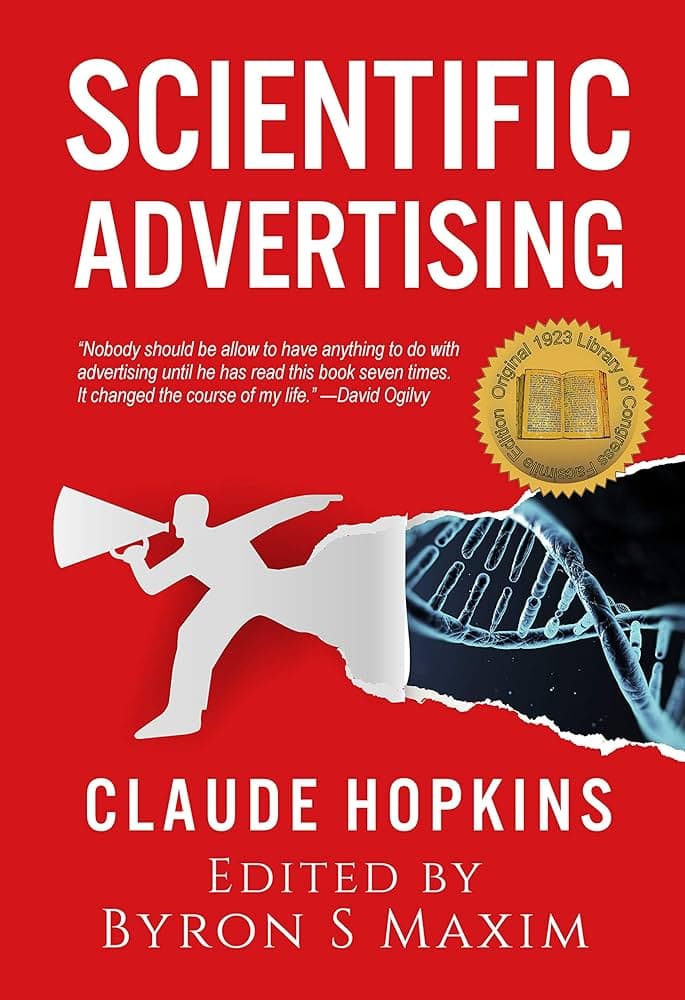
Scientific Advertising
Claude C. Hopkins
Free download · 500+ book summaries
What is Scientific Advertising about?
This pioneering book remains an essential read for anyone who envisions their future in copywriting and advertising, reminding them that the goal of advertising is solely to sell. Claude Hopkins articulates powerful, tested truths about "printed salesmanship" that have remained relevant over decades and across all media, including today's internet marketing.
Key ideas of Scientific Advertising
Advertising as Salesmanship
Every ad is a printed salesman, and its only valid measure is whether it closes a sale for a real buyer.
Specifics Beat Generalities
Vague claims like "best in the world" get ignored, while precise facts and numbers build trust and drive conversions.
Test Before You Scale
Any advertising question can be answered cheaply and quickly by a small test campaign run before a national rollout.
Read an excerpt from the summary
Why a 1923 Book Still Owns the Internet
There is a book from 1923 sitting on the desks of more growth marketers than any single growth book published in the last decade. It is eighty-something pages long. It was written by a Scotch-American copywriter who quit the ministry to advertise cough syrup, who taught himself by handing out pamphlets at age nine, and who once made the equivalent of millions of dollars writing ads in a cabin in the Michigan woods. The book is called Scientific Advertising. Its author, Claude C. Hopkins, never lived to see a banner ad, a Google search, or a Facebook split-test, and yet every Facebook split-test in the world is essentially a Hopkins experiment with a faster feedback loop.
That is the strange thing about this book. It reads like an artifact and works like a manual. Hopkins is talking about pork and beans, carpet sweepers, cigars sent through the mail, and tooth paste sold on coupons clipped from the Ladies' Home Journal. The tactics belong to a museum. The principles are doing your job for you right now whether you know it or not. The entire discipline of performance marketing, the entire vocabulary of A/B testing, attribution, conversion optimization, headline testing, offer reversal, and customer acquisition cost has its DNA in this single small book.
Hopkins is direct, slightly contemptuous of bad work, allergic to fluff, and willing to tell you in the first chapter that ninety-five percent of his customers are common people because he does not know how the rich think. He earned a hundred thousand dollars a year writing copy in the 1910s, and he did it by being right about what worked and ruthless about discarding what did not. This is the summary of what he figured out.
Like it?
Continue in the appWho is it for?
- Anyone who writes marketing copy and wants a grounded, principle-based framework for what actually works.
- Anyone who runs paid ads and needs to understand why testing and measurement matter more than creative instinct.
- Anyone launching a product who wants to know how sampling, risk reversal, and offer design drive customer acquisition.
- Anyone curious about why modern digital marketing looks the way it does and where its core ideas came from.
About the author: Claude C. Hopkins
Claude C. Hopkins was one of the most influential advertising copywriters in American history. He worked at Lord and Thomas, one of the leading agencies of the early twentieth century, and earned a hundred thousand dollars a year writing copy at a time when that sum was extraordinary. His campaigns for brands including Schlitz, Pepsodent, Palmolive, and Puffed Wheat shaped entire product categories.
Hopkins built his method entirely from direct experience, starting as a boy who distributed handbills and tracked his own results. He was one of the first practitioners to insist on keyed returns, coupon tracking, and small-market testing before national rollout. Scientific Advertising, published in 1923, distilled forty years of that work into a single short book that David Ogilvy later called the most important book ever written about advertising.
Read it in 45 minutes
The summary of Scientific Advertising and 500+ more books await in the BookBase app.