 English
 Magyar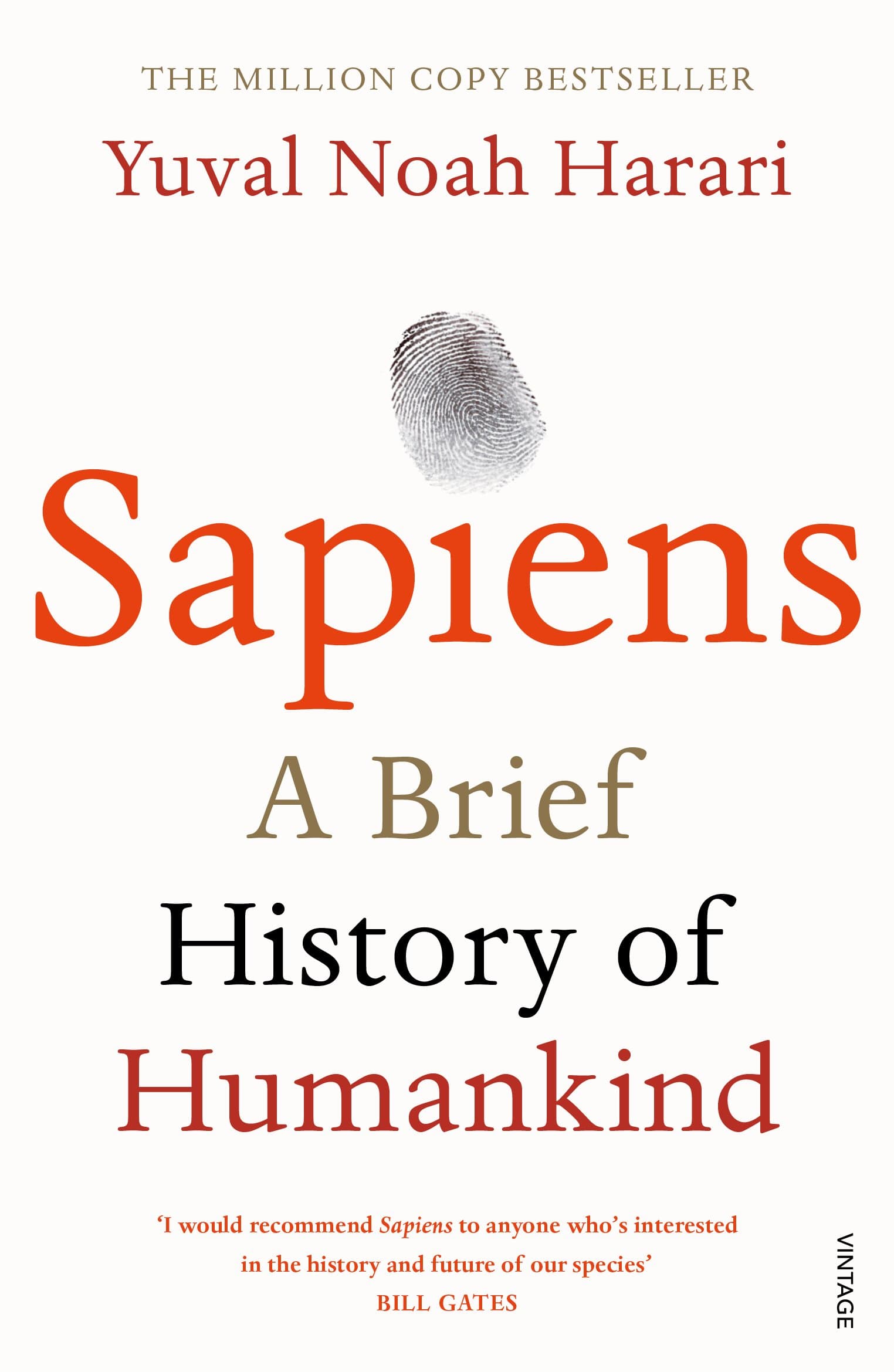
Sapiens
Yuval Noah Harari
Free download · 500+ book summaries
What is Sapiens about?
Sapiens is a scientific look at the history of humanity through three revolutions. Yuval Noah Harari begins the book with our cognitive revolution 70 000 years ago. He then describes our agricultural revolution 12 000 years ago. Finally, he outlines the scientific revolution of 500 years ago. These three revolutions shaped the people we are today and the planet we live on.
Key ideas of Sapiens
Shared Fiction Drives Civilization
Homo sapiens outpaced all other species by cooperating in large groups through belief in things that have no physical reality, such as nations, money, and laws.
Agriculture as a Human Trap
The shift to farming produced denser populations but measurably worse health, longer working hours, and a social hierarchy that individual farmers could not escape.
Progress Without Guaranteed Happiness
Centuries of scientific and economic growth have not proven to produce more contentment, leaving the central question of whether modernity was worth it genuinely open.
Read an excerpt from the summary
Sapiens: A Brief History of Humankind
In the winter of 1928, a French archaeologist named Henri de Lumley was examining bones at a site in southern France when he found something that did not fit the timeline he had been taught. He found cut marks on the bones of a Neanderthal, made with stone tools. The pattern was consistent with defleshing -- the deliberate removal of flesh from a corpse. Whether it indicated cannibalism, ritual burial, or something else entirely, no one could say. But it confirmed that the creatures who left those bones were not simple animals following instinct. They were doing something deliberate and strange, something that involved treating a dead body as meaningful.
Decades later, Yuval Noah Harari would cite precisely this kind of evidence in a book that would sell 25 million copies globally: Homo sapiens was not the only creature on earth who behaved in ways that implied something beyond immediate survival. But we were the creature who took that tendency to a scale and complexity that no other species ever reached. Harari's argument -- the central thesis of *Sapiens: A Brief History of Humankind* -- is that the gap between us and every other animal, including our close relatives the Neanderthals, was not a gap of anatomy or brain size. It was a gap of fiction. We could tell stories about things that did not exist. They, apparently, could not. And that gap was enough to produce everything: agriculture, empire, religion, money, science, and the prospect of our own self-engineered replacement.
*Sapiens* was published in Hebrew in 2011 and in English in 2014 by Harper. Harari is an Israeli historian at Hebrew University Jerusalem, where he teaches today. His PhD from Oxford was in medieval military history -- a detail worth noting, because the book ranges from 300,000 years ago to speculations about 2200, and the quality of his analysis varies significantly depending on how far he is from his actual expertise. Bill Gates recommended the book. Barack Obama called it thought-provoking. Mark Zuckerberg made it a club pick. It was translated into over 65 languages. It became the kind of book that people display prominently and reference in conversations about anything.
Like it?
Continue in the appWho is it for?
- Anyone who wants a single-volume account of how humans went from one of many ape species to rulers of the planet.
- Anyone who questions whether modern life is actually an improvement over how people lived thousands of years ago.
- Anyone who wants to understand why institutions like money, corporations, and nations hold so much power over human behavior.
- Anyone who is curious about where the human species might be heading as biology and technology converge.
About the author: Yuval Noah Harari
Yuval Noah Harari is an Israeli historian and professor at the Hebrew University of Jerusalem. He completed his PhD at Oxford in medieval military history and went on to write works that address the full sweep of human history and the future of the species.
Sapiens, first published in Hebrew in 2011 and in English in 2014, became one of the best-selling nonfiction books of the century, translated into more than 65 languages. Harari is also the author of Homo Deus and 21 Lessons for the 21st Century.
Read it in 47 minutes
The summary of Sapiens and 500+ more books await in the BookBase app.