 English
 Magyar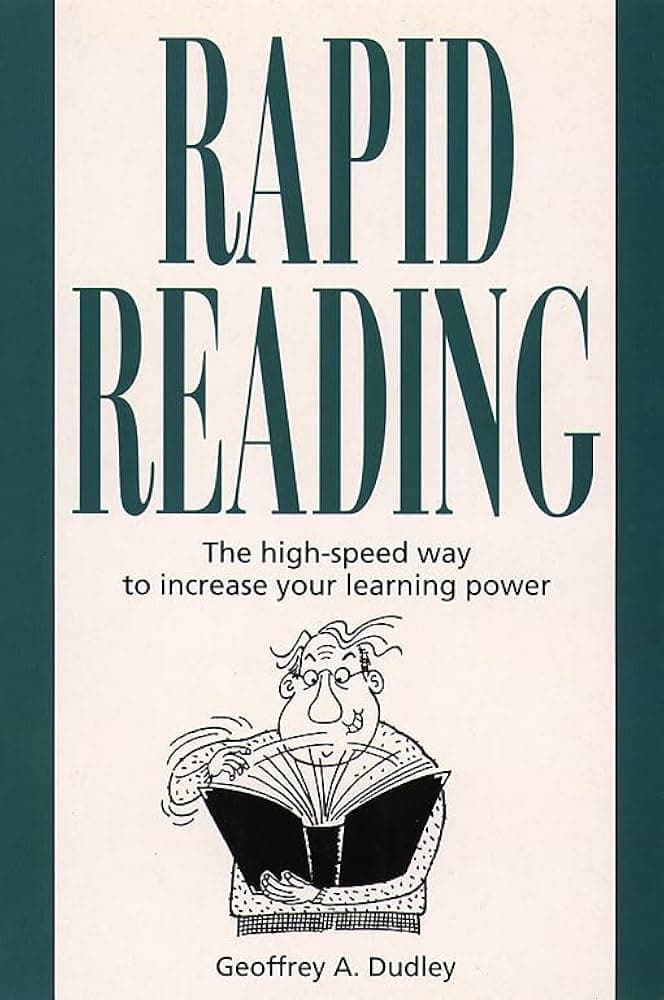
Rapid Reading
Geoffrey A. Dudley
Free download · 500+ book summaries
What is Rapid Reading about?
Imagine how much time you would save if you could finish the same text in a third or even a fifth of the time it used to take you! Speed reading is simply the practice of how to control fine motor movements.
Key ideas of Rapid Reading
Reading Speed Is a Habit
Dudley argues that slow reading is not a fixed trait but a learned habit, and habits can be changed through deliberate practice.
Eye Movement and Regression Control
Most adults read one word at a time and frequently backtrack, and eliminating these two patterns is the fastest route to doubling your reading speed.
Speed and Comprehension Together
Slow reading creates more distraction and wandering attention, so increasing pace and improving retention are complementary goals, not competing ones.
Read an excerpt from the summary
Rapid Reading by Geoffrey A. Dudley
Most adults read at roughly 200 words per minute. That is barely faster than someone talking to you at a leisurely dinner, and it is the reason your stack of unread books keeps growing, the reason your inbox feels heavier on Friday than it did on Monday, and the reason you finish a chapter and wonder what exactly you just read. Geoffrey A. Dudley, writing in the 1970s for the British self-instruction reader, makes one bold claim and then spends ten chapters proving it. Reading speed, he says, is not set by nature. It is set by habit. And habits can be changed.
What follows is a tour through Dudley's book, *Rapid Reading*, published by Thorsons. It is a practical manual rather than a theoretical treatise. He asks you to do exercises. He asks you to time yourself. He asks you to put a pencil between your teeth and feel ridiculous. The promise is modest by speed-reading standards. He does not promise to quadruple your speed. He promises to double it, and to lift your comprehension at the same time, because the two are not enemies. Slow reading does not mean careful reading. Often it means distracted reading. Dudley's whole project rests on that insight.
Why Read Faster?
Dudley opens by asking a fair question. Why bother? His answer is a list of ten benefits, and they hold up well even read decades later. Faster reading saves time, so the papers, the magazines, and the library books actually get finished. It makes you more efficient at work, which makes you more valuable. It frees executives from the paper backlog so they can think about policy rather than process. It lets you enjoy foreign film subtitles, novels, and the small pleasures of leisure reading. It widens your mental horizon. It helps you gather material for a talk or a conversation. It helps you pass exams. It improves understanding. It keeps you up to date with news and your field. And finally, it functions as a mental tonic. Reading more, more easily, keeps your mind exercised.
Like it?
Continue in the appWho is it for?
- Anyone who has a growing pile of unread books and wants to actually get through them.
- Anyone who spends a significant part of their workday reading reports, emails, or documents.
- Anyone who struggles to stay focused while reading and wants practical, exercise-based techniques.
- Anyone who wants to improve both their reading speed and their ability to remember what they read.
About the author: Geoffrey A. Dudley
Geoffrey A. Dudley was a British author who wrote practical self-instruction books for a general adult readership, primarily in the 1970s. His work focused on applied psychology and personal development skills such as memory, concentration, and reading.
Rapid Reading was published by Thorsons, a UK publisher known for self-improvement titles of that era. Dudley draws on the educational and psychological research of his time, citing researchers from American reading institutes and British universities to ground his techniques in observable evidence.
Read it in 52 minutes
The summary of Rapid Reading and 500+ more books await in the BookBase app.