 English
 Magyar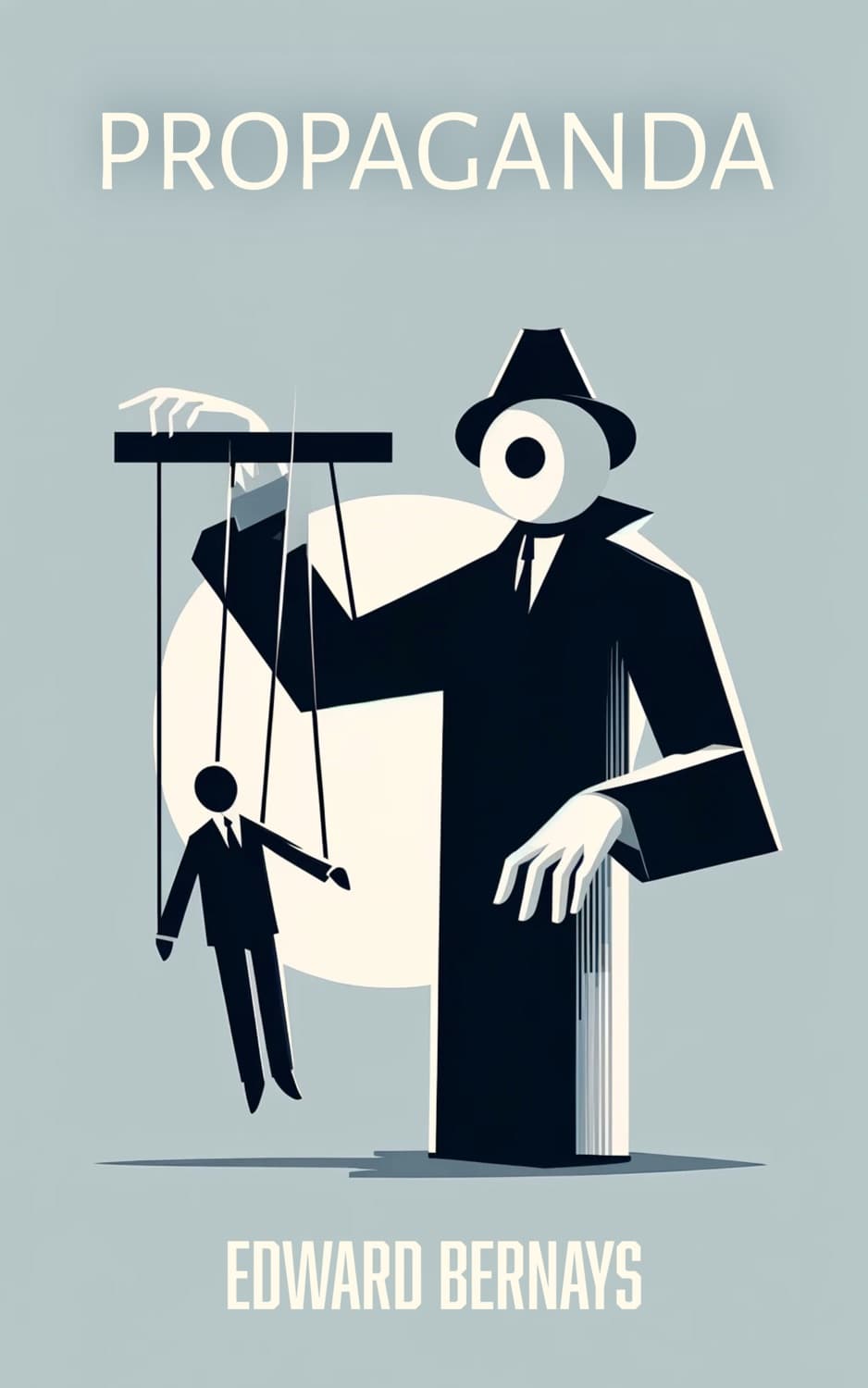
Propaganda
Edward Bernays
Free download · 500+ book summaries
What is Propaganda about?
Freud's nephew explains how to engineer public opinion. Edward Bernays' shockingly candid 1928 essay on shaping mass behavior through media, symbolism, and group psychology. Required reading for anyone who wants to see how modern marketing, PR, and political messaging actually work, and where the line between persuasion and manipulation begins.
Key ideas of Propaganda
The Invisible Government of Opinion
Bernays argues that modern democracies are quietly steered by specialists who manufacture public consent through media, symbols, and group psychology rather than open debate.
Identity Sells, Arguments Do Not
Effective persuasion attaches a product or idea to a desire people already hold, bypassing rational evaluation entirely by linking it to who someone wants to be.
Borrowed Credibility as the Core Tool
The most potent campaigns work by routing a commercial message through trusted third parties such as doctors or journalists, so the sponsor stays invisible and the credibility feels independent.
Read an excerpt from the summary
Propaganda
On Easter Sunday, 1929, a group of young debutantes gathered on Fifth Avenue in New York City just as Sunday services let out. They were well-dressed, poised, and visibly part of the city's social elite. At a prearranged signal, they reached into their handbags, pulled out Lucky Strike cigarettes, and lit them publicly on the street -- a gesture that, for women in 1929, was roughly as shocking as undressing in the square.
Newspapers across the country ran the story. The Associated Press wire sent it everywhere. "Group of Girls Puff at Cigarettes as a Gesture of Freedom" ran one headline. The coverage framed the act not as a tobacco stunt but as a protest. The women were marching for emancipation. Their cigarettes were, as one report called them, "torches of freedom."
None of the reporting mentioned Edward L. Bernays. None of it mentioned the American Tobacco Company, or its president George Washington Hill, who had hired Bernays specifically because he wanted to open the female market and called the opportunity "like finding a gold mine in our front yard." The entire operation had been arranged behind the scenes: Bernays had contacted a friend at Vogue, asked her to recruit women willing to join a demonstration for "women's equality," timed the action for maximum press attendance, and even consulted a psychoanalyst named A. A. Brill -- a student of Sigmund Freud -- who told him that cigarettes represented phallic power for men and that women, if framed correctly, could see smoking as a claim on that same power.
The campaign worked. It is still taught in business schools and communications programs nearly a century later. What makes it worth studying is not the scale of the deception. It is the precision of the architecture. Bernays did not run an advertisement. He did not make a sales pitch. He manufactured a news event that caused journalists to deliver the message on his behalf, wrapped in the credibility of independent reporting. He sold an identity -- the liberated woman -- and attached a cigarette to it as the price of admission.
Like it?
Continue in the appWho is it for?
- Anyone who wants to understand how modern advertising, PR, and political messaging actually shape public opinion.
- Anyone who is curious about why rational arguments so rarely change minds at scale.
- Anyone who works in marketing, communications, or politics and wants to understand the intellectual roots of their craft.
- Anyone who suspects they are being influenced but wants clearer language for describing how it works.
About the author: Edward Bernays
Edward Bernays (1891-1995) is widely regarded as the founder of modern public relations. Born in Vienna and raised in New York, he was doubly connected to Sigmund Freud by family ties, and drew heavily on Freudian ideas about unconscious motivation and crowd psychology when developing his theory of public persuasion.
Bernays applied his methods for clients ranging from the American Tobacco Company to the United Fruit Company, and his campaigns, including the notorious Torches of Freedom cigarette stunt of 1929, are still studied in business and communications programs. He published several books, including Crystallizing Public Opinion (1923) and his 1965 autobiography Biography of an Idea.
Read it in 45 minutes
The summary of Propaganda and 500+ more books await in the BookBase app.