 English
 Magyar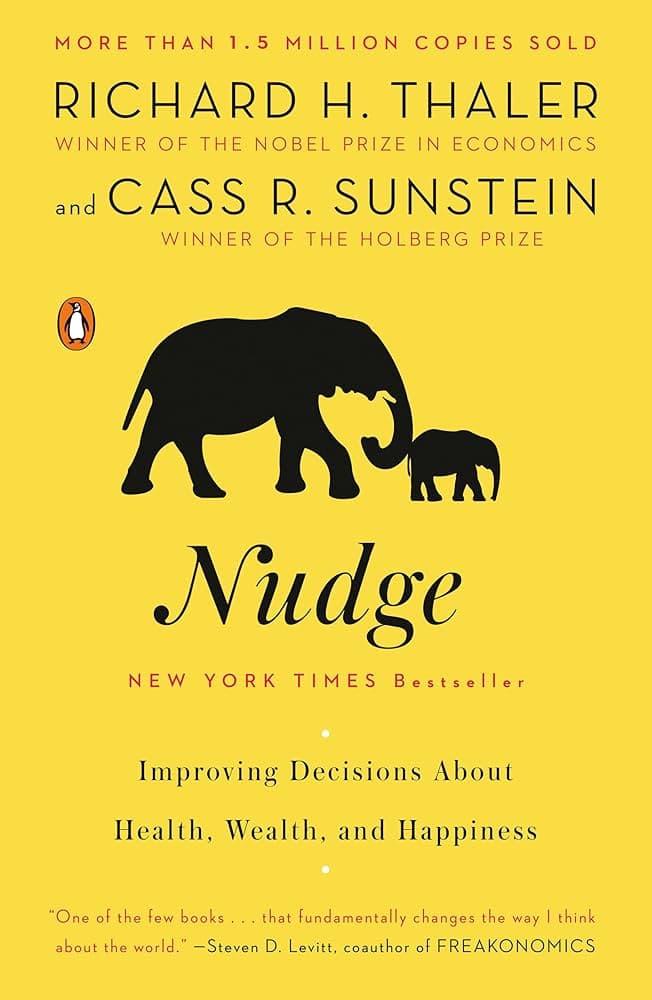
Nudge
Richard H. Thaler, Cass R. Sunstein
Free download · 500+ book summaries
What is Nudge about?
The Nudge shows how to make better decisions and how to become happier, healthier, and freer as a result.
Key ideas of Nudge
Choice Architecture Is Unavoidable
Someone always decides how options are presented, so the only real question is whether that design is intentional or left to accident.
Defaults Drive Behavior at Scale
Automatic enrollment in retirement plans raised participation from 65 to 90 percent almost immediately, proving that inertia can be redirected rather than fought.
Social Norms Nudge Better Than Warnings
Telling people that most of their peers pay taxes or drink moderately changed behavior more reliably than threats, lectures, or appeals to civic duty.
Read an excerpt from the summary
The Fly in the Urinal
At Amsterdam's Schiphol Airport, the men's restrooms hold a small secret. Etched into each urinal is the image of a single black housefly, positioned just off-center. There is no sign, no instruction, no plea to aim carefully. Yet men who spot the fly do what men have always done when given a target: they aim. The result, measured by the airport, was an eighty percent drop in spillage and a much cleaner floor.
The fly was the idea of an economist named Aad Kieboom, and it captures the entire argument of this book in a single image. Nobody was forced to do anything. Nobody lost a choice. A tiny change in the environment produced a large change in behavior, simply by working with the grain of how people actually act rather than against it.
Richard Thaler and Cass Sunstein call this a nudge. Their definition is precise: a nudge is any aspect of the way choices are presented that alters people's behavior in a predictable way, without forbidding any options or meaningfully changing their economic incentives. Putting fruit at eye level counts as a nudge. Banning junk food does not. The test is whether the intervention is cheap and easy to avoid. A fly you can ignore is a nudge. A locked door is not.
The person who decides where the fly goes, where the fruit sits, or which form arrives in the mail is what the authors call a choice architect. And here is the uncomfortable truth at the heart of the book: there is no such thing as neutral design. Someone always decides what the menu looks like, what happens if you do nothing, what comes first and what comes last. Once you accept that the architecture is unavoidable, the only real question is whether it's built thoughtfully or left to accident.
Like it?
Continue in the appWho is it for?
- Anyone who wants to understand why people consistently make poor decisions in areas that matter most to their lives.
- Anyone who designs products, policies, or benefits packages and wants those systems to work better for the people using them.
- Anyone who is trying to save more money, eat better, or follow through on long-term goals and keeps falling short.
- Anyone who wants a grounded, evidence-based alternative to both heavy-handed regulation and the assumption that markets always get it right.
About the author: Richard H. Thaler, Cass R. Sunstein
Richard H. Thaler is an economist at the University of Chicago Booth School of Business and a pioneer of behavioral economics. He was awarded the Nobel Prize in Economic Sciences in 2017 for his contributions to understanding how psychological and social factors shape economic decisions.
Cass R. Sunstein is a legal scholar who has taught at the University of Chicago Law School and Harvard Law School. He served as administrator of the White House Office of Information and Regulatory Affairs from 2009 to 2012 and has written extensively on law, behavior, and public policy.
Read it in 44 minutes
The summary of Nudge and 500+ more books await in the BookBase app.