 English
 Magyar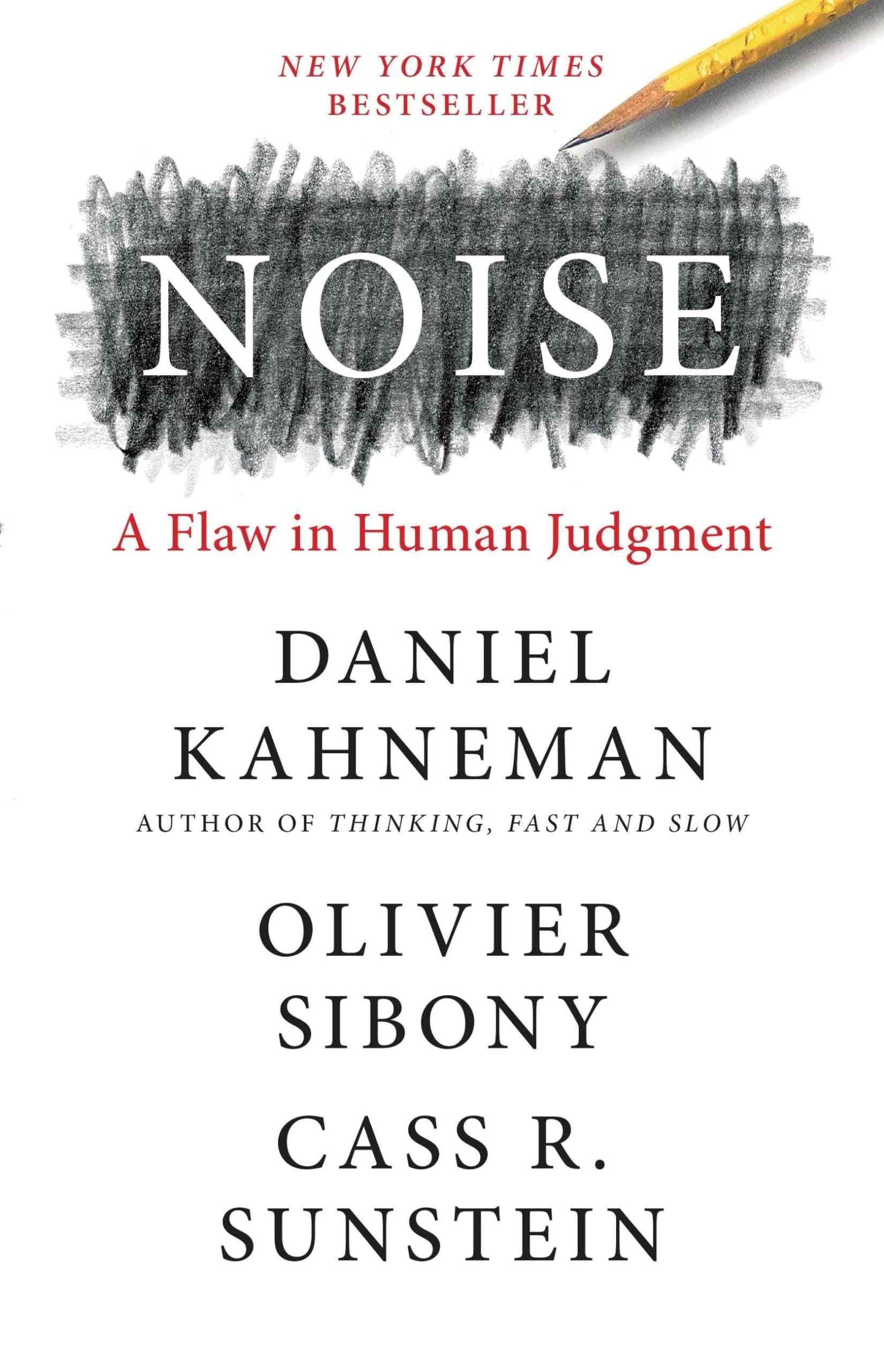
Noise
Daniel Kahneman
Free download · 500+ book summaries
What is Noise about?
Daniel Kahneman's Noise delves into a critical yet often overlooked problem in decision-making: the variability in human judgment that leads to inconsistencies, even when individuals are faced with similar information. This noise, according to Kahneman and his co-authors, can have serious consequences in areas like law, medicine, and business. The book provides a detailed exploration of the nature of noise, how it differs from bias, and how we can reduce it to make better, more consistent decisions.
Key ideas of Noise
Noise vs. Bias
Noise is unwanted variability in judgments that should be identical, a problem as costly as systematic bias but almost universally ignored.
Hidden Scale of Disagreement
Professionals in the same firm judging the same case diverge far more than their managers expect, by fifty-five percent in insurance underwriting in one audit.
Decision Hygiene Reduces Noise
Simple practices like sequencing information, collecting independent judgments, and delaying intuition can cut noise without requiring perfect human judgment.
Read an excerpt from the summary
The Hidden Twin of Bias
There is a shooting range in your head. Every judgment you make is a shot at a target, and every shot you fire lands somewhere. Sometimes you hit dead center. More often you miss, and the question that should haunt you, but rarely does, is how exactly you missed.
Picture four teams of marksmen, each firing five shots at the same target. Team A puts every shot near the bull's-eye. Team B clusters tightly, but well off to one side, hitting almost the same wrong spot five times in a row. Team C sprays its shots all over the target, the center of the spread close to the bull's-eye but no individual shot anywhere near it. Team D is the worst of both worlds: a wide scatter, far from the center.
Team B is biased. Something predictable is pulling its shots in one direction, perhaps a misaligned sight, perhaps an instructor who taught everyone the same wrong stance. Team C has a different problem entirely. Each shooter aims at the right place, but their hands shake, their eyes flicker, the wind moves and they don't compensate for it the same way twice. Team C is noisy.
This little metaphor opens "Noise," the book Daniel Kahneman, Olivier Sibony, and Cass Sunstein published in 2021, and it carries the whole argument. Bias is a systematic error: you can name it, point at it, and at least imagine fixing it. Noise is something stranger. Noise is unwanted variability in judgments that should have been the same. Two judges, same case, very different sentences. Two doctors, same patient, very different diagnoses. Same forecaster, same question on two different mornings, very different answers. Noise.
Like it?
Continue in the appWho is it for?
- Anyone who makes repeated high-stakes judgments at work, such as hiring, lending, or sentencing.
- Anyone who wants to understand why two equally qualified professionals so often reach opposite conclusions.
- Anyone who manages a team or organization and assumes their people agree more than they actually do.
- Anyone who has read Thinking, Fast and Slow and wants to go deeper into the mechanics of human error.
About the author: Daniel Kahneman
Daniel Kahneman is a psychologist and Nobel laureate in Economic Sciences, best known for his decades of research on cognitive biases and decision-making. His earlier book Thinking, Fast and Slow introduced the System 1 and System 2 framework to a wide audience.
Noise was co-written with legal scholar Cass Sunstein and business strategist Olivier Sibony. The three authors bring together perspectives from psychology, law, and management consulting to make the case that variability in human judgment is a neglected and costly problem.
Read it in 48 minutes
The summary of Noise and 500+ more books await in the BookBase app.