 English
 Magyar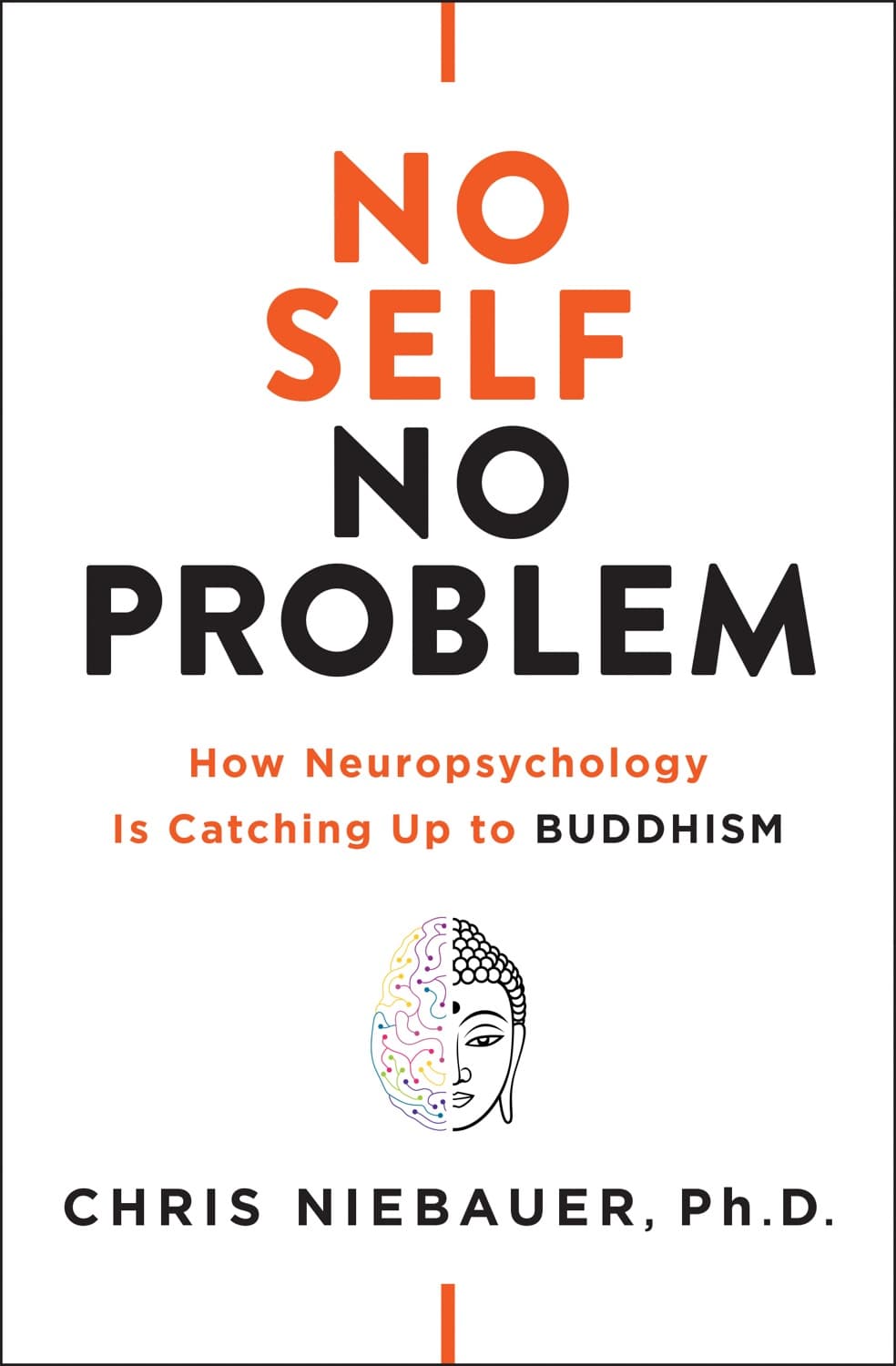
No Self, No Problem
Chris Niebauer
Free download · 500+ book summaries
What is No Self, No Problem about?
Neuropsychologist Chris Niebauer connects modern brain science to Buddhist insight, arguing that the self that worries, judges, and ruminates is a story spun by the left hemisphere rather than a real entity. Once you see the trick, anxiety, comparison, and self-criticism lose their grip. Crisp prose and disarming experiments make a 2,500-year-old claim feel newly accessible.
Key ideas of No Self, No Problem
The Interpreter Makes Things Up
The left brain continuously invents confident explanations for behavior and feelings, acting as a press secretary rather than a reliable witness to reality.
The Self Is a Constructed Pattern
What you call "I" is a pattern the brain assembles from memories and habits, disappearing between thoughts much like an optical illusion needs its surrounding cues.
Right-Brain Awareness as an Alternative
The right hemisphere offers a non-verbal, quieter mode of consciousness that Buddhist and contemplative traditions have pointed toward for thousands of years.
Read an excerpt from the summary
No Self No Problem — summary
A chicken foot, a snow shovel, and the first crack in your story about yourself
Imagine you are sitting in a small lab in California in the early 1970s. A neuroscientist named Michael Gazzaniga shows your right eye a picture of a chicken foot and your left eye a picture of a snow scene. There is nothing strange about this until you remember one important detail: your corpus callosum, the thick cable of fibers that lets your two hemispheres talk to each other, has been cut. Surgeons did this to stop your epileptic seizures, and it worked beautifully. But it left your brain split in half, with each side now operating like a separate person who cannot reach the other.
Gazzaniga asks you to point with each hand to a card that matches what you saw. Your left hand, controlled by the right brain that saw the snow, points to a snow shovel. Your right hand, controlled by the left brain that saw the chicken foot, points to a chicken. Perfect. Then he asks the question that will quietly redraw the map of human psychology for the next half century. "Why is your left hand pointing at the shovel?" Your left brain has no idea. It never saw the snow. But instead of admitting this, it does something astonishing. It invents an answer on the spot, with full confidence. "Oh, that's simple. The chicken foot goes with the chicken, and you need a shovel to clean out the chicken coop."
That story did not happen. The shovel had nothing to do with the chicken. But your left brain, faced with a gap in its information, did not pause, hesitate, or say "I don't know." It produced a tidy explanation and believed it. Chris Niebauer, a cognitive neuropsychologist who spent his career studying the two halves of the brain, opens his book *No Self No Problem* with this experiment because he thinks it is the single most important thing modern neuroscience has accidentally discovered. The little narrator in your head, the voice that explains why you do what you do and feel what you feel, is doing exactly what that split-brain patient did. It is making things up, all day, and you almost always believe it.
Like it?
Continue in the appWho is it for?
- Anyone who struggles with relentless self-criticism, rumination, or anxiety that thinking alone cannot resolve.
- Anyone who is curious about what neuroscience and Buddhist philosophy actually agree on about the nature of the self.
- Anyone who has tried meditation or mindfulness but wants a research-grounded explanation of why those practices work.
- Anyone who wants a practical, non-dogmatic way to take life seriously without being completely run by their inner narrator.
About the author: Chris Niebauer
Chris Niebauer is a cognitive neuropsychologist and professor who has spent his career studying the two hemispheres of the human brain. His academic work focuses on how the left and right brain process reality differently, and he brings that research into conversation with Eastern philosophy, particularly Zen Buddhism and Vedantic thought.
Niebauer writes for general audiences, translating laboratory findings about split-brain patients, perceptual illusions, and neurological case studies into accessible, practical insights. He is known for drawing a direct line between modern brain science and the ancient claim that a fixed, continuous self is more illusion than fact.
Read it in 46 minutes
The summary of No Self, No Problem and 500+ more books await in the BookBase app.