 English
 Magyar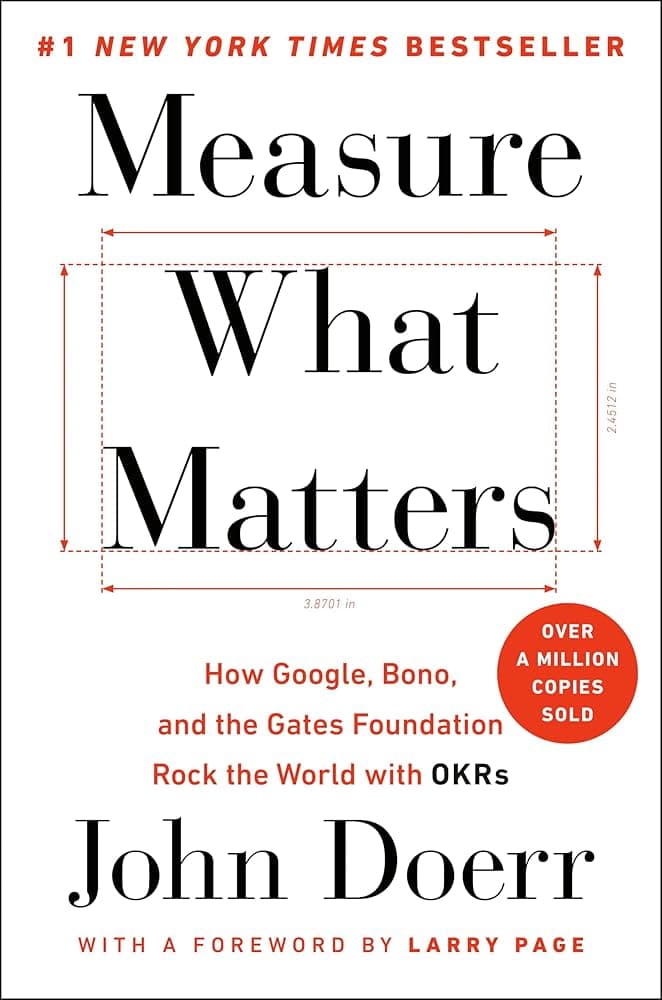
Measure what matters
John Doerr
Free download · 500+ book summaries
What is Measure what matters about?
Measure What Matters teaches you how to implement tracking systems in your company and life that help you record progress, stay accountable, and make achieving your goals almost inevitable.
Key ideas of Measure what matters
Focus Through Fewer Goals
Choosing three to five objectives per cycle forces teams to prioritize ruthlessly and avoid the costly trap of pursuing everything at once.
Transparency Drives Alignment
Making every employee's goals visible to everyone else eliminates redundant work and connects individual effort to company-wide strategy.
Stretch Goals Unlock Breakthroughs
Aspirational targets set far beyond comfort produce higher performance and, even when missed, deliver results that safe goals never could.
Read an excerpt from the summary
The Ping-Pong Table
In the fall of 1999, John Doerr walked into a two-story L-shaped building off the 101 freeway in Mountain View and tried to teach two twenty-six-year-olds how to run a company. He had just put eleven point eight million dollars into Google in exchange for twelve percent of the business — the largest check of his career — and he was, by his own admission, slightly terrified. Larry Page had told him the revenue target. Not the market cap. The revenue. Ten billion dollars. That was a number that lived in the province of Microsoft and Intel and IBM, and Page had said it the way someone else might say "we should get lunch."
There was no boardroom. The pitch happened around a ping-pong table that doubled as the conference table, with beanbag chairs scattered around it. Larry was there. Sergey was there. So were Marissa Mayer and Susan Wojcicki and Salar Kamangar and about thirty other people who would later become some of the most consequential operators in the history of technology. Doerr put a slide up on a plastic overhead projector — the kind teachers used in middle schools — and he laid out a system he had learned twenty-four years earlier as a summer intern at Intel, working for a Hungarian refugee named Andy Grove.
The system had two parts. An Objective was what you wanted to achieve. A Key Result was how you would know you had achieved it. Objectives were qualitative and inspiring. Key Results were numbers, dates, deliverables. As Marissa Mayer would put it, with the bluntness that became her signature, it was not a Key Result unless it had a number. There was no gray area. At the end of the quarter you either hit the number or you did not, and the system was designed to make that fact impossible to hide.
Like it?
Continue in the appWho is it for?
- Anyone who manages a team and wants a concrete system for turning strategy into measurable quarterly outcomes.
- Anyone who struggles to keep their organization aligned and working toward the same priorities.
- Anyone who is building a startup and needs a lightweight framework for staying focused during rapid growth.
- Anyone who wants to understand how companies like Google, YouTube, and the Gates Foundation set and achieve ambitious goals.
About the author: John Doerr
John Doerr is a venture capitalist and partner at Kleiner Perkins, one of Silicon Valley's most prominent investment firms. He learned the OKR framework as a summer intern at Intel under Andy Grove in the 1970s and has championed it ever since.
Over his career Doerr backed companies including Google, Amazon, and Intuit. He introduced OKRs to Google's founders in 1999, a system that became central to how the company operates to this day.
Read it in 49 minutes
The summary of Measure what matters and 500+ more books await in the BookBase app.