 English
 Magyar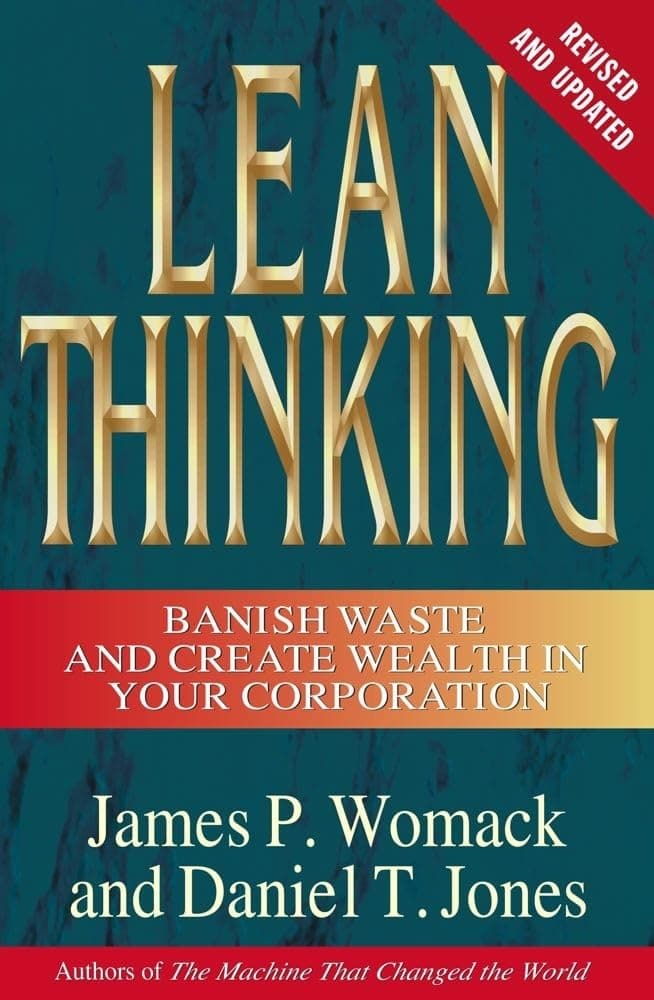
Lean Thinking
James P. Womack, Daniel T. Jones
Free download · 500+ book summaries
What is Lean Thinking about?
Lean Thinking encourages leaders to redefine their values based on customer experiences and to track the value stream from production to final sale. The result is that companies save time, energy, and money, thereby revolutionizing their organization. This book challenges the current trend in business literature that proclaims doom and then offers quick fixes. Instead, this book advocates for hope.
Key ideas of Lean Thinking
Value starts with the customer
Value is defined by what customers actually want, not by what internal teams assume or find convenient to produce.
Eliminating waste at every step
Muda, the Japanese term for waste, describes any activity consuming time, money, or energy without delivering meaningful value to the customer.
Five principles for lean transformation
Defining value, mapping value streams, creating flow, enabling customer pull, and pursuing perfection form a self-reinforcing cycle of continuous improvement.
Read an excerpt from the summary
The book in 3 sentences: Value is what the customer perceives it to be. Transparency between collaborating companies should be viewed as a rule, not a bonus. Eliminating waste of time, energy, and money within organizations is like cutting excess fat from a diet—it's important and essential for health. Favorite quotes: “Teams that engage in direct dialogue with customers always find ways to more accurately define value and often discover how to improve both the flow and pull of the product.” “How can performance be improved? Sweating it out and working longer hours is not the solution, but that’s what most will resort to until they learn how to work smarter.” “Most companies can immediately significantly increase their sales if they find a mechanism to rethink the value of their core products for their customers.”
Key points: The Tragedy of Waste First Principle: Define Value Second Principle: Discover Value Streams Third Principle: Create Flow Fourth Principle: Use Your Pull Fifth Principle: Pursue Perfection Action Plan Summary + notes: The Tragedy of Waste
A.C. Bradley, the great Shakespeare scholar, defined tragedy in a single word: waste. What emerges in *Hamlet* and *Romeo and Juliet* is simple — there was immense potential in them. We can learn a lot from Bradley's definition. First of all, he gets straight to the point — this is the first characteristic of someone who knows what they are talking about. And, of course, it provides fundamental insight into the nature of tragedy.
In Japanese, "waste" is "muda." Interestingly, muda carries a handful of business meanings. It refers to human activities that consume resources without creating meaningful value. Resources are spent on correcting mistakes that arise from large inventories. These accumulate when supply exceeds demand, waiting on unnecessary or redundant processing steps, while people wait for parts to finish their work.
Like it?
Continue in the appWho is it for?
- Anyone who leads a manufacturing, logistics, or operations team and wants to reduce costs without cutting corners.
- Anyone who feels their organization is busy but not productive and wants a structured way to cut through the inefficiency.
- Anyone who manages supplier relationships and needs a framework for building transparent, collaborative value chains.
- Anyone who has tried process improvement initiatives before and wants a proven, principle-driven approach rather than a quick fix.
About the author: James P. Womack, Daniel T. Jones
James P. Womack and Daniel T. Jones are management researchers best known for their landmark study of the global automotive industry. Their earlier book, The Machine That Changed the World, introduced the term lean production to a wide audience and remains a foundational text in operations management.
In Lean Thinking, they expanded those ideas into a practical framework that companies in any industry can apply. Both authors have spent decades working directly with organizations on lean transformation and are widely regarded as the leading voices in the field.
Read it in 14 minutes
The summary of Lean Thinking and 500+ more books await in the BookBase app.