 English
 Magyar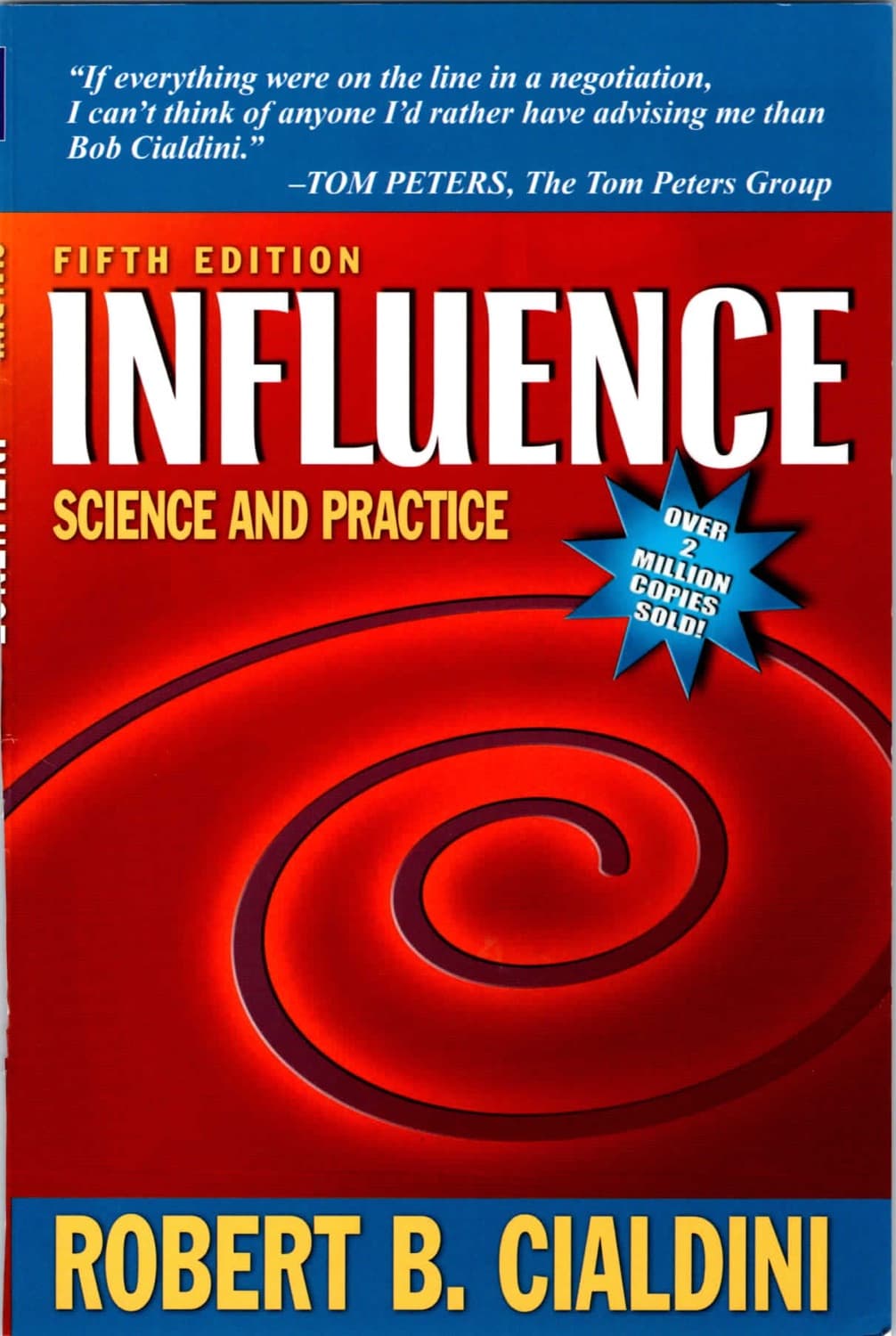
Influence
Robert B. Cialdini
Free download · 500+ book summaries
What is Influence about?
The seven principles that quietly shape every yes you give: reciprocity, commitment, social proof, authority, liking, scarcity, and unity. Robert Cialdini's classic study of human compliance, backed by decades of psychology research. Read it once and you'll spot the moves everywhere, in marketing, in negotiations, even in friends' favors.
Key ideas of Influence
Seven Compliance Shortcuts
Every successful persuasion tactic falls into one of seven psychological principles that the human brain uses as decision-making shortcuts.
Click-and-Whirr Automaticity
Like animals responding to trigger features, humans comply automatically when the right cue fires, even when they consciously know they are being manipulated.
Defense Through Recognition
Naming the principle being used against you in real time is the single most reliable way to interrupt the automatic compliance response.
Read an excerpt from the summary
Influence: The Psychology of Persuasion
Robert B. Cialdini (1984; expanded 2007; New and Expanded 2021)
A jewelry store, a misread note, and a price that doubled
A friend of Cialdini’s once opened an Indian jewelry store in Arizona. She had a batch of turquoise pieces that simply refused to move. Peak tourist season, plenty of foot traffic, fair prices, decent quality. The jewelry sat there. She tried the standard tricks. Moved the case to a more visible spot. Told her staff to push harder. Nothing.
The night before a buying trip, she scrawled a note to her head saleswoman: "Everything in this display case, price × ½." She wanted the stuff gone, even at a loss. A few days later she returned, and every piece was sold. Not surprising. What was surprising: the saleswoman had misread the smudged scribble. Instead of halving the price, she had doubled it. The jewelry that had been impossible to move at the original price flew out of the case at twice that price.
This is the puzzle Robert Cialdini spent his career trying to crack. Why do humans, who like to think of themselves as deliberate, rational decision-makers, behave more like turkeys reacting to a cheep-cheep sound? Why does a higher price sometimes cause more demand, not less? Why do we say yes when every fiber of our self-image insists we are too smart to fall for the pitch?
Cialdini, an experimental social psychologist at Arizona State, was not content to study compliance from inside a laboratory. He suspected the real experts on saying yes were not academics. They were the people whose paychecks depended on it. So for almost three years he went undercover. He answered newspaper ads for sales trainees and let car salesmen, vacuum-cleaner reps, fund-raisers, and dance-lesson studios teach him their methods. He sat through training programs. He memorized scripts. He took notes at night in his car. And he watched the same handful of psychological levers being pulled in completely different industries by people who had never read a textbook in their lives, who had simply discovered, through trial and error, what worked.
Like it?
Continue in the appWho is it for?
- Anyone who wants to understand why they keep saying yes to requests they later regret.
- Anyone who works in sales, marketing, or product design and wants to use persuasion techniques honestly.
- Anyone who manages a team or negotiates deals and needs to recognize manipulation before it costs them.
- Anyone who has read about cognitive biases and wants a field-tested, example-rich companion to that theory.
About the author: Robert B. Cialdini
Robert B. Cialdini is Regents' Professor Emeritus of Psychology and Marketing at Arizona State University. His career has focused on the science of compliance, specifically what causes people to say yes to requests.
What sets his research apart is his fieldwork method. For nearly three years he went undercover inside sales training programs, fundraising organizations, and advertising agencies to observe compliance tactics in practice. The first edition of Influence appeared in 1984. The 2021 New and Expanded edition added a seventh principle, Unity, drawn from his later research on shared identity and in-group belonging.
Read it in 43 minutes
The summary of Influence and 500+ more books await in the BookBase app.