 English
 Magyar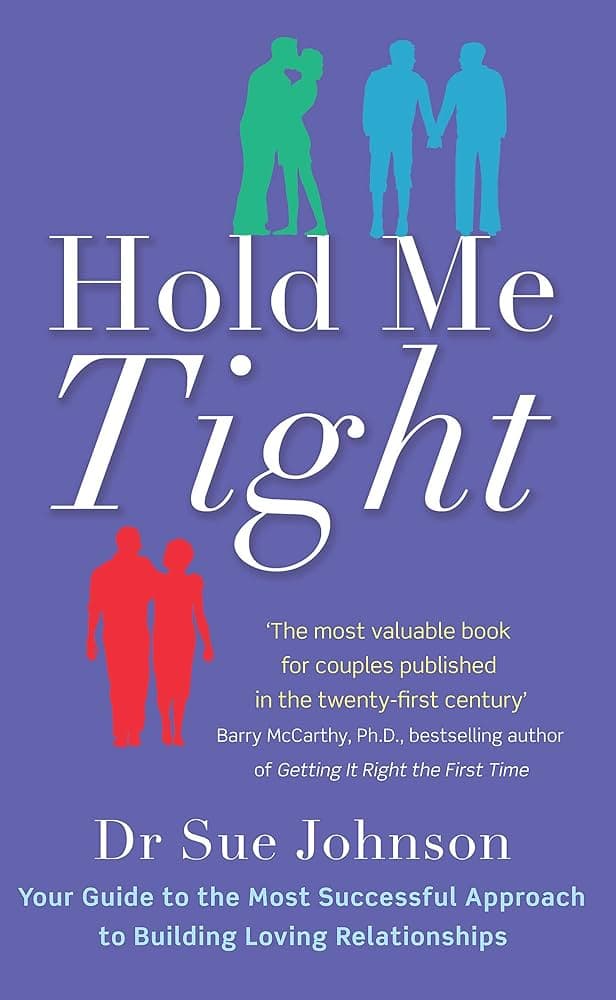
Hold Me Tight
Sue Johnson
Free download · 500+ book summaries
What is Hold Me Tight about?
Hold Me Tight presents practical and theoretical examples to show future couples how to nurture their relationships properly so that it can provide them with lifelong happiness and love.
Key ideas of Hold Me Tight
Love as Attachment Need
Romantic love is a biological survival system, not a sentiment, and emotional disconnection causes measurable harm to physical health.
Demon Dialogue Patterns
Most couple conflicts are driven by three destructive loops that mask deeper fears about losing the relationship.
Seven Healing Conversations
Emotionally Focused Therapy guides couples through structured conversations that rebuild trust, repair old injuries, and create lasting security.
Read an excerpt from the summary
The Babies Who Died for Lack of Touch
In the 1940s, doctors in American hospitals noticed something they could not explain. Orphaned infants in clean, warm wards, fed on schedule, were dying anyway. The pediatrician David Levy gave the syndrome a name in 1937, in the American Journal of Psychiatry: emotional starvation. A few years later René Spitz coined a phrase that still gets used today, failure to thrive. A Spanish bishop had already worked it out in 1760, jotting in his diary that the children in foundling homes "die from sadness" despite shelter and food. They needed to be held. Without being held, their bodies gave up.
This is the discovery underneath Sue Johnson's Hold Me Tight, and it is the reason the book exists. Romantic love, she argues, is not a sentiment. It is not a fluttery feeling, a chemical accident, or a thirteenth-century invention by French minstrels, though plenty of writers have called it all three. Love is the same survival system that kept those babies alive, scaled up to adulthood. We are wired to attach. When we cannot, we deteriorate. When we can, we flourish. Everything in the book runs off this one claim.
Johnson is a couples therapist who developed Emotionally Focused Therapy in the early 1980s, and she has been quietly proving the claim with data ever since. Across more than two decades of clinical research, EFT helps roughly seventy percent of distressed couples move from distress to recovery, and about ninety percent show meaningful improvement. Those are unusually large numbers in couples work. They suggest that something fundamental was being missed by older approaches that treated love as a bargain, a power struggle, or a communication breakdown.
Like it?
Continue in the appWho is it for?
- Anyone who feels stuck in the same argument with their partner and cannot break the cycle.
- Anyone who wants to understand why emotional closeness is as necessary as food or shelter.
- Anyone who has been hurt in a relationship and struggles to trust or open up again.
- Anyone who wants a science-backed, practical guide to building a stronger and more secure bond.
About the author: Sue Johnson
Sue Johnson is a clinical psychologist and couples therapist who developed Emotionally Focused Therapy (EFT) in the early 1980s. EFT is one of the most extensively researched approaches to couples work, with clinical studies showing roughly seventy percent of distressed couples moving from distress to recovery.
Johnson has spent decades applying John Bowlby's attachment theory to adult romantic relationships. She has written several books for both therapists and general readers, and her work has shaped how therapists around the world understand love and emotional bonding.
Read it in 43 minutes
The summary of Hold Me Tight and 500+ more books await in the BookBase app.