 English
 Magyar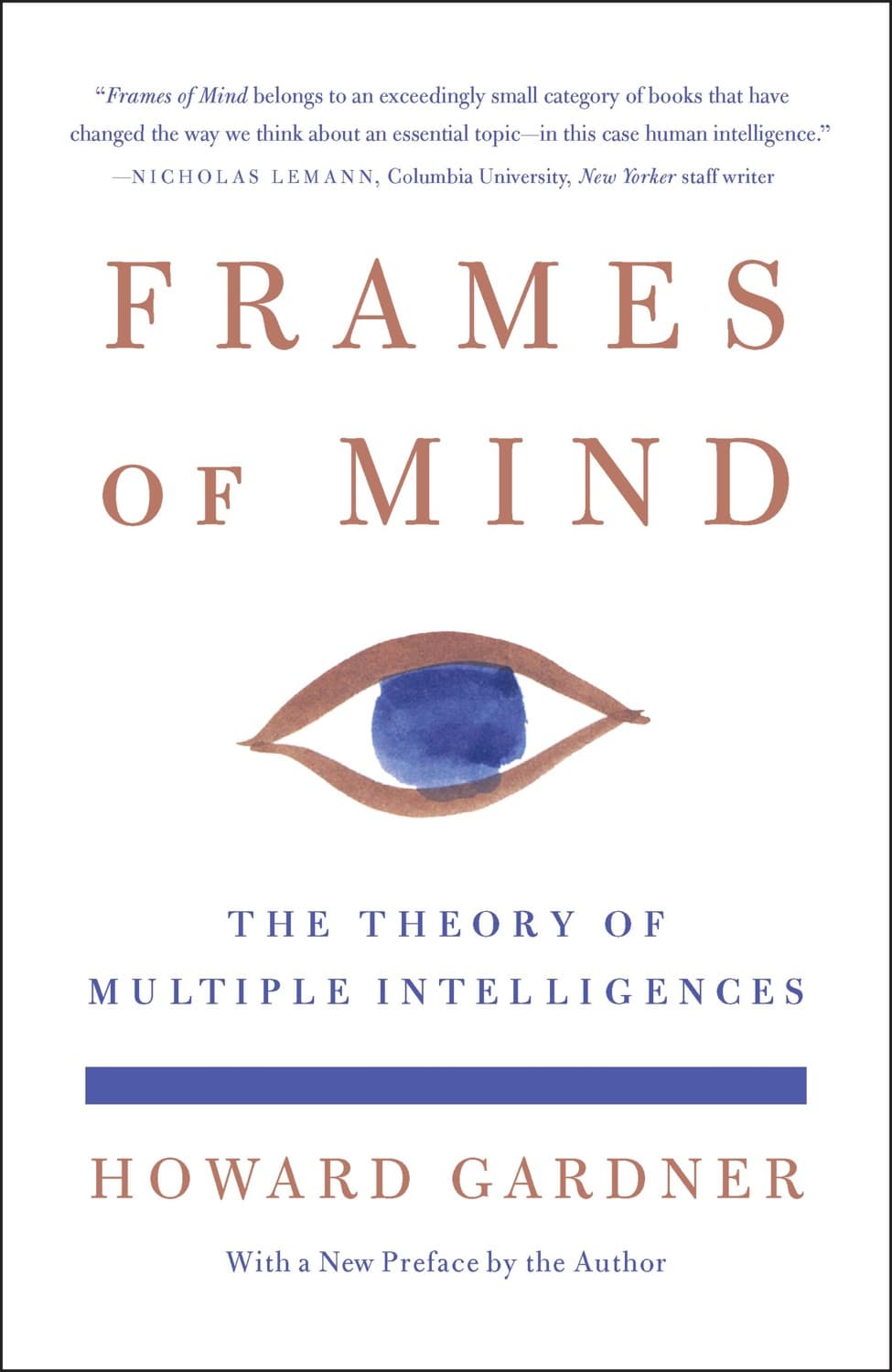
Frames of Mind
Howard Gardener
Free download · 500+ book summaries
What is Frames of Mind about?
The book that introduced the world to multiple intelligences. Howard Gardner argues that IQ is a wildly incomplete measure of human capability, and identifies eight distinct ways of being smart: linguistic, musical, kinesthetic, interpersonal, and more. The foundational text for how we think about talent, learning, and education today.
Key ideas of Frames of Mind
Intelligence Is Not One Thing
Gardner argues the mind is a set of distinct cognitive systems, each with its own biology and developmental path, not a single general-purpose engine.
IQ Tests Measure Too Little
Standard intelligence tests capture only linguistic and logical-mathematical ability, leaving musical, bodily, interpersonal, and other capacities entirely unmeasured.
Brain Damage as Evidence
Patients who lost one ability while keeping others intact revealed that cognitive systems are genuinely independent, grounding the theory in hard neuroscience.
Read an excerpt from the summary
Frames of Mind
In the autumn of 1979, a neuropsychologist at Boston's Veterans Administration Medical Center watched a patient named Frank try to name a fork. Frank had suffered a stroke two months earlier and lost most of his language. He could not say the word "fork." He could not write it. He could not find it in a list of words read aloud to him. Yet when the fork was placed in his hand, he picked it up, slid it under a piece of beef, cut deftly, and brought the food to his mouth without hesitation. He knew what a fork was. He just could not say so.
Howard Gardner had been watching patients like Frank for years. The Veterans Administration hospitals of greater Boston were full of men who had lost one ability and kept another, men whose brains had been selectively damaged by war injuries and strokes and tumors, leaving islands of competence floating in seas of deficit. A mathematician who could no longer recognize faces. A sculptor who could no longer follow a conversation. A musician who had lost his nouns but could still play Chopin from memory. Gardner was not just treating these patients. He was reading them -- reading the architecture of intelligence they revealed by breaking down in pieces rather than all at once.
The question that had been forming in his mind for a decade was this: what if intelligence was never a single thing in the first place?
That question became a book. In 1983, after years of research funded by the Bernard van Leer Foundation through Harvard's Project on Human Potential, Gardner published Frames of Mind: The Theory of Multiple Intelligences. It argued that the human mind is not a general-purpose engine running a single program called "smart." It is a collection of relatively independent cognitive systems -- at least seven of them, Gardner proposed -- each with its own developmental trajectory, its own biological substrate, its own history in evolution, and its own potential to be damaged or preserved in isolation. A linguistically brilliant person is not automatically a gifted spatial reasoner. A child who struggles with numbers may have the kind of bodily intelligence that makes her a natural dancer. Smart, Gardner was saying, comes in kinds.
Like it?
Continue in the appWho is it for?
- Anyone who ever felt that school tests did not capture what they were actually good at.
- Anyone who works with children and wants a richer framework than IQ for understanding them.
- Anyone interested in how neuroscience and cognitive science changed our model of the mind.
- Anyone who wants to think more clearly about talent, learning differences, and human potential.
About the author: Howard Gardener
Howard Gardner is a developmental psychologist and professor at Harvard University, where he has been affiliated with Project Zero, a research group focused on human cognition and learning, for decades. He trained as a neuropsychologist and spent years working with brain-damaged patients at Boston's Veterans Administration hospitals before developing his theory of multiple intelligences.
Gardner is the author of more than twenty books on intelligence, creativity, leadership, and education. He is best known for Frames of Mind, published in 1983, which introduced the theory of multiple intelligences to a wide audience and reshaped how educators, researchers, and parents think about human ability.
Read it in 50 minutes
The summary of Frames of Mind and 500+ more books await in the BookBase app.