 English
 Magyar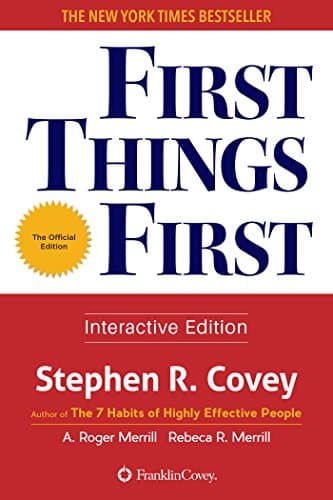
First things first!
Stephen R. Covey
Free download · 500+ book summaries
What is First things first! about?
Stephen Richards Covey, born in 1932, is an American educator, writer, entrepreneur and university professor. His most famous works include The 7 Habits of Highly Effective People and First Things First. In 1996, Time magazine named him one of the 25 most influential people in the world. The book shows us how to improve the quality of our lives and focus on the things that really matter.
Key ideas of First things first!
Urgency Addiction
Constant busyness and crisis-chasing creates an adrenaline dependency that crowds out everything that genuinely matters.
The Four-Quadrant Matrix
Separating tasks by urgency and importance reveals that the most life-changing activities are important but never urgent.
Clock Versus Compass
A full schedule and a clear sense of direction are different things, and only the compass can tell you whether you are living the right life.
Read an excerpt from the summary
There is a man in Covey's book who realized, partway through a seminar exercise, that he was an addict. Not to alcohol or drugs — to urgency. To the adrenaline of every ringing phone, every fire to put out, every crisis that demanded he be the hero. Then came the second realization, which knocked him further back in his chair. He wasn't just an addict. He was a pusher. He had built a whole company that ran on the stuff, and he had been handing it out to his people for years.
That moment of clear seeing sits at the center of First Things First. Covey, writing with Roger and Rebecca Merrill, is making one long argument: the reason your life feels frantic and shallow is not that you need a better calendar. It is that you have confused urgency with importance, and the cost is everything that actually matters. Faster, harder, smarter, more — none of that closes the gap between what you say is important and how you actually spend Tuesday afternoon. A different paradigm closes it. That is the book.
The Clock and the Compass
Covey opens with a metaphor that runs the length of the book. The clock represents how we manage time — schedules, appointments, deadlines, the ringing-and-buzzing furniture of modern life. The compass represents how we lead our lives — vision, values, principles, conscience, the inner sense of true north. Most people live with a gap between the two. Their clock is full and their compass is mute. Or their compass is clear and their clock has been hijacked by everybody else's emergencies.
Running faster does not close the gap. It widens it. Covey saw this in his own daughter Maria, a young mother of three small children. She was frustrated, she told him, because she wasn't getting anything done. His advice ran counter to what time management literature usually says. Don't keep a schedule, he told her. Forget your calendar. This baby is the first thing in your life right now, and short-term imbalance, when it is chosen on purpose by your compass, is sometimes exactly the right thing.
Like it?
Continue in the appWho is it for?
- Anyone who feels perpetually busy but senses their most important relationships and goals are slipping away.
- Anyone who wants a practical framework for deciding what to work on each week instead of reacting to whatever is loudest.
- Anyone who manages a team and wants to replace micromanagement with high-trust accountability agreements.
- Anyone who has achieved a goal only to feel it cost more than it was worth.
About the author: Stephen R. Covey
Stephen R. Covey (1932-2012) was an American educator, author, and businessman best known for The 7 Habits of Highly Effective People, one of the best-selling nonfiction books of the twentieth century. He co-founded the Covey Leadership Center and later FranklinCovey, a global consultancy focused on organizational and personal effectiveness.
In 1996 Time magazine named him one of the 25 most influential Americans. First Things First, written with Roger and Rebecca Merrill, extends the principles of the 7 Habits into a full framework for time and life management built on the distinction between urgency and importance.
Read it in 43 minutes
The summary of First things first! and 500+ more books await in the BookBase app.