 English
 Magyar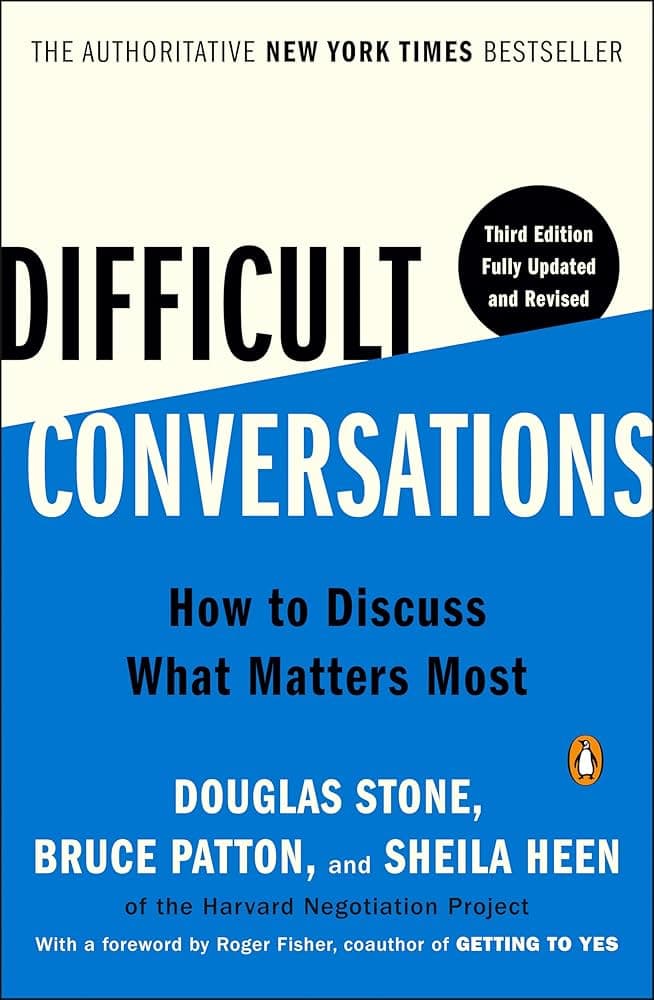
Difficult Conversation
Douglas Stone
Free download · 500+ book summaries
What is Difficult Conversation about?
Every day, we try to engage in or avoid difficult conversations—whether we're dealing with an underperforming employee, disagreeing with our spouse, or negotiating with a client. The book Difficult Conversations by the Harvard Negotiation Project (the same organization behind the book Getting to Yes) outlines a step-by-step approach for conducting these tough conversations with less stress and more success.
Key ideas of Difficult Conversation
Three Hidden Conversations
Every difficult exchange contains simultaneous disputes about facts, unspoken feelings, and threats to each person's identity.
Curiosity Over Certainty
Replacing the assumption that you are right with genuine curiosity about the other person's story is the core shift that makes hard talks productive.
Intent Versus Impact
Good intentions do not cancel real harm, and assuming you know the other person's motives almost always makes the conflict worse.
Read an excerpt from the summary
The Hand Grenade in Your Pocket
You have a difficult conversation waiting for you. Maybe with your sister about your mother's care. Maybe with the friend who keeps borrowing money. Maybe with the colleague whose missed deadlines keep landing on your desk. Whatever it is, you have probably rehearsed it in your head a dozen times, and you have probably decided you are going to handle it badly no matter what.
Douglas Stone, Bruce Patton, and Sheila Heen, the Harvard Negotiation Project veterans behind *Difficult Conversations*, have a simple explanation for why those rehearsals never work. You are preparing the wrong kind of conversation. You think you are about to deliver a message. You are actually about to enter a learning conversation, and the difference between those two things is the difference between a relationship that survives and one that does not.
Their core image for the dilemma is the hand grenade. Delivering a hard message, they write, is like throwing one. You can coat it in sugar, you can lob it gently, but it is still going to do damage. The other side of the choice is no better. Choosing not to deliver the message is like hanging on to the grenade once you have pulled the pin. Most of us hold the grenade until we cannot stand it anymore, then throw it harder than we meant to, then spend the next month trying to apologize for the explosion.
The book is built around the question of how to stop doing this. The answer, the authors argue, is not better technique for delivering bad news. It is a complete shift in what you think you are doing when two people start talking about something that matters. The shift is small to describe and hard to perform. Stop trying to deliver a message. Start trying to learn one.
Like it?
Continue in the appWho is it for?
- Anyone who avoids a recurring hard conversation because past attempts have made things worse.
- Anyone who wants to give honest feedback at work without triggering defensiveness or losing the relationship.
- Anyone who tends to assume the worst about what others meant and wants a more accurate, less costly habit.
- Anyone who needs to deliver bad news, set a limit, or address a long-standing grievance with a family member or colleague.
About the author: Douglas Stone
Douglas Stone is a lecturer at Harvard Law School and a founding partner of Triad Consulting Group, which advises organizations on negotiation and communication. He is a long-standing member of the Harvard Negotiation Project, the research group that also produced the negotiation classic Getting to Yes.
Stone co-authored Difficult Conversations with fellow Harvard Negotiation Project colleagues Bruce Patton and Sheila Heen. The book draws on years of research into how people handle conflict, and it has been used widely in management training, mediation practice, and professional coaching.
Read it in 42 minutes
The summary of Difficult Conversation and 500+ more books await in the BookBase app.