 English
 Magyar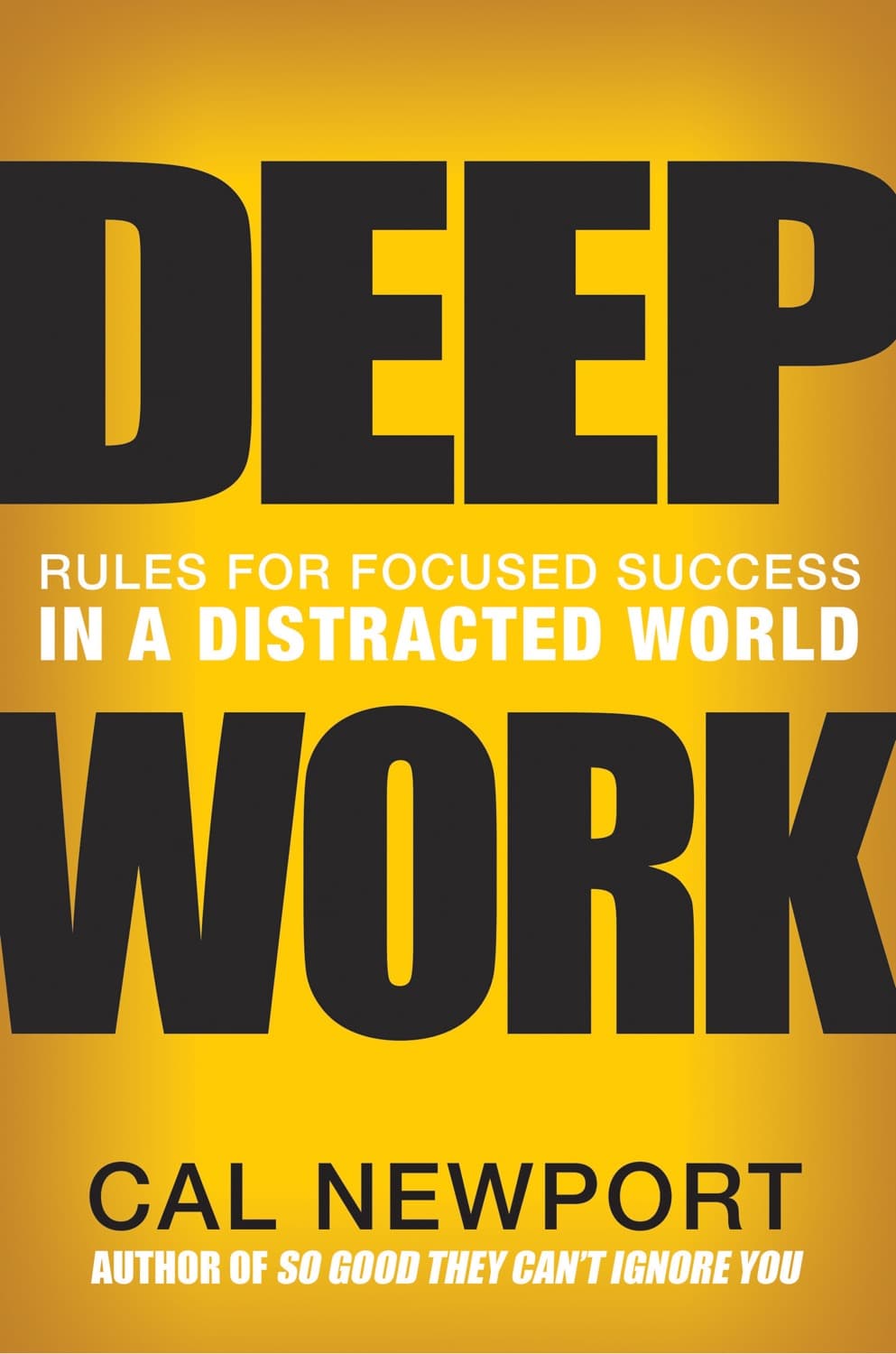
Deep Work
Cal Newport
Free download · 500+ book summaries
What is Deep Work about?
The skill that separates extraordinary careers from ordinary ones. Cal Newport argues focused work has become rare and therefore valuable. He walks through the philosophical case for it and the practical disciplines (time-blocking, ritual, removing social media) that make sustained concentration possible in a world built to fragment attention.
Key ideas of Deep Work
Deep Work Builds Rare Skills
Sustained, distraction-free concentration is the mechanism by which knowledge workers learn hard things fast and produce output that compounds over time.
Attention Is a Finite Resource
Context switching leaves attention residue that degrades focus for hours, making a few protected deep blocks worth more than a full day of fragmented availability.
Structure Replaces Willpower
Choosing a scheduling philosophy, installing shutdown rituals, and budgeting shallow work removes daily willpower decisions and makes depth the default.
Read an excerpt from the summary
Deep Work: Rules for Focused Success in a Distracted World
Author: Cal Newport Year: 2016 Reading time of this summary: about 45 minutes
A psychiatrist locks the door
In 1922, on the northern banks of Lake Zurich, the psychiatrist Carl Jung climbed a wooded hillside in the Swiss canton of St. Gallen and began stacking stones for a tower. He called it Bollingen. There was no electricity. Light came from oil lamps. Heat came from a stone fireplace. After breakfast each morning, Jung would walk into a small private room, lock the door behind him, and write for two undisturbed hours. "In my retiring room I am by myself," he said of the space. "I keep the key with me all the time; no one else is allowed in there except with my permission." Afternoons were for meditation and long walks through the surrounding countryside. By ten in the evening he was in bed.
This was not a vacation house. In 1921 Jung had published *Psychological Types*, a book that put a clear, public crack between his thinking and Sigmund Freud's. Disagreeing with Freud in the 1920s was a bold professional move. To survive the fight he had picked, Jung needed a steady output of careful, original work. His Zurich practice paid the bills and kept him sharp on patients, but it also fragmented his attention. The lakeside retreat was the opposite of a break. It was the engine. The world owes Jung's commitment to analytical psychology, in part, to a stone room with no electricity and a key that stayed in his pocket.
Cal Newport opens *Deep Work* with this image because it is exactly the kind of behavior our modern professional life finds unreasonable. A successful working psychiatrist disappears into the woods for days at a stretch to read and write in silence. His patients wait. His correspondence waits. He chooses depth over availability, and the choice changes the shape of twentieth-century psychology.
Like it?
Continue in the appWho is it for?
- Anyone who feels productive all day but struggles to point to meaningful output at week's end.
- Anyone who wants to learn a complex technical or creative skill faster than their peers.
- Anyone whose calendar is full of meetings and chat but whose real work keeps slipping to weekends.
- Anyone who suspects their phone and social media habits are quietly eroding their ability to concentrate.
About the author: Cal Newport
Cal Newport is a professor of computer science at Georgetown University and the author of several books on work, technology, and skill development. He is known for his Study Hacks blog and the Deep Questions podcast, where he applies the same principles he writes about.
Newport is unusual among productivity writers in that he does not use social media and publishes his research alongside his popular writing. His later books, including Digital Minimalism and A World Without Email, extend the arguments first laid out in Deep Work.
Read it in 44 minutes
The summary of Deep Work and 500+ more books await in the BookBase app.