 English
 Magyar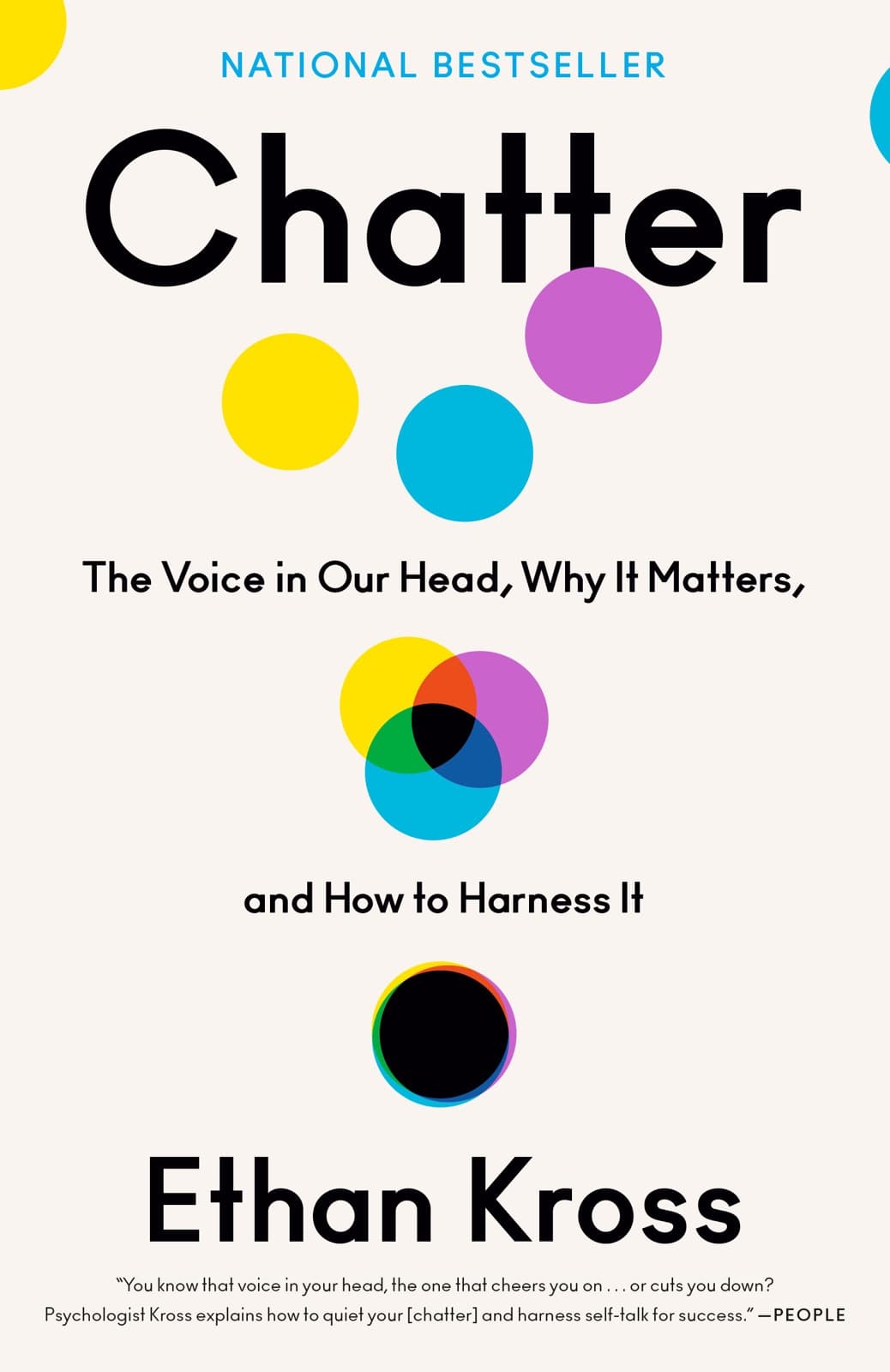
Chatter
Ethan Kross
Free download · 500+ book summaries
What is Chatter about?
Your inner voice is your most powerful ally or fiercest opponent. Learn why we talk to ourselves, what happens when that voice spirals out of control, and the science-backed tools that actually quiet it. From stepping back as an observer to addressing yourself by name, Kross offers a practical toolkit for tuning that voice, not silencing it.
Key ideas of Chatter
Chatter vs. inner voice
The inner voice is a universal human tool, but chatter turns it into circling, paralyzing negativity that blocks clear thinking and action.
Psychological distance as cure
Stepping back to observe yourself from the outside, using your own name or a third-person view, quiets negative spirals within seconds.
Outside-in environmental tools
Nature, physical order, ritual, and placebo belief reduce chatter without mental effort, working from the environment inward.
Read an excerpt from the summary
Chatter — Summary
It is three in the morning. A serious adult with a serious scientific career is standing in his living room, in his pajamas, holding a child's baseball bat. Every so often he peeks out from behind the curtain, hoping to spot someone in the street. He hasn't slept in days, can barely eat. A few hours ago he caught himself seriously typing into a search engine: "bodyguards for academics." Then he stopped for a moment and asked himself the question that turned his whole night around.
This man is Ethan Kross. He runs the emotion and self-control research laboratory at the University of Michigan, which means that studying how we rein in the negative thoughts raging in our heads is literally his job. And yet, when he himself got into trouble, the very thing he knew the most about in the world took hold of him. His own inner voice got the better of him. If anyone should have known what to do, it was him. He still couldn't. And here is where the body is buried: the voice living in our head can be our greatest ally and our fiercest enemy, often on the same day.
This book goes after three big questions. Why do we talk to ourselves at all, and why does this voice sometimes turn against us? What happens in our heads, our relationships and our bodies when the voice gets loose? And, most usefully of all, with what concrete, scientifically tested tools can we quiet it when it gets too loud? Kross has gathered a whole toolbox, and by the end you get one too.
When the head starts to roar
Let's start with what this voice actually is. Kross has a word for it: chatter. Those circling, negative thoughts and emotions that turn our singular human capacity for introspection from a blessing into a curse. We turn inward looking for our inner coach. Instead, we often find our inner critic.
Like it?
Continue in the appWho is it for?
- Anyone who lies awake at night replaying conversations or catastrophizing about tomorrow.
- Anyone who gives friends great advice but cannot apply the same calm reasoning to their own problems.
- Anyone whose anxious inner monologue is hurting their performance at work, in sport, or in relationships.
- Anyone who wants science-backed, immediately usable tools for managing stress and negative self-talk.
About the author: Ethan Kross
Ethan Kross is a professor of psychology and management at the University of Michigan, where he directs the Emotion and Self-Control Laboratory. His research focuses on how people regulate their emotions and inner experiences, with particular attention to the role language and self-talk play in mental and physical health.
He has published widely in leading scientific journals and his work has been cited in media outlets around the world. Chatter, his first book for a general audience, draws directly on his own research and on a broad range of findings from psychology, neuroscience, and behavioral science.
Read it in 53 minutes
The summary of Chatter and 500+ more books await in the BookBase app.