 English
 Magyar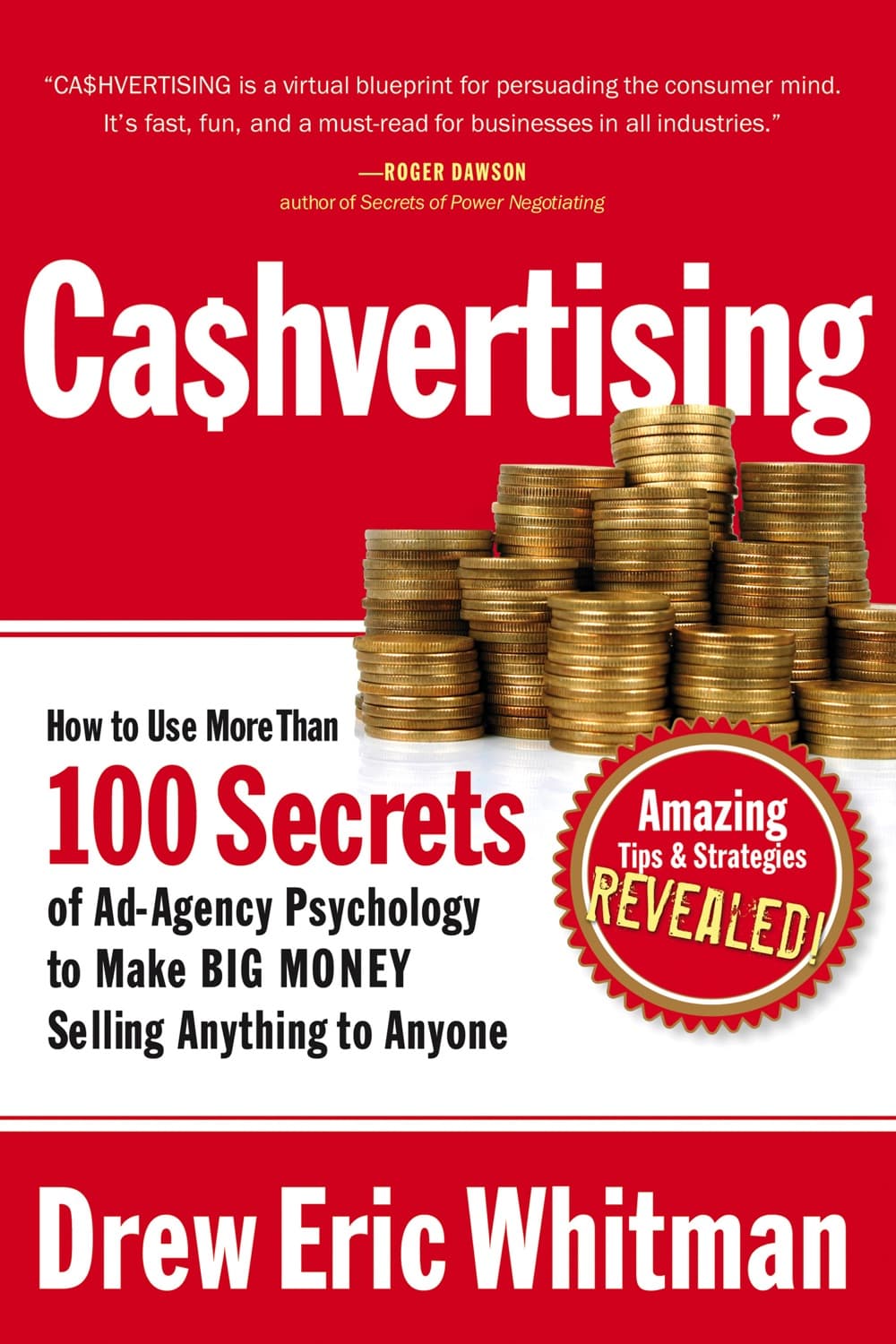
Cashvertising
Drew Eric Whitman
Free download · 500+ book summaries
What is Cashvertising about?
The 100+ direct-response copywriting techniques that actually move money. Drew Eric Whitman distills decades of consumer psychology and scientifically tested ad data into a single playbook. The eight Life-Force 8 desires, the seventeen principles of consumer psychology, and the forty-one proven techniques every advertiser, marketer, and copywriter should burn into memory. The most pragmatic copy book ever written.
Key ideas of Cashvertising
The Life-Force 8 Framework
Eight biological desires hardwired into every person drive purchase decisions far more reliably than product features or rational arguments ever can.
Psychology Before Technique
Fear, ego, social proof, and scarcity each exploit documented cognitive mechanisms, and understanding them is what separates copy that converts from copy that merely informs.
Testing Over Opinion
Changing one variable at a time and measuring response rates is the only discipline that reliably separates what works from what the advertiser merely believes should work.
Read an excerpt from the summary
Cashvertising
In 1925, a twenty-three-year-old copywriter sat in a cramped office at Ruthrauff & Ryan on Madison Avenue and stared at a blank legal pad. His name was John Caples, and his assignment was to sell piano lessons by mail to people who had never asked for them. Nobody wanted piano lessons. Nobody was lying awake at night wishing they could find a good correspondence course. The challenge was to manufacture desire out of thin air and direct it toward a coupon at the bottom of a magazine page.
Caples wrote down several headlines. His supervisor crossed most of them out. Then Caples wrote a single line that would make advertising history: "They Laughed When I Sat Down at the Piano -- But When I Started to Play!" The ad ran in Physical Culture magazine and pulled more coupons than anything the US School of Music had ever published. The copy told the story of a young man named Jack, who walks into a party, sits down at the piano without warning, and performs Beethoven's Moonlight Sonata while the room falls silent in shock. His friends had mocked him. Now they were begging him to teach them. The product was a home-study course. But the ad was not selling lessons. It was selling the moment when the laughing stops.
That distinction -- between the product on the shelf and the emotion in the reader's chest -- is the whole of advertising psychology in two sentences. It is also the engine that drives Drew Eric Whitman's 2008 book Cashvertising.
Whitman spent years in the trenches of direct-response copywriting. He wrote for the direct-marketing division of the largest ad agency in Philadelphia. He was senior copywriter for a major direct-to-consumer insurance company. He served as associate copy chief at Day-Timers, the catalog giant. He was not an academic theorizing about persuasion from a corner office. He was the person producing control packages and tracking which headline beat which challenger, which offer format doubled the response rate, and which fear-based appeal sold more units than any rational argument could.
Like it?
Continue in the appWho is it for?
- Anyone who writes ads, emails, or sales pages and wants to understand why some copy sells and some does not.
- Anyone who runs a small business and spends money on marketing without a framework for knowing what is working.
- Anyone who wants to understand how consumer psychology actually operates underneath every buying decision they make.
- Anyone who manages a marketing team and needs a shared, evidence-based vocabulary for evaluating creative work.
About the author: Drew Eric Whitman
Drew Eric Whitman spent years as a working direct-response copywriter, including as senior copywriter for a major direct-to-consumer insurance company and associate copy chief at Day-Timers, one of the largest catalog operations in the United States. His background is in producing measurable results for clients rather than in academic theory.
He draws heavily on the tradition of Claude Hopkins and John Caples, both pioneers of tested, data-driven advertising, and positions Cashvertising as a bridge between behavioral science research and day-to-day advertising practice.
Read it in 46 minutes
The summary of Cashvertising and 500+ more books await in the BookBase app.