 English
 Magyar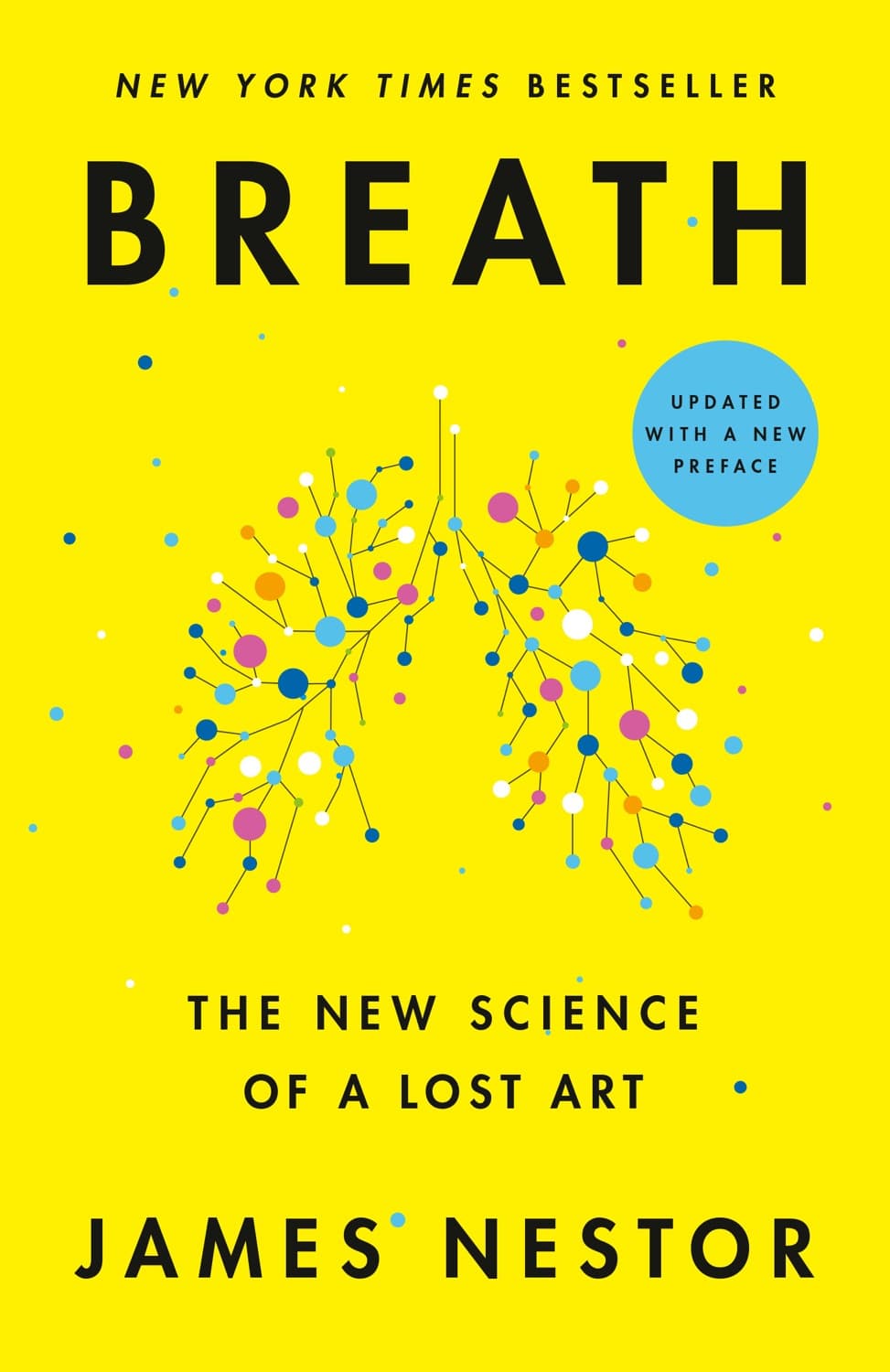
Breath
James Nestor
Free download · 500+ book summaries
What is Breath about?
How a lost art quietly determines your health. Journalist James Nestor digs into the science and culture of breathing: nasal vs. mouth, slow vs. fast, ancient pranayama practices, modern Buteyko methods. A surprisingly fascinating investigation into the most basic human function and how most of us have been doing it wrong our entire lives.
Key ideas of Breath
Nose Over Mouth
Nasal breathing filters and humidifies air, delivers nitric oxide to the lungs, and absorbs roughly 18 percent more oxygen than mouth breathing.
The 5.5 Breath Rhythm
Inhaling and exhaling for 5.5 seconds each, at about 5.5 breaths per minute, synchronizes the cardiovascular system and lowers blood pressure measurably.
CO2 Is Not Just Waste
Chronically breathing too fast purges carbon dioxide, which the body needs to release oxygen to tissues, driving anxiety, asthma, and poor sleep.
Read an excerpt from the summary
Breath
*James Nestor*
On the twenty-second day of the experiment, James Nestor woke up at three in the morning absolutely certain he was dying. His heart was hammering. The pulse oximeter clipped to his finger read below 85 percent -- the threshold where emergency rooms begin to take serious interest. He was drenched in sweat. He had just logged twenty-five obstructive sleep apnea episodes in a single night, each one a moment where his airway collapsed, his body lurched awake without him knowing, and his brain fired off a cascade of stress hormones into the dark. His systolic blood pressure had climbed to 142 millimeters of mercury. Stage 2 hypertension. The danger zone.
He had been healthy when the experiment started. He was still healthy in every conventional sense. The only thing that had changed was this: his nostrils had been plugged with medical-grade silicone, sealed with surgical tape, for ten days straight. He had been forced to breathe exclusively through his mouth -- the way roughly half the people alive breathe every night without anyone telling them it is a problem.
The year was recent. The location was Stanford University. The researcher overseeing everything was Dr. Jayakar Nayak, a professor of otolaryngology with a rigorous scientific mind and, apparently, a high tolerance for watching a journalist suffer in the name of data. Nestor's partner in the experiment was Anders Olsson, a Swedish breathing therapist who kept a daily journal of his deteriorating mental state. After one week, Olsson wrote that it felt as if someone had pulled a damp cloth over his thinking. Nestor's snoring had increased by 4,820 percent. Not doubled. Not tripled. Nearly fifty times worse -- a number so outlandish it barely sounds real until you read the polysomnography printouts, which are very, very real.
Like it?
Continue in the appWho is it for?
- Anyone who snores, mouth-breathes at night, or wakes up tired despite a full night of sleep.
- Anyone who deals with asthma, anxiety, or high blood pressure and wants to understand a root-cause approach.
- Anyone curious about how ancient contemplative traditions and modern physiology arrived at the same breathing insights.
- Anyone interested in low-cost, evidence-backed habits that can improve endurance, focus, and long-term health.
About the author: James Nestor
James Nestor is an American science journalist and author. He has written for Outside, Scientific American, The New York Times, and other publications, and his work frequently focuses on the intersection of human physiology, extreme environments, and overlooked health practices.
He spent about a decade researching breath after encountering free-divers in Greece whose bodies behaved in ways mainstream medicine rarely discussed. That investigation led him to laboratories, ancient texts, clinical therapists, and his own self-experiments, producing a book that drew wide attention from both the scientific community and general readers.
Read it in 48 minutes
The summary of Breath and 500+ more books await in the BookBase app.