 English
 Magyar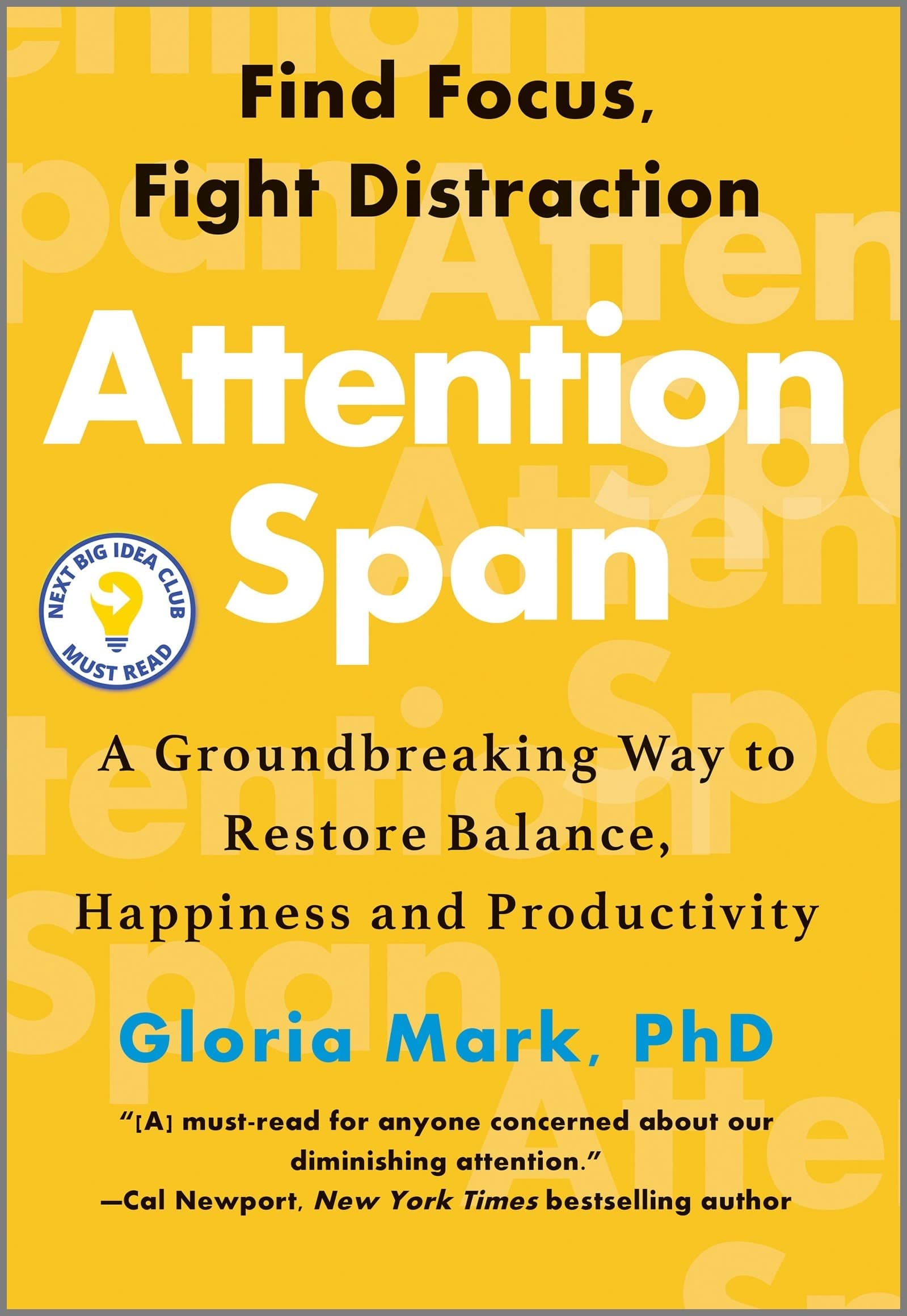
Attention Span
Gloria Mark
Free download · 500+ book summaries
What is Attention Span about?
On average, we spend only 47 seconds on one thing before shifting our attention elsewhere. After an interruption, it takes 25 minutes to refocus on the task at hand. Psychologist Gloria Mark writes about these topics in her book Attention Span, where she uncovers the surprising findings from her decades of research into how technology affects our attention.
Key ideas of Attention Span
Attention as a finite resource
Your mental fuel depletes throughout the day, and willpower alone cannot override the depletion, making rest and rhythm essential to sustained performance.
Self-interruption and attention residue
Nearly half of all task switches are self-initiated, and switching leaves a mental residue that quietly drags on focus for the next activity.
Rhythm over flow
Alternating between focused, rote, and restful states throughout the day is more achievable and sustainable than chasing extended deep-flow sessions.
Read an excerpt from the summary
The Number That Should Worry You
In 2004, when Gloria Mark first started timing how long people held their gaze on a single screen before switching to something else, the average was two and a half minutes. By 2012 it had fallen to seventy-five seconds. A few years after that it settled at around forty-seven seconds, and there it has stayed. Forty-seven seconds. That is how long the average person now stays on one screen before jumping to the next — an email, a browser tab, a phone, a message — all day, every workday.
Mark is a professor of informatics at the University of California, Irvine, and she has spent more than two decades measuring attention in the wild. Not in a sealed laboratory with college sophomores, but in real offices, with real workers, using heart-rate monitors, computer logs that timestamp every click, and wearable cameras that record face-to-face encounters. When she began this work in 2003, she didn't know of anyone else who had tried to measure attention span at all. That fact matters more than it sounds. What we don't measure, we tend to treat as unimportant. By putting a stopwatch to attention, Mark made an invisible problem visible.
Her conclusions overturn most of the productivity advice you have ever heard. The dream of marathon deep focus, of grinding for hours in a distraction-free cocoon, is not just hard to achieve. It is biologically unrealistic, and chasing it makes us miserable. Mark's argument is gentler and more useful: attention is a limited, rhythmic resource. The goal is not to focus harder but to design your day around how your mind actually works — including its need to rest, wander, and do easy things.
Like it?
Continue in the appWho is it for?
- Anyone who feels scattered, overloaded, or chronically behind despite working long hours.
- Anyone who wants to understand why notifications and social feeds are so hard to ignore and what to do about it.
- Anyone who manages knowledge workers and wants to design better working conditions around how attention actually functions.
- Anyone who suspects that hustle culture and the demand for constant focus are making them less effective, not more.
About the author: Gloria Mark
Gloria Mark is a professor of informatics at the University of California, Irvine. She has spent more than two decades studying how people interact with technology in real workplace settings, using tools like heart-rate monitors, computer activity logs, and wearable cameras to measure behavior as it actually happens, not as people remember it.
Her research on attention spans and digital interruption has been widely cited in science journalism and organizational psychology. She conducted some of the first empirical studies to put precise time measurements on how long people stay focused and how long recovery from interruption takes.
Read it in 45 minutes
The summary of Attention Span and 500+ more books await in the BookBase app.