 English
 Magyar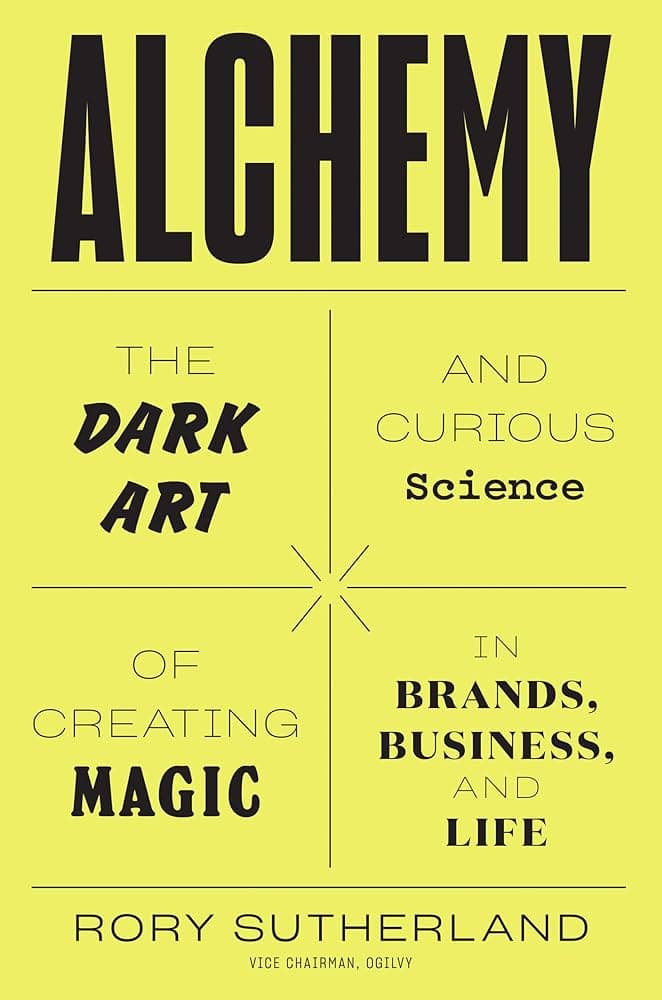
Alchemy
Rory Sutherland
Free download · 500+ book summaries
What is Alchemy about?
The Alchemy guide serves as a manual on how to be successful in business. It shows you how to solve problems effortlessly with irrational thinking.
Key ideas of Alchemy
Psycho-Logic Over Pure Reason
Human decisions are driven by a largely unconscious system shaped by evolution, not by logical calculation, and ignoring this leads to costly blind spots.
Costly Signals Create Trust
Expensive, inconvenient, or effortful gestures convey credibility precisely because they are hard to fake, making them more persuasive than logical arguments.
Perception Is the Product
Changing how something is framed, named, or presented can transform its value without altering the thing itself, often at a fraction of the cost of a physical improvement.
Read an excerpt from the summary
The Drink That Should Have Failed
Imagine you are asked the hardest question in the soft-drinks business: what product could ever rival Coca-Cola as the world's second most popular cold, non-alcoholic drink? Every logical instinct points the same way. Make it taste better. Make it cheaper. Make the bottle bigger. Give people more of what they already like, for less money.
Now look at what actually happened. The drink that pulled it off did the exact opposite of all three. It was expensive. It came in a tiny can. And it tasted, by most accounts, faintly medicinal. When the company behind it ran pre-launch research, the specialist agency reported that in its entire history it had never seen a worse reaction to any proposed new product. People did not politely shrug. One typical comment was that the respondent wouldn't drink the stuff if you paid them to.
That drink was Red Bull. Today it sells something in the order of six billion cans a year, and the profits are healthy enough to bankroll a Formula One team. Here is the uncomfortable lesson at the heart of Rory Sutherland's *Alchemy*. Red Bull did not succeed in spite of breaking every rule of rational product design. It succeeded, at least in part, *because* it broke them. A small can implies potency. A high price implies value. An odd taste implies that something serious is going on inside. The logical version of Red Bull, the cheap, large, pleasant one, would have been just another soft drink, and you would never have heard of it.
Sutherland spent his career at the advertising agency Ogilvy, and his whole book is an argument for taking that Red Bull lesson seriously. The opposite of a good idea, he says, can also be a good idea. We have built a world run by logical people who only ever discover logical things, and in doing so we have quietly outlawed the one thing that creates disproportionate value: magic.
Like it?
Continue in the appWho is it for?
- Anyone who wants to understand why rational marketing and product decisions so often fail.
- Anyone who makes business decisions and suspects the data is missing something important.
- Anyone who studies consumer behavior, psychology, or behavioral economics.
- Anyone who needs to persuade people and finds that logical arguments rarely work on their own.
About the author: Rory Sutherland
Rory Sutherland is a longtime executive at Ogilvy, one of the world's best-known advertising agencies, where he has spent his career applying behavioral science to real marketing and business problems.
He is a prominent public speaker and writer on advertising, psychology, and irrationality, and is widely associated with bringing ideas from evolutionary biology and behavioral economics into practical business thinking.
Read it in 44 minutes
The summary of Alchemy and 500+ more books await in the BookBase app.