 English
 Magyar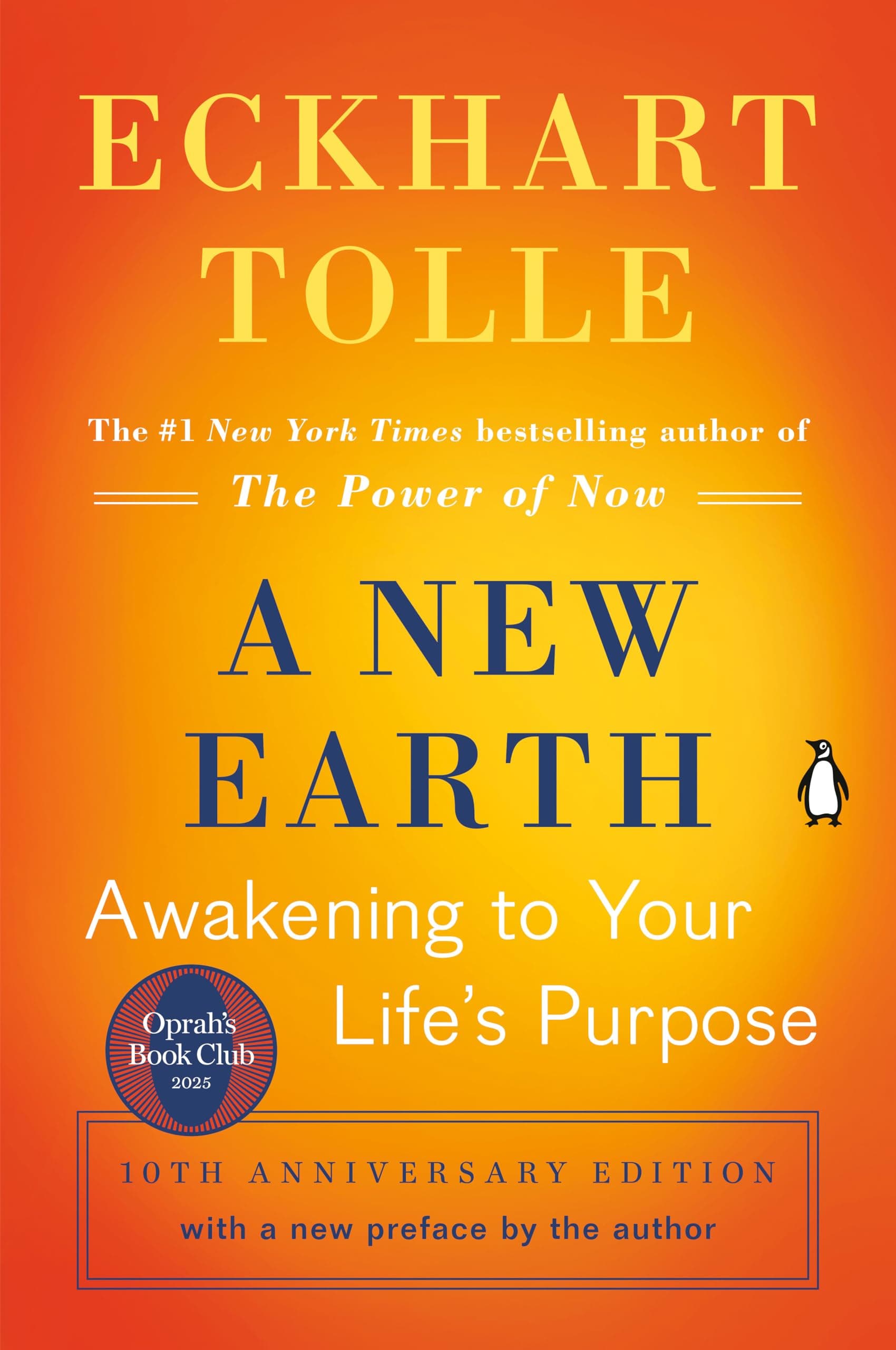
A New Earth
Eckhart Tolle
Free download · 500+ book summaries
What is A New Earth about?
In A New Earth, Eckhart Tolle argues that the dysfunction we see in the world is not a political or economic problem, it is a problem of consciousness. The ego — the voice in your head that needs to be right, important, and special — is what creates suffering, both personal and collective. This book is a clear, practical guide to recognizing the ego in yourself and stepping into the awake awareness underneath it.
Key ideas of A New Earth
The Ego Is Not You
The constant inner voice that judges, compares, and rehearses old arguments is a mental pattern you can observe, not the self you truly are.
The Pain-Body Holds Old Hurt
Unprocessed emotional pain accumulates in the body as a reactive pattern that hijacks behavior until met with steady, conscious attention.
Inner Purpose Over Outer Goals
Lasting wellbeing comes from the quality of presence you bring to any task, not from the achievements or identities you build around it.
Read an excerpt from the summary
A New Earth — summary
A man wakes up on a park bench and the world looks different
In the spring of 1977, a twenty-nine-year-old PhD student in London woke up one night convinced he could not survive another day. He had lived with depression and free-floating dread for years. That night the dread sharpened into a single sentence that kept repeating in his head: I cannot live with myself any longer. He sat with it. And then a strange question landed: Wait. If I cannot live with myself, how many of me are there? There must be two: the I, and the self that I cannot stand.
Something in him stopped. The thought stream cut out. He felt himself fall into a kind of empty space, blacked out, and woke up at dawn to a bird singing outside his window. The room looked as if someone had just made it. Light coming through the curtain felt alive. He spent the next two years sitting on park benches, often without a fixed address, in what he later called a state of intense and uninterrupted joy. The man was Eckhart Tolle, and out of that one night came two of the most-read spirituality books of the last fifty years: The Power of Now and the bigger, more ambitious follow-up you are about to read about, A New Earth.
This summary is going to walk you through the heart of what Tolle actually teaches. Where the pain in your head and chest comes from, why most of it is created by something inside you that is not really you, and what changes when you stop feeding it. We will look at the practical moves Tolle recommends, the sharp criticisms his work has attracted, and the question every reader eventually has to answer: is this really a roadmap, or just very pretty fog?
Like it?
Continue in the appWho is it for?
- Anyone who feels ruled by anxious, repetitive thoughts they cannot seem to switch off.
- Anyone who notices they keep reacting to old emotional wounds in present-day situations.
- Anyone who chases goals relentlessly but finds each arrival leaves them feeling the same.
- Anyone curious about mindfulness and presence but put off by purely religious or jargon-heavy explanations.
About the author: Eckhart Tolle
Eckhart Tolle is a German-born spiritual teacher and author who spent years in depression before an inner shift in his late twenties redirected his life entirely. He has lived and taught in the English-speaking world since the 1990s, and his work draws on Zen, Vedanta, Christian mysticism, and other contemplative traditions without formally belonging to any of them.
His first book, The Power of Now, brought him a wide international readership. A New Earth, published several years later, expanded those ideas into a broader argument about ego, collective suffering, and the possibility of a more conscious way of living. Both books have sold tens of millions of copies worldwide.
Read it in 41 minutes
The summary of A New Earth and 500+ more books await in the BookBase app.