 English
 Magyar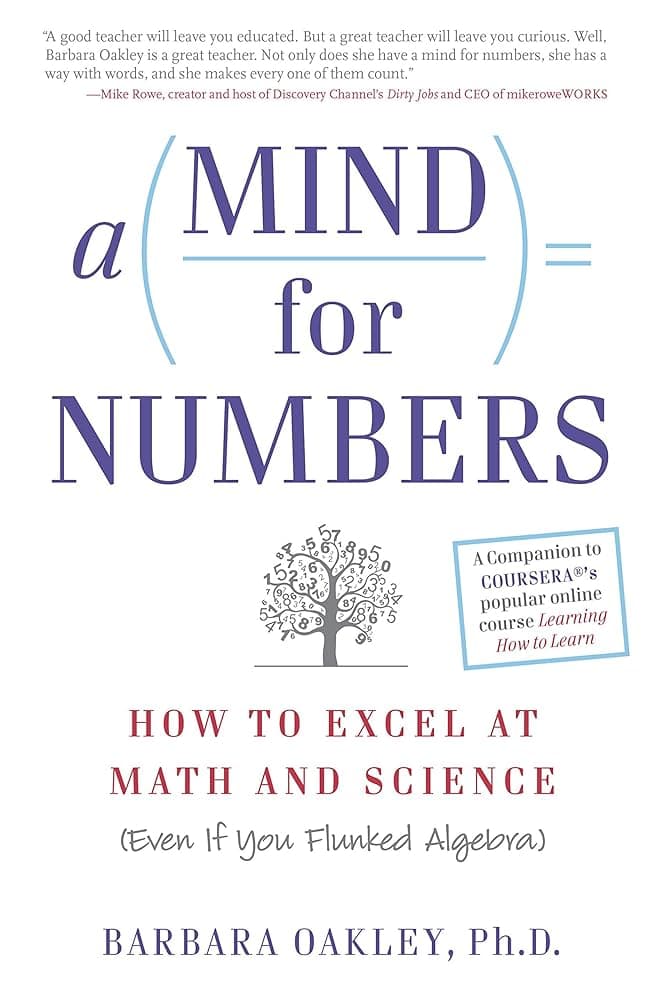
A Mind for Numbers
Barbara Oakley
Free download · 500+ book summaries
What is A Mind for Numbers about?
A Mind for Numbers offers insight into how our brain absorbs and processes information. It outlines strategies that can help improve learning, particularly when it comes to mathematics and the sciences. Even if mathematical or scientific concepts don’t come easily, with the right dedication and perseverance, you can master them – and this book teaches you how.
Key ideas of A Mind for Numbers
Focused and Diffuse Thinking
Alternating between concentrated problem-solving and relaxed mind-wandering is essential because breakthroughs often arrive only after you step away from a problem.
Chunking Builds Real Understanding
Practicing knowledge until it compresses into a single retrievable unit frees up mental space and turns surface familiarity into genuine, transferable understanding.
Retrieval Beats Rereading
Closing the book and recalling information from memory strengthens learning far more than rereading or highlighting, which create a false sense of mastery.
Read an excerpt from the summary
A Mathophobe Becomes an Engineer
Barbara Oakley flunked her way through high school math and science. Not just struggled — flunked. As a kid she couldn't read a clock face. She didn't know which button on the family television was the power button. By the time she was finishing high school she had decided, with the stubborn clarity that thirteen-year-olds reserve for self-diagnosis, that she was "technically, scientifically, and mathematically incapable." She majored in the opposite: Slavic languages, with Russian fluent enough that native speakers mistook her for one of their own.
Then she joined the United States Army Signal Corps and discovered that the officers who could actually fix radios, switching systems, and electronics were the ones everyone needed. She, the language major, finished at the bottom of her class in electronics. She watched the problem-solvers get promoted past her. So at twenty-six, on the GI Bill, she sat down to start over. She began with remedial trigonometry. The first semesters were what she calls "frightening frustration." Eventually she earned a bachelor's in electrical engineering, a master's in electrical and computer engineering, and a Ph.D. in systems engineering. "By the time I reached my doctoral studies," she writes, "I was breezing by with perfect grades." She is now a professor of engineering and an editor of the journal of bioengineering.
This is the book's foundational claim and its proof of concept in the same person: brains can be retrained. Not by working harder in the same broken way you have always worked, but by understanding what your brain is actually doing when it learns — and then matching your habits to that machinery. Oakley spent years talking to leading professors across math, physics, chemistry, biology, engineering, psychology, and neuroscience, and she noticed something. They all used the same set of underlying techniques. Most of them had stumbled into those techniques the hard way, treating the discovery as a private initiation rite. Her book exists to make those techniques accessible without the initiation.
Like it?
Continue in the appWho is it for?
- Anyone who struggled with math or science in school and wants to know why and what to do about it.
- Anyone who procrastinates on difficult study tasks and wants a practical, neuroscience-backed system to get started.
- Anyone who prepares for exams by rereading notes and wonders why that approach keeps failing.
- Anyone who wants to learn a technical or abstract subject faster and retain it longer.
About the author: Barbara Oakley
Barbara Oakley is a professor of engineering who retrained her own brain as an adult, starting from remedial math after years of avoiding technical subjects entirely. Her personal transformation from self-described math failure to engineering PhD forms the backbone of this book.
She has researched how experts across mathematics, physics, chemistry, and neuroscience actually learn, and she teaches these methods at Oakland University. Her work bridges cognitive science and practical study skill in a way aimed at ordinary learners rather than specialists.
Read it in 44 minutes
The summary of A Mind for Numbers and 500+ more books await in the BookBase app.