Ch. 1free to read
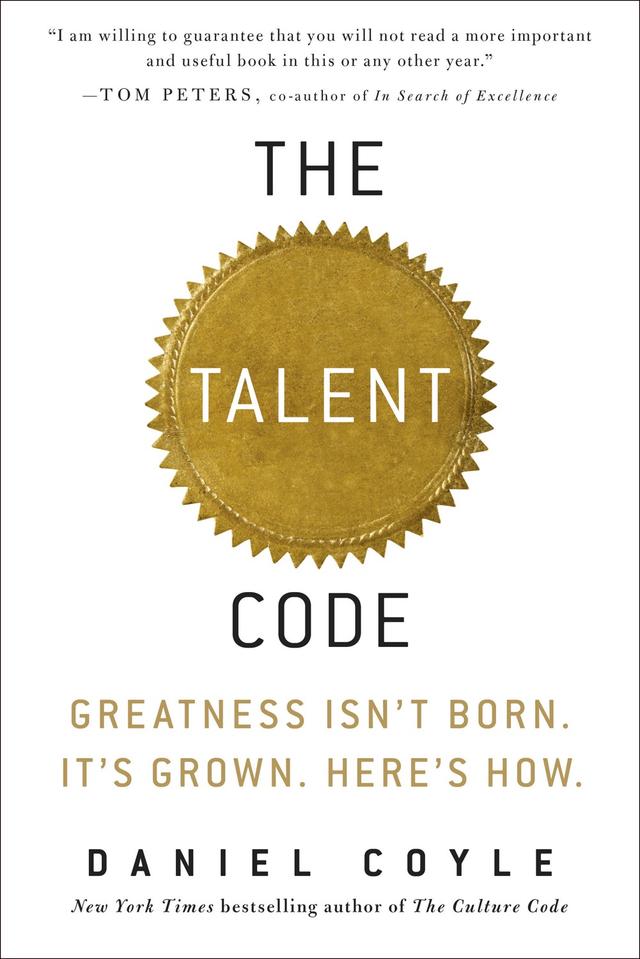
The Talent Code
What It’s About
Talent is grown, not born. Daniel Coyle visits the world's hotbeds of skill, from Brazilian soccer pitches to Russian tennis academies, and identifies the three ingredients producing world-class performers: deep practice, ignition, and master coaching. The neuroscience of skill acquisition, told through field reporting.
Three Key Ideas
Myelin Builds Skill
Every nerve fiber you fire correctly grows a thicker myelin sheath, physically converting deliberate practice into speed, precision, and fluency.
Deep Practice Through Struggle
Skill grows fastest when you practice at the edge of failure, slow down hard passages, and correct errors before repeating them.
Ignition and Master Coaching
A spark of identity-level motivation and a coach who diagnoses gaps rather than cheers are the fuel and accelerant that make deep practice sustainable.
Read a Sample
The Talent Code
In the summer of 2006, a journalist named Daniel Coyle flew to Moscow to watch eight-year-olds play tennis. Not to watch them compete. There were no tournaments, no rankings, no trophies for the smallest players at Spartak Tennis Club. The coach who ran the program, a woman in her seventies named Larisa Preobrazhenskaya, had decided decades earlier that young children should not play matches at all for the first three years of their training. No competition. No scoreboard. Just practice. Coyle found her in a cramped indoor facility on the edge of the city, watching a small girl struggle through a forehand rally, stopping her every few strokes to correct the angle of her wrist. The court was modest: worn green paint, a sagging net, fluorescent lighting that buzzed faintly overhead. None of it looked like a factory for champions. And yet Preobrazhenskaya had been doing this since 1962, and her former students included Anna Kournikova and Marat Safin. This single club had produced an astonishing fraction of the world's top professional players.
Coyle had not come to Russia to write about tennis. He had come chasing a question that had been bothering him for years: where does talent come from, and why does so much of it seem to cluster in strange, unlikely places? Why would a single tennis club in a mid-sized Moscow suburb produce more elite players than entire nations? Why would a small island in the Caribbean produce more major-league baseball players per capita than virtually anywhere on earth? Why would a village in South Korea have more top-ranked female golfers than most developed countries combined? These were not random statistical anomalies. They were patterns, and patterns have causes.
Who It’s For
- Anyone who wants to understand the neuroscience behind why deliberate practice works.
- Anyone who coaches, teaches, or raises children and wants to structure better learning environments.
- Anyone frustrated by slow progress in a skill and looking for a more effective practice method.
- Anyone curious about why certain schools, clubs, or countries consistently produce world-class performers.
About the Author: Daniel Coyle
Daniel Coyle is an American journalist and author known for writing about human performance and skill development. He is a contributing editor at Outside magazine and has reported from talent hotbeds across five continents.
In addition to The Talent Code, Coyle has written about team culture and organizational excellence. His work is grounded in field reporting and interviews with scientists, coaches, and practitioners rather than purely theoretical argument.