Ch. 1free to read
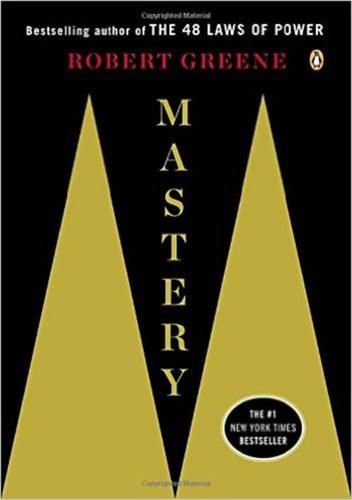
Mastery
What It’s About
This book debunks the myth of talent and shows you that there are proven steps you can take to become a master.
"Become who you want to be by learning who you are."
Robert Greene is a bestselling author of 4 NYT bestsellers between 1998 and 2009. Mastery, published in 2012, is not only his own account of the journey to becoming a writing master, but the journey every master must take. We imagine that creativity and genius just appear out of nowhere, the fruit of natural talent, perhaps good humour or a confluence of stars. It would help enormously if we could unravel the mystery - name this sense of power, examine its roots, determine what intelligence leads to it, and understand how it can be produced and sustained. Let's call this feeling mastery - the feeling of being more in control of reality, of other people and of oneself. Although we may only experience it for a short time, for others - masters in their field - it becomes a way of life, a way of seeing the world. (Such masters include Leonardo da Vinci, Napoleon Bonaparte, Charles Darwin, Thomas Edison and Martha Graham.) And at the root of this power is a simple process that leads to becoming a master - a process that is available to all of us.
Three Key Ideas
Life's Task and Calling
Every person has a unique set of innate inclinations that, when identified and pursued, provide the motivation to endure the decades of work mastery requires.
Deliberate Apprenticeship
Mastery demands roughly ten to twenty thousand hours of focused, uncomfortable practice targeting weaknesses, not repeating existing strengths.
Intuition as Fused Knowledge
At the final stage, accumulated knowledge and pattern recognition merge into rapid intuition that looks like genius but is the direct product of sustained deep work.
Read a Sample
The Sculptor and the Stone
In April 1519, a sixty-seven-year-old man lay dying in a stone château in the Loire Valley, the personal guest of the King of France. Leonardo da Vinci had been born illegitimate, barred from university and never formally trained. The notebooks by his bed held sketches of human hearts, flying machines, fetal anatomy, river hydraulics, optics and the geology of cliffs. In his prime, Michelangelo had mocked him for failing to finish a bronze horse. He'd been passed over when Florence's leading painters were sent to decorate the Sistine Chapel. And yet the King had crossed the bedroom to hold his hand, because on that day Leonardo had something the King didn't: command. Command of his mind, of his materials, and of the world he'd spent six decades looking into.
That command is what Robert Greene means by mastery, and his book's argument is brutally simple. What Leonardo had isn't out of your reach. It isn't the talent, because talent is a myth, or rather a misdescription. What he had was time, focus and a calling he wouldn't give up. Six million years of evolution built the human brain to do exactly what he did. Most people opt out. Greene wrote *Mastery* to convince you that opting out is the only real failure, and to map the way back.
He opens with a quiet provocation. We've been sold, he says, on every shortcut humans have ever come up with: drugs, rituals, productivity hacks, ten-day courses, ancient secrets finally revealed. The wall between us and mastery, the one the shortcuts claim to break through, isn't real. There's no wall. There's only the brain we already have, and the question of whether we'll use it the way it was designed to be used. That means slowly, patiently, with deep focus, over a lifetime.
Who It’s For
- Anyone who suspects their career does not reflect what they actually care about.
- Anyone who wants to understand the real mechanics behind exceptional achievement in any field.
- Anyone who feels stuck mid-career and needs a practical framework for breaking through to deeper competence.
- Anyone who is early in their professional life and wants to invest their time and effort where it will compound most.
About the Author: Robert Greene
Robert Greene is an American author best known for a series of books on power, strategy, and human behavior. He studied classical literature at the University of Wisconsin and worked as a writer and editor in Hollywood and New York before publishing his first book.
His books draw on historical biography, psychology, and philosophy to extract practical principles. Mastery, published in 2012, followed his earlier works on power and seduction and is based in part on extended interviews with living masters across fields ranging from neuroscience to architecture to combat sports.