Ch. 1free to read
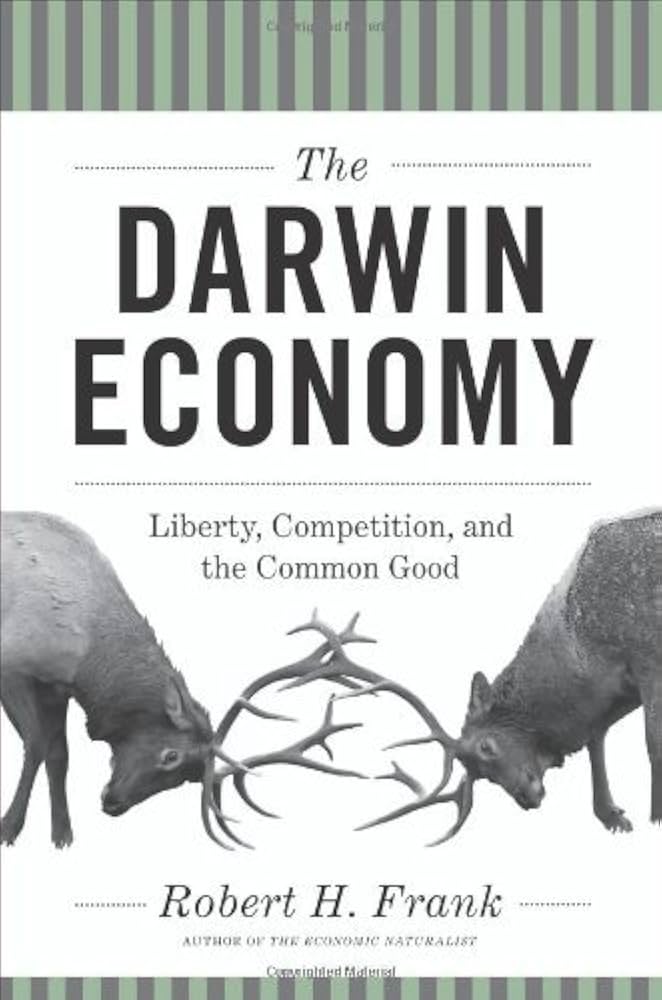
The Darwin Economy
What It’s About
Who was the greater economist—Adam Smith or Charles Darwin? The question may seem absurd. This is because Darwin’s concept of competition describes economic reality much more accurately than Smith's. This fact has profound consequences. If we don’t recognize that we live in Darwin’s world, not Smith’s, it could put all of us in danger, as we fail to realize that competition alone doesn’t solve our problems.
Three Key Ideas
Darwin Over Smith
Individual competition often harms the group, making Charles Darwin's model of rivalry a more accurate guide to markets than Adam Smith's invisible hand.
Positional Spending Trap
People waste resources on status-signaling goods that raise relative standing without making anyone better off, while underfunding shared public goods.
Role of Luck in Success
Success depends far more on chance than effort or talent, which undermines the moral case against redistribution and progressive taxation.
Read a Sample
The book in 3 sentences: People want an edge over one another, but the government has to fight for everyone.
Success in life often comes down to luck and chance, not talent and hard work.
People waste money on "positional" spending that raises their relative status. "Non-positional" spending on things like security and clean air, though, would benefit everyone. Favorite quotes: “Ignorance more often breeds confidence than knowledge.” “The essence of instincts is precisely that they are followed regardless of reason.” “It is not the strongest species that survive, nor the most intelligent. It is the one that is most adaptable to change.”
Stagnation.
Over recent decades, living standards for many Americans have stalled. Wages have stagnated, the gap between rich and poor keeps widening, and infrastructure is deteriorating. Climate change is denied, and there's little willingness to invest in easing unemployment and reviving the economy. They're all social problems in the United States. A widespread but false belief makes things worse: that the government is the source of every problem. That belief gets in the way of action and solutions. The inaction itself comes from a basic misunderstanding of what competition really is.
Who It’s For
- Anyone who wants to understand why free markets alone cannot solve collective-action problems.
- Anyone who is curious about how evolutionary biology explains economic behavior and competition.
- Anyone who wonders why wealthy societies chronically underinvest in infrastructure and public goods.
- Anyone who questions trickle-down economics and wants evidence-based alternatives to current tax policy.
About the Author: Robert H. Frank
Robert H. Frank is a professor of economics at Cornell University's Johnson Graduate School of Management. He has written widely on behavioral economics, inequality, and the gap between individual incentives and social welfare.
Frank is known for applying evolutionary thinking to economic questions, arguing that many market failures stem from the same competitive dynamics Darwin observed in nature. His work draws on decades of research into consumption, taxation, and the structure of modern labor markets.