Ch. 1free to read
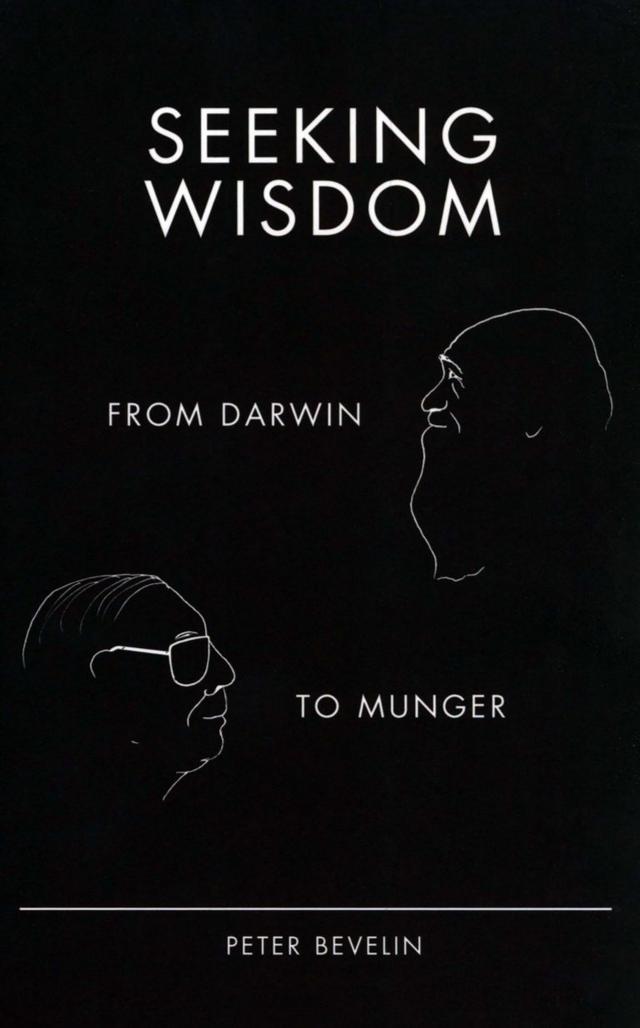
Seeking Wisdom: From Darwin To Munger
What It’s About
The book Seeking Wisdom: From Darwin to Munger is for those who constantly seek knowledge.
Three Key Ideas
Psychology of Poor Decisions
The book catalogs 28 cognitive biases, from anchoring to social proof, that systematically lead people into bad judgments.
Evolution Shapes Our Thinking
Human behavior is rooted in natural selection, which wired the brain for survival and reproduction rather than rational deliberation.
Models and Principles for Better Judgment
Applying mental models from physics, mathematics, and multiple disciplines helps reduce misjudgments and sharpen decision-making.
Read a Sample
The book in 3 sentences: Why do we behave the way we do? What do we expect from life? What stands in the way of reaching our goals? Favorite quotes: “A bull market is like sex. It feels best just before it ends.” “Praise by name, criticize by category.” “A wise person sees as much as necessary, not as much as possible.”
Key points: How does the human mind work? Evolution and adaptive behavior. 28 psychological reasons behind bad decisions. 9 physical and mathematical principles to reduce judgment errors. 12 guidelines for better thinking.
Charles Munger once said, *"I just want to know where I’m going to die so I never go there."* Some paths lead to dissatisfaction. Knowing how and why we might "fail" helps us stay off them. We can't avoid every mistake, but we can steer clear of the ones that could really hurt us. How Does the Human Mind Work?
Our thinking is shaped by the brain: its anatomy, physiology, and biochemistry, and the way these interact. And since the brain works hand in hand with the body's own anatomy, physiology, and biochemistry, we can't study one without the other. They're all part of the same system.
The Interconnection and Interaction of Systems
Who It’s For
- Anyone who wants to understand why smart people consistently make predictable mistakes.
- Anyone who wants to apply Charlie Munger's multidisciplinary thinking to everyday decisions.
- Anyone who is curious about how evolution and neuroscience shape human behavior and judgment.
- Anyone who wants a practical, checklist-driven framework for clearer thinking and risk reduction.
About the Author: Peter Bevelin
Peter Bevelin is a Swedish author and investor known for his work on rational thinking and decision-making. He spent years studying the writings of Charles Munger and Warren Buffett alongside foundational texts in biology, psychology, and physics.
Bevelin writes for a general audience and is best known for synthesizing ideas across disciplines into practical frameworks. He is not affiliated with any academic institution and keeps a deliberately low public profile.