Ch. 1free to read
Procrastination
What It’s About
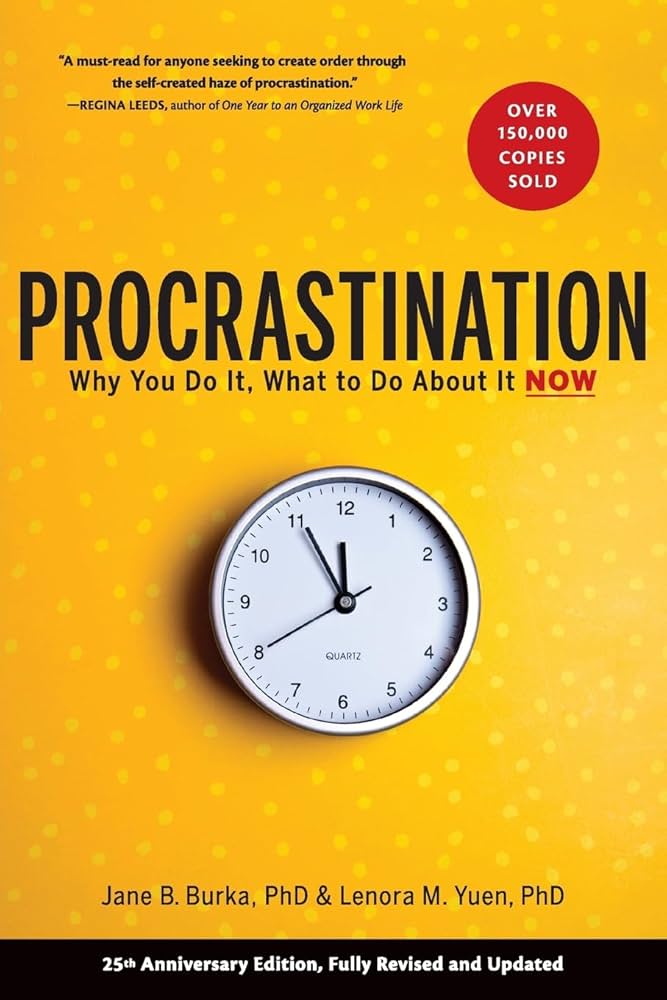
Procrastination delves deeply into procrastination and why people struggle with it. Drawing on personal and professional experiences, it offers a proven program and tips for overcoming the tendency to procrastinate.
Three Key Ideas
Procrastination Protects the Self
Procrastination is not a time-management failure but a way of shielding your self-worth from the threat that finishing something might expose.
The Procrastinator's Code
Unconscious beliefs like "I must be perfect" and "if it's not done right, it's not worth doing" keep avoidance running far more than laziness ever could.
Subjective Time and the Un-Schedule
Procrastinators live in distorted subjective time, and the Un-Schedule rebuilds a realistic, finite sense of the week by logging only completed work.
Read a Sample
When Tomorrow Becomes a Strategy
Some people can describe, in vivid detail, the project they haven't started. They know its structure. They know the opening paragraph. They've already lived through the moment of handing it in. The only thing they haven't done is the work. If that sounds like someone you know (or like you, all morning), Jane Burka and Lenora Yuen's book is a long, patient explanation of why you keep doing this. It skips the moralizing that usually comes along for the ride on this subject.
Burka and Yuen are clinical psychologists who first wrote about procrastination in 1983. In 2008, after years of running workshops, seeing patients, and watching the internet do unprecedented damage to the modern attention span, they put out a heavily revised twenty-fifth anniversary edition. As they bluntly note in that update, avoidance behavior has increased over the years, and the internet is the single most powerful cause. There's too much information, too many decisions, too many options, and a quiet slide into what they call procrastination paralysis. The book's argument is deceptively simple: procrastination isn't a time-management problem. It's a way of protecting yourself. Once you accept that, you stop trying to fix it with planners and start asking the right question. What, exactly, are you protecting yourself from?
Procrastination as Nuisance, and Then as Nemesis
The authors start by drawing a line most readers don't usually draw. On one side is procrastination that's a mild inconvenience. On the other is procrastination that has quietly become the organizing principle of your life. Nuisance procrastination is the friend who shows up late, the report turned in the morning it's due, the gym bag that sits in the trunk for two weeks. Nemesis procrastination is the dissertation that's been "almost done" for four years, the tax return that sets off a panic attack, the relationship someone won't end because starting the conversation feels too final.
Who It’s For
- Anyone who keeps promising themselves they will start tomorrow and genuinely wants to understand why.
- Anyone who suspects perfectionism is behind their chronic delays rather than laziness or poor discipline.
- Anyone in a relationship with a procrastinator and trying to break the cycle of nagging and standoffs.
- Anyone whose procrastination has moved from a mild annoyance into a serious obstacle at work or in life.
About the Author: Jane B. Burka
Jane B. Burka and Lenora M. Yuen are clinical psychologists who began researching procrastination in the early 1980s and ran workshops on the subject for decades. They first published this book in 1983, making it one of the earliest serious psychological treatments of the topic.
Their work draws on years of clinical practice with patients whose procrastination ranged from mild inconvenience to a pattern that had derailed careers and relationships. The 2008 revised edition added new chapters on neuroscience and the role of ADD, reflecting how their thinking evolved over a quarter century of practice.