Ch. 1free to read
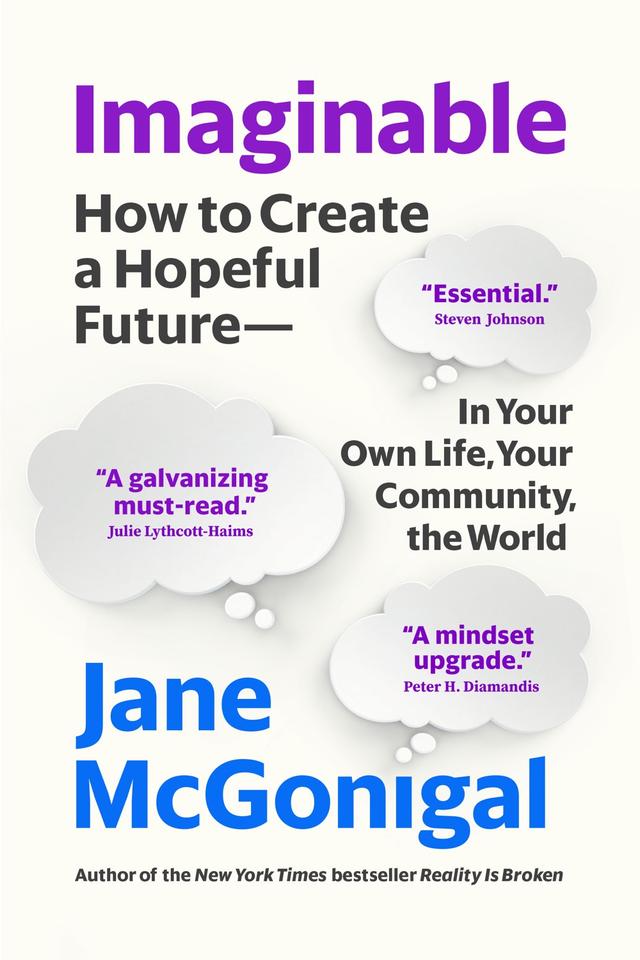
Imaginable
What It’s About
Game designer Jane McGonigal teaches you to mentally rehearse the unthinkable so you stop being blindsided by it. Drawing on a decade of "future-thinking" workshops at the Institute for the Future, she shows how a structured imagination practice quiets panic, sharpens agency, and turns crisis into creative material. Practical exercises help you stretch your time horizon to ten years and pre-feel scenarios most people would rather avoid.
Three Key Ideas
Imaginative Fitness Is Trainable
McGonigal argues that imagining vivid, specific futures is a learnable skill that builds mental resilience before crises arrive.
Episodic Future Thinking
Mentally pre-living detailed future scenarios activates distinct brain regions and measurably boosts willpower, creativity, and long-term motivation.
Signals and Future Forces
Spotting small, real-world signals of change and tracking large-scale future forces lets ordinary people act early instead of being blindsided.
Read a Sample
In April of 2020, in the first months of the pandemic, the World Bank called Jane McGonigal. The man on the line was Robert Hawkins, a senior executive who had once hired her to design a ten-week online simulation called EVOKE. That simulation had taken place a full decade earlier, in 2010, and it had asked roughly twenty thousand players to imagine the year 2020. A year shaped by a respiratory pandemic that began in China. A wave of conspiracy theorists who organized on social media. Historic wildfires across the American West. An electric grid that buckled under the strain of aging infrastructure and extreme weather. Hawkins had just been comparing the EVOKE storylines to his morning newsfeed. His question was direct and slightly stunned. "How did you get so much right?"
That phone call is the most quietly thrilling moment in *Imaginable*. McGonigal does not frame it as prophecy or a magic trick. She frames it as the natural result of doing one thing well, repeatedly, for fifteen years. Imagining specific, vivid, uncomfortable futures, and then living with them long enough for the brain to file them under "familiar." Her argument across the entire book is that this capacity, which she calls *imaginative fitness*, is trainable the way physical fitness is trainable. We have spent so long treating imagination as a personality trait that we have missed the obvious: it is a muscle, and most adults have not done a serious set since college. The rest of the book is, in effect, a gym membership. Ten rules, each one tied to a piece of neuroscience and a piece of homework, designed to lift your score on three baseline questions she will ask you in the first chapter and ask you again at the end.
Who It’s For
- Anyone who wants to feel less anxious and more prepared when major disruptions hit.
- Anyone who struggles with long-term planning or finds the future too uncertain to think about clearly.
- Anyone who works in strategy, education, or public policy and needs practical foresight tools.
- Anyone who wants concrete exercises to build personal agency and resilience over the next decade.
About the Author: Jane McGonigal
Jane McGonigal is a game designer and futurist who has spent over fifteen years at the Institute for the Future developing workshops, simulations, and research on how people imagine and prepare for what comes next. Her earlier book "Reality Is Broken" made the case that games can solve real-world problems, and she has brought that same practical, evidence-based lens to futures thinking.
She has led future-scenario workshops for tens of thousands of participants worldwide, including students at Stanford Continuing Studies and participants in large-scale online simulations. Her work draws on neuroscience, behavioral research, and decades of applied futures practice.