Ch. 1free to read
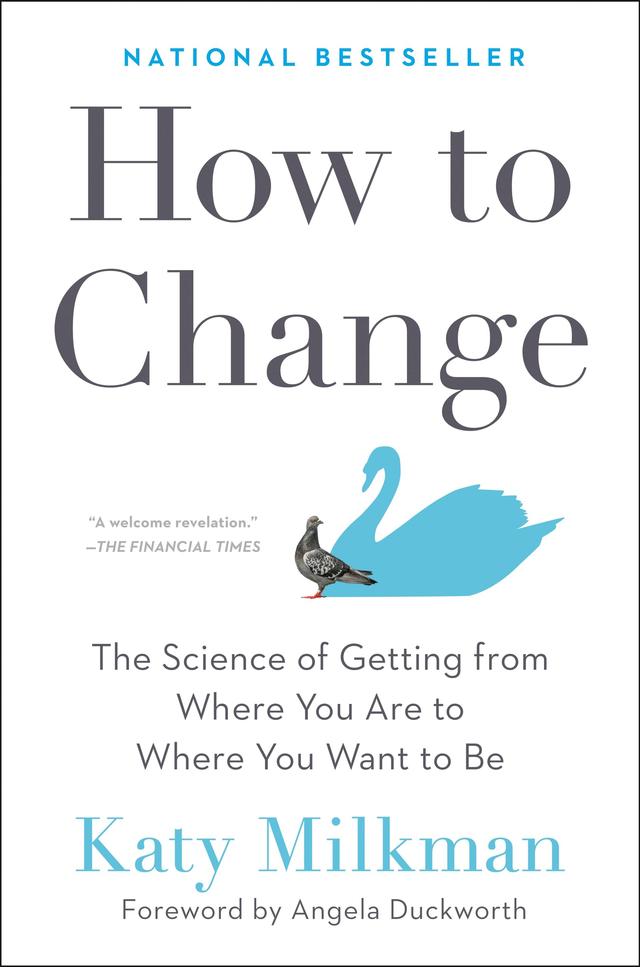
How To Change
What It’s About
How to Change serves as a simple guide for achieving our goals. It diagnoses our most stubborn problems, from laziness to impulsivity, and provides research-backed solutions for each.
Three Key Ideas
Scout Your Own Weaknesses
Lasting change requires diagnosing your specific inner obstacles first, then matching a targeted tactic to each one.
Fresh Starts and Commitment Devices
Psychological new beginnings open motivation windows, and locking in decisions early prevents your future self from backing out.
Make Good Behavior Easy and Fun
Defaults, habits, and temptation bundling reduce the daily willpower cost of better choices until the behavior runs on autopilot.
Read a Sample
How to Change: Katy Milkman
In 1994, Andre Agassi was falling apart in slow motion. His world ranking had skidded from seventh to twenty-second to thirty-first. His coach had walked. He was telling friends he hated tennis. Then his manager set up a dinner with a journeyman named Brad Gilbert, a player who had peaked at fourth in the world and then written a book called *Winning Ugly*. Fifteen minutes into the meal, Gilbert had already named Agassi's flaw. You try to hit a winner on every ball, he said. You learned it from your father, the Olympic boxer who screamed "hit harder, hit earlier" across the court. Stop thinking about yourself. The guy on the other side of the net has weaknesses. Make him fail. Better yet, let him fail. Agassi turned to his manager and said, "That's our guy."
Months later, Agassi entered the U.S. Open unseeded. He scouted every opponent for tells, and he walked out the first unseeded champion in twenty-eight years. He went on to hold the world's number one ranking for one hundred one weeks. Gilbert had told him to stop trying to hit a winner on every ball and to scout the player across the net.
Katy Milkman opens her book with that story because she thinks most advice about change is the tennis version of "hit harder." Eat less. Save more. Try again. Try harder. A generic playbook works on average, the way a generic tennis playbook works on average. But the people who actually change are the ones who scout their own weaknesses first and then build a tactic against each one.
Milkman is a behavioral scientist at the Wharton School, an engineer by training who fell into economics through a graduate microeconomics course. There she discovered that roughly forty percent of premature deaths in the United States trace back to changeable personal behaviors. Smoking. Diet. Drinking. Exercise. Sex. Driving. That single statistic became her career. She runs the Behavior Change for Good Initiative with Angela Duckworth. The effort gathered more than a hundred researchers across economics, medicine, law, sociology, and computer science to find out what actually moves human behavior. This book is her field guide. Each chapter takes one inner opponent (getting started, impulsivity, procrastination, forgetfulness, laziness, low confidence, conformity) and gives you the counterpunch.
Who It’s For
- Anyone who has set the same goal multiple times and wants to understand why it keeps failing.
- Anyone who manages a team or organization and wants evidence-based tools to shift group behavior.
- Anyone who struggles with procrastination, impulsivity, or low motivation and needs a concrete action plan.
- Anyone who is curious about behavioral science and wants research translated into practical daily strategies.
About the Author: Katy Milkman
Katy Milkman is a behavioral scientist and professor at the Wharton School of the University of Pennsylvania. Her research focuses on why people fail to act in their own best interests and what interventions actually move behavior at scale.
She co-founded the Behavior Change for Good Initiative alongside Angela Duckworth, a collaboration that brought together more than a hundred researchers across economics, medicine, law, and computer science to study human motivation and change.