 English
 Magyar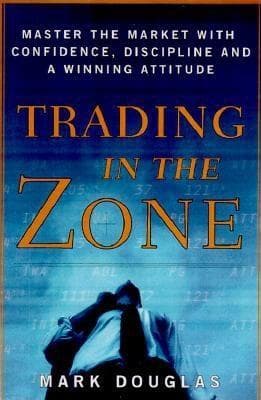
Trading in the Zone
Mark Douglas
Free download · 500+ book summaries
What is Trading in the Zone about?
Trading in the Zone reveals the underlying reasons for the lack of consistency and helps traders overcome ingrained mental habits that cost them substantial amounts of money.
Key ideas of Trading in the Zone
Psychology Drives Trading Results
Most traders fail not from poor analysis but from fear-based mental habits that prevent them from executing what they already know.
Thinking in Probabilities
Treating each trade as one in a series with a probable outcome, like a casino, removes the emotional charge from individual wins and losses.
Beliefs Shape What You Perceive
Deeply held beliefs filter market information before it reaches conscious awareness, making distorted perception the root cause of consistent losses.
Read an excerpt from the summary
Trading in the Zone — Mark Douglas
The Problem Nobody Wants to Hear
Here is a number that should stop any aspiring trader cold: roughly ninety-five percent of futures traders lose all of their money within the first year. These are not lazy people. Many are doctors, lawyers, engineers, CEOs, and successful entrepreneurs, some of the brightest and most disciplined people in society. The markets take their money anyway.
Mark Douglas spent more than seventeen years trying to understand why. He started trading in 1978 while running a commercial insurance agency outside Detroit, moved to Chicago in 1981, and lost nearly everything within nine months. That failure became his life's work. He founded Trading Behavior Dynamics and coached market-makers and major firms. *Trading in the Zone*, published in 2000, is the clearer of his two books on the subject.
His conclusion is blunt and, at first, hard to swallow. Trading is roughly eighty percent psychology and twenty percent mechanics. Most traders fail not because their analysis is wrong but because they cannot actually execute what they know. You can have a system that works and still bleed money for years, because the real game is not happening on the chart. It is happening between your ears.
Three Kinds of Analysis, Two of Them a Trap
When a new trader hits a losing streak, the instinct is universal: learn more, find a better indicator, study harder. Douglas argues this points you in exactly the wrong direction, and to see why, he splits the trading world into three kinds of analysis.
Fundamental analysis came first. It uses mathematical models that weigh variables like interest rates and balance sheets to project where a price should go. Its fatal flaw is that these models almost never factor in other traders. As Douglas puts it, people, expressing their beliefs about the future, make prices move, not models. A floor trader who knows nothing about supply and demand can move a market on pure emotion. That creates a reality gap, the space between what should be happening and what is.
Like it?
Continue in the appWho is it for?
- Anyone who keeps losing money despite having a solid trading system and good market knowledge.
- Anyone who freezes, hesitates, or second-guesses entries and exits under real market conditions.
- Anyone who wants to understand why discipline and emotional control matter more than technical skill in trading.
- Anyone who has ever sabotaged a winning streak or held a losing position far past the point of reason.
About the author: Mark Douglas
Mark Douglas spent over two decades studying trading psychology and coaching professional traders and market-makers. He founded Trading Behavior Dynamics and worked directly with floor traders at major Chicago firms.
He began trading in 1978, experienced significant early losses, and turned that failure into a lifelong focus on the mental side of markets. His two books on trading psychology are widely read among both retail and professional traders.
Read it in 47 minutes
The summary of Trading in the Zone and 500+ more books await in the BookBase app.