 English
 Magyar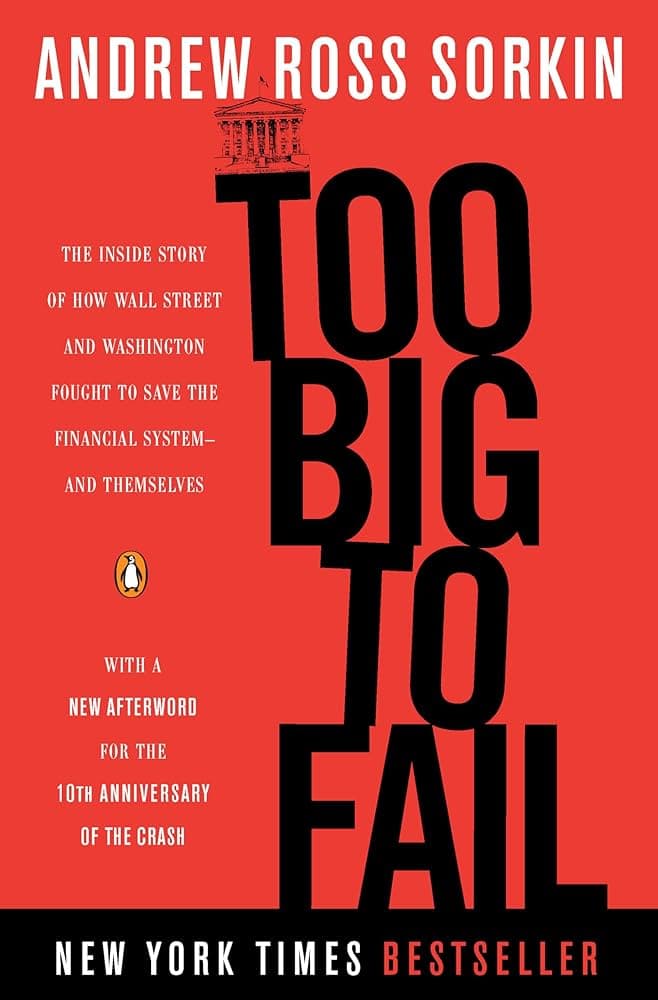
Too Big to Fail
Andrew Ross Sorkin
Free download · 500+ book summaries
What is Too Big to Fail about?
Too Big to Fail takes the reader deep into the heart of the 2008 financial crisis, revealing the high-stakes decisions and power struggles that shaped the global economic landscape at the time. This gripping narrative unravels the complex web of financial intrigues and helps to understand the forces that were driving one of the most tumultuous periods in financial history.
Key ideas of Too Big to Fail
Leverage as a Death Trap
Wall Street firms borrowed thirty-two dollars for every dollar they owned, leaving no cushion when housing prices stopped rising.
Executives Who Felt Untouchable
Nearly every catastrophic decision came from leaders who stopped questioning assumptions that applied to everyone but themselves.
Crisis Decided by Exhausted People
The fate of the global financial system was settled in conference rooms and on cell phones by a small group acting on incomplete information.
Read an excerpt from the summary
The Saturday Morning Phone Call
It is seven o'clock in the morning on Saturday, September 13, 2008, and Jamie Dimon — chief executive of JP Morgan Chase, the third-largest bank in America — is standing in his Park Avenue kitchen nursing a hangover. The night before, he had been across town at the Federal Reserve Bank of New York with about a dozen rival Wall Street CEOs, brainstorming a private rescue of Lehman Brothers. By Sunday night, Lehman would be a corpse. Within a week, Merrill Lynch would be swallowed by Bank of America, AIG would be ninety days from a federal seizure, and the last two independent investment banks in the country would beg to be turned into something they had spent decades despising: ordinary commercial banks.
At seven thirty Dimon dials two dozen members of his management team. "You are about to experience the most unbelievable week in America ever," he tells them, "and we have to prepare for the absolutely worst case." Then he pauses, and reads a list. Lehman. Merrill Lynch. AIG. Morgan Stanley. Goldman Sachs. Five firms, all filing.
There was, Sorkin writes, a collective gasp on the phone.
That gasp is the spine of Andrew Ross Sorkin's *Too Big to Fail*. The book covers about six months, March through October 2008, but it is really about a question that has nothing to do with derivatives: how a small number of unbelievably powerful men, most of whom had known each other for decades, made decisions in conference rooms and on cell phones and over plastic bottles of Diet Coke that determined whether the global financial system would survive the weekend. Sorkin had access that almost nobody else had. He talked to virtually everyone in the room. The book reads like a thriller because, for those months, the people inside it were living inside one.
Like it?
Continue in the appWho is it for?
- Anyone who wants to understand what actually caused the 2008 financial crisis from the inside.
- Anyone who leads a team and wants a case study in how groupthink and unchecked loyalty destroy institutions.
- Anyone interested in how Wall Street, the Treasury, and the Federal Reserve interact under extreme pressure.
- Anyone who wants to understand why leverage is the single most dangerous variable in any financial system.
About the author: Andrew Ross Sorkin
Andrew Ross Sorkin is a financial journalist and author who serves as a columnist and editor-at-large at The New York Times, where he founded the DealBook financial news service. He is also a co-anchor on CNBC's Squawk Box.
For Too Big to Fail, Sorkin conducted hundreds of interviews with the central figures of the 2008 crisis, gaining access to conversations and internal deliberations that most journalists never reached. His reporting background in corporate dealmaking gave him both the sourcing and the technical fluency to reconstruct those events in precise detail.
Read it in 45 minutes
The summary of Too Big to Fail and 500+ more books await in the BookBase app.