 English
 Magyar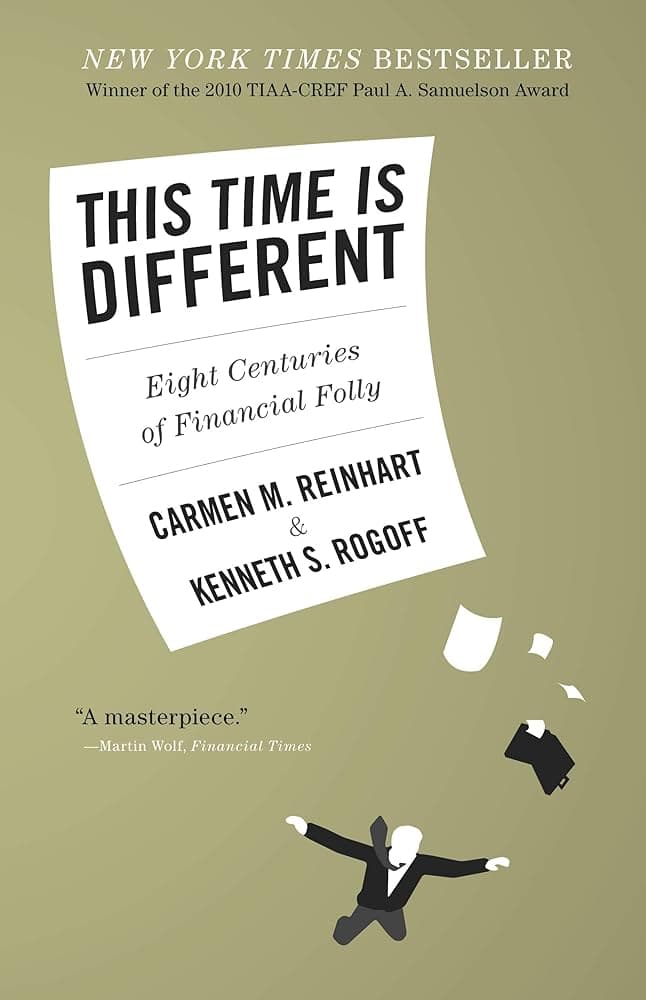
This Time is Different
Carmen Reinhart
Free download · 500+ book summaries
What is This Time is Different about?
This Time Is Different provides a comprehensive overview of the different types of financial crises, guiding us through eight centuries of sovereign defaults, banking panics, and inflationary spikes—from medieval currency debasements to today's subprime disaster.
Key ideas of This Time is Different
Crises Are the Norm
Eight centuries of data show that financial crises are a near-constant of economic life, not rare exceptions confined to poor or careless countries.
Debt Intolerance Trap
Countries with weak institutions often default at surprisingly low debt levels because market confidence collapses long before the underlying math becomes impossible.
Domestic Debt Is the Missing Link
Governments routinely hide half their liabilities by excluding domestic debt, which explains why defaults and inflation episodes are far more severe than they appear.
Read an excerpt from the summary
Sometime around the collapse of Long-Term Capital Management in 1998, a trader sat in a Federal Reserve board meeting and said something that would later become the title of a book. More money has been lost because of four words, he told the room, than at the point of a gun. The four words are this time is different.
That trader's line is the spine of Carmen Reinhart and Kenneth Rogoff's 2009 history of financial disasters. They didn't invent the phrase. They just spent the better part of a decade proving how reliably it gets quoted right before everything falls apart. Across eight hundred years and sixty-six countries, the same conviction shows up at every market peak. The new financial product is safer than the old one. The new monetary regime has finally tamed inflation. The new generation of regulators has finally outsmarted the cycle. And then the bill arrives, on time, as it always has.
The book is not a polemic. It is, in fact, a database with a story wrapped around it. Reinhart and Rogoff assembled price series going back to the 1200s, sovereign default records from the Italian city-states, public debt figures dug out of yellowing League of Nations yearbooks, and inflation data scraped from colonial archives. What they found is so consistent it should be embarrassing. Financial crises are not rare. They are not exotic. They are not the property of poor countries or careless ones. They are something close to a constant of human economic life, and the only thing that changes is which excuse people use to ignore them.
What Counts as a Crisis
Before they could count crises, the authors had to define them, and they were careful about this because vague definitions are how you lose arguments to skeptics. They settled on four broad types. A sovereign external default is when a government fails to pay its foreign creditors on time. A banking crisis is when a meaningful chunk of the banking sector becomes insolvent, either through panic-driven runs or through quieter collapses where one institution closes and pulls others down with it. A currency crash is when a currency loses a large share of its value against the dollar or another anchor inside a short window. An inflation crisis is an episode of severe price increases, which the authors treat as a soft form of default since lenders are paid back in money worth less than what they handed over.
Like it?
Continue in the appWho is it for?
- Anyone who wants to understand why financial crises keep repeating despite warnings from history.
- Anyone who works in finance, economics, or policy and wants a data-grounded account of how sovereign defaults unfold.
- Anyone who has heard the phrase this time is different and wants the evidence for why it is almost always wrong.
- Anyone curious about how banking panics, inflation, and government debt collapses are connected across eight centuries and sixty-six countries.
About the author: Carmen Reinhart
Carmen Reinhart is an economist specializing in international finance and macroeconomics, known particularly for her research on financial crises, sovereign debt, and capital flows. She has held senior positions at the World Bank and Harvard's Kennedy School, and is one of the most cited economists in the world.
Kenneth Rogoff, her co-author, is a Harvard economics professor and former chief economist of the International Monetary Fund. Together they built one of the most comprehensive historical databases of financial crises ever assembled, spanning eight centuries and sixty-six countries.
Read it in 47 minutes
The summary of This Time is Different and 500+ more books await in the BookBase app.