 English
 Magyar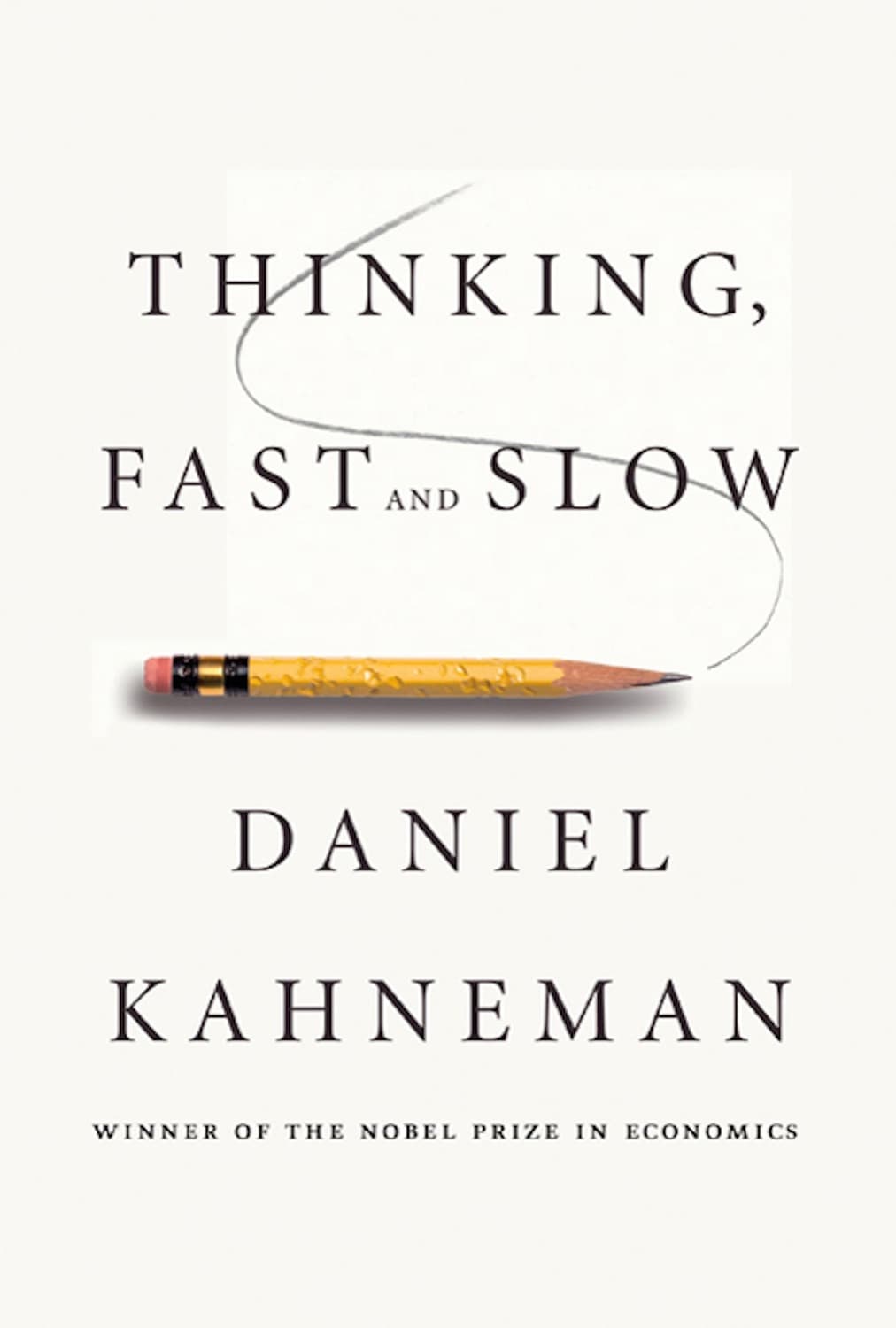
Thinking, Fast and Slow
Daniel Kahneman
Free download · 500+ book summaries
What is Thinking, Fast and Slow about?
A Nobel laureate's tour of how the mind actually works. Daniel Kahneman maps the two systems behind every decision: fast intuition (System 1) and slow deliberation (System 2). The result is the foundational text behind behavioral economics, modern psychology, and almost every cognitive bias you have ever heard of.
Key ideas of Thinking, Fast and Slow
Two Systems of Thinking
The mind runs on a fast, automatic System 1 and a slow, effortful System 2, and most errors arise because System 2 rarely checks System 1's work.
Predictable Judgment Errors
Anchoring, availability, and representativeness are reliable mental shortcuts that produce systematic, predictable mistakes in risk and probability judgment.
Loss Aversion and Prospect Theory
Losses feel roughly twice as painful as equivalent gains feel good, which distorts decisions in negotiations, markets, and everyday risk-taking.
Read an excerpt from the summary
Thinking, Fast and Slow
It is 1955, and a young Israeli psychologist named Daniel Kahneman is trying to figure out why some soldiers fail leadership training and others do not. His job is to send recruits through leaderless group challenges -- moving heavy beams, crossing obstacles, solving tactical problems as a team -- and then predict which ones will become good officers. He and his colleagues watch a recruit take charge of the beam, notice how he handles setbacks, observe whether the others follow him naturally. Then they score him and write a prediction.
The predictions turn out to be useless. Kahneman later checks them against actual officer school performance. The correlation is near zero. The scores his team produces with such confidence tell almost nothing about who will succeed. The recruits are strangers; the observations last a few hours; the social dynamics shift with every new exercise. And yet Kahneman and his colleagues sit down after each session and write their predictions with the quiet certainty of men who believe they have seen something real.
He calls this the "illusion of validity." It does not go away when you learn it exists. Years later, after a Nobel Prize, after decades of research, Kahneman says that he still makes these errors. He still feels the pull of a compelling story, still jumps to conclusions that are not justified by the evidence. His book -- published in 2011, fifty-six years after that military training ground -- is an attempt to explain why. Not to cure us of our thinking errors, but to help us recognize when we are making them.
Thinking, Fast and Slow is one of the most important books written about the human mind. It is also one of the most honest. Kahneman does not position himself above the material. He is not selling you a system for becoming a perfectly rational thinker. He is telling you, clearly and with some sadness, that you are not one -- and neither is he.
Like it?
Continue in the appWho is it for?
- Anyone who wants to understand why smart people make consistently bad decisions.
- Anyone who negotiates, invests, or sets prices and wants to recognize how anchoring shapes outcomes.
- Anyone curious about why their memories of an experience can contradict what they actually felt in the moment.
- Anyone who works in policy, medicine, or management and needs to design better decision environments.
About the author: Daniel Kahneman
Daniel Kahneman is an Israeli-American psychologist who spent his career at Hebrew University, the University of British Columbia, and Princeton University. He received the Nobel Memorial Prize in Economic Sciences in 2002 for his foundational work on judgment and decision-making under uncertainty.
Much of that work was developed in close collaboration with Amos Tversky, with whom he co-founded the field now known as behavioral economics. Their joint research on heuristics and biases, and their landmark 1979 paper on prospect theory, reshaped psychology, economics, medicine, and public policy.
Read it in 46 minutes
The summary of Thinking, Fast and Slow and 500+ more books await in the BookBase app.