 English
 Magyar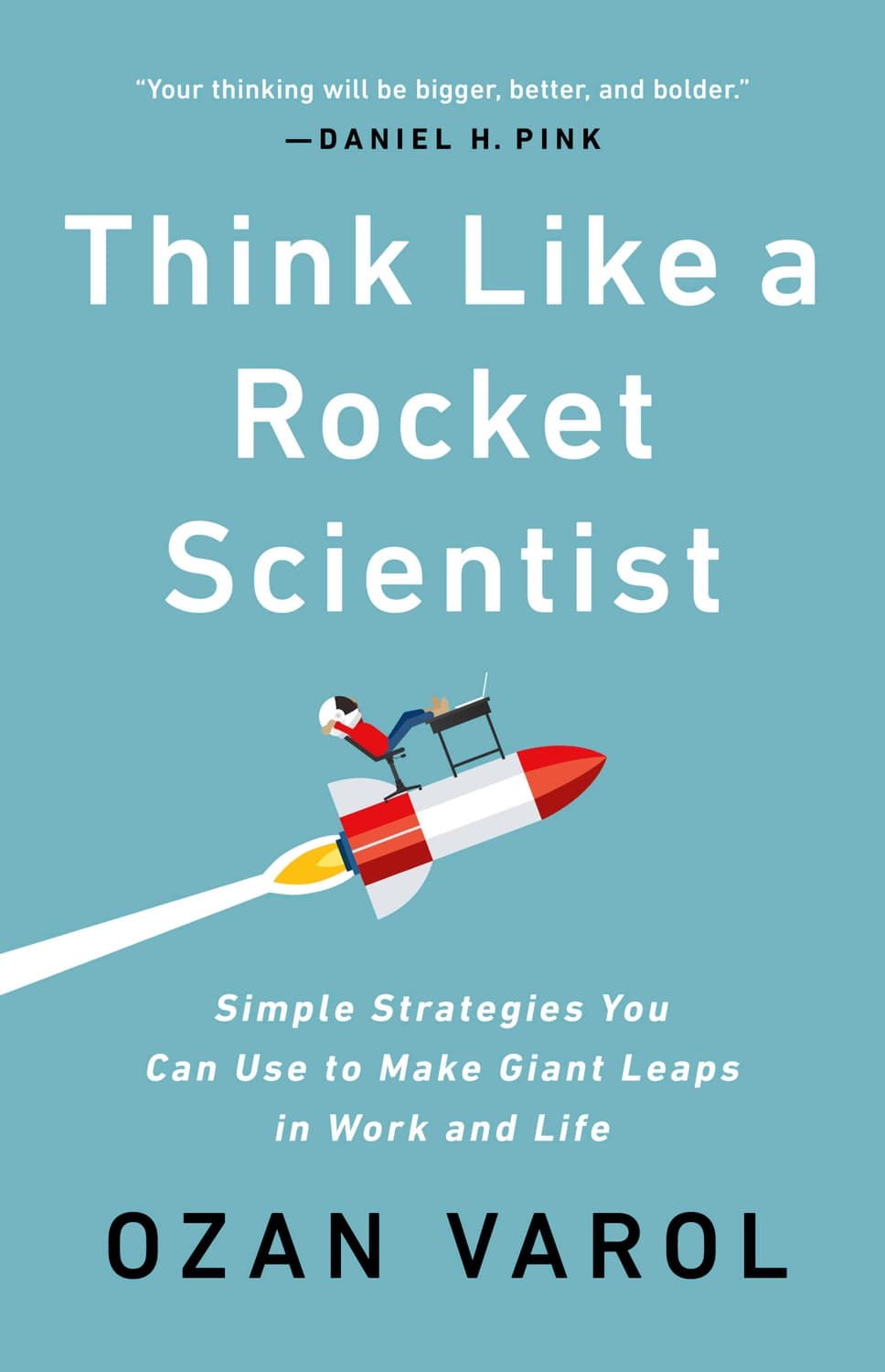
Think Like a Rocket Scientist
Ozan Varol
Free download · 500+ book summaries
What is Think Like a Rocket Scientist about?
Nine strategies for solving extraordinary problems, borrowed from rocket science. Former rocket scientist Ozan Varol distills the mental habits that put humans on the moon into transferable principles for everyday work. Embrace uncertainty, run thought experiments, test before you commit. Smart, pragmatic, surprisingly personal.
Key ideas of Think Like a Rocket Scientist
Embrace Calibrated Uncertainty
Treating uncertainty as a feature of any worthwhile path, not an obstacle, prevents the false certainty that leads organizations to ignore real risks.
First-Principles Problem Solving
Stripping away inherited assumptions to find what is actually constrained by reality, rather than by habit, opens solution spaces most people never consider.
Normalization of Deviance
Repeated anomalies that never cause immediate disaster quietly get reclassified as normal, and that gradual drift is how well-run organizations ultimately fail.
Read an excerpt from the summary
Think Like a Rocket Scientist
It is January 28, 1986, and the temperature at Cape Canaveral has dropped to 28 degrees Fahrenheit overnight. Engineers at Morton Thiokol have been on the phone with NASA managers since the previous evening, warning that the O-rings -- the rubber seals that keep combustion gases from leaking between the shuttle's solid rocket booster segments -- have never been tested below 53 degrees. They are asking to delay the launch. NASA managers push back. They have schedules to keep, budgets to justify, a presidential address that mentioned the mission. The engineers eventually relent and sign off.
Seventy-three seconds after liftoff, the Space Shuttle Challenger breaks apart. All seven crew members die.
The Rogers Commission convened to investigate the disaster. Among its members was physicist Richard Feynman, who grew frustrated watching institutional testimony designed to minimize blame rather than find truth. The NASA officials spoke in a vocabulary engineered to obscure. The engineering presentations were layered with qualifications and organizational hedges. Feynman did not ask for a new simulation or another technical review. He walked down the hall, found a cup of ice water, and dropped a small rubber O-ring sample into it. The O-ring became visibly rigid and brittle within seconds. He held it up for the room to see.
The entire cause of the disaster, demonstrated in a paper cup of ice water.
That image -- one clear, honest question cutting through an ocean of organizational complexity -- sits at the center of what Ozan Varol argues in Think Like a Rocket Scientist. The book is not about rocket science. It is about how rocket scientists think. And the difference, Varol insists, is available to anyone willing to question the right things at the right time.
Like it?
Continue in the appWho is it for?
- Anyone who wants sharper thinking tools for navigating ambiguous, high-stakes decisions at work.
- Anyone who manages teams and needs a framework for building honest, failure-tolerant cultures.
- Anyone who is stuck optimizing an existing system and suspects the real problem is the question they are asking.
- Anyone who is curious about how rocket scientists and mission planners actually think through uncertainty.
About the author: Ozan Varol
Ozan Varol is a former rocket scientist who worked on the operations team for NASA's 2003 Mars Exploration Rovers mission, helping manage the Spirit and Opportunity rovers. He later left astrophysics to study law and became a professor at Lewis and Clark Law School in Portland, Oregon.
He writes and speaks on applying the cognitive habits of rocket science to everyday decision-making, leadership, and creative problem-solving.
Read it in 47 minutes
The summary of Think Like a Rocket Scientist and 500+ more books await in the BookBase app.