 English
 Magyar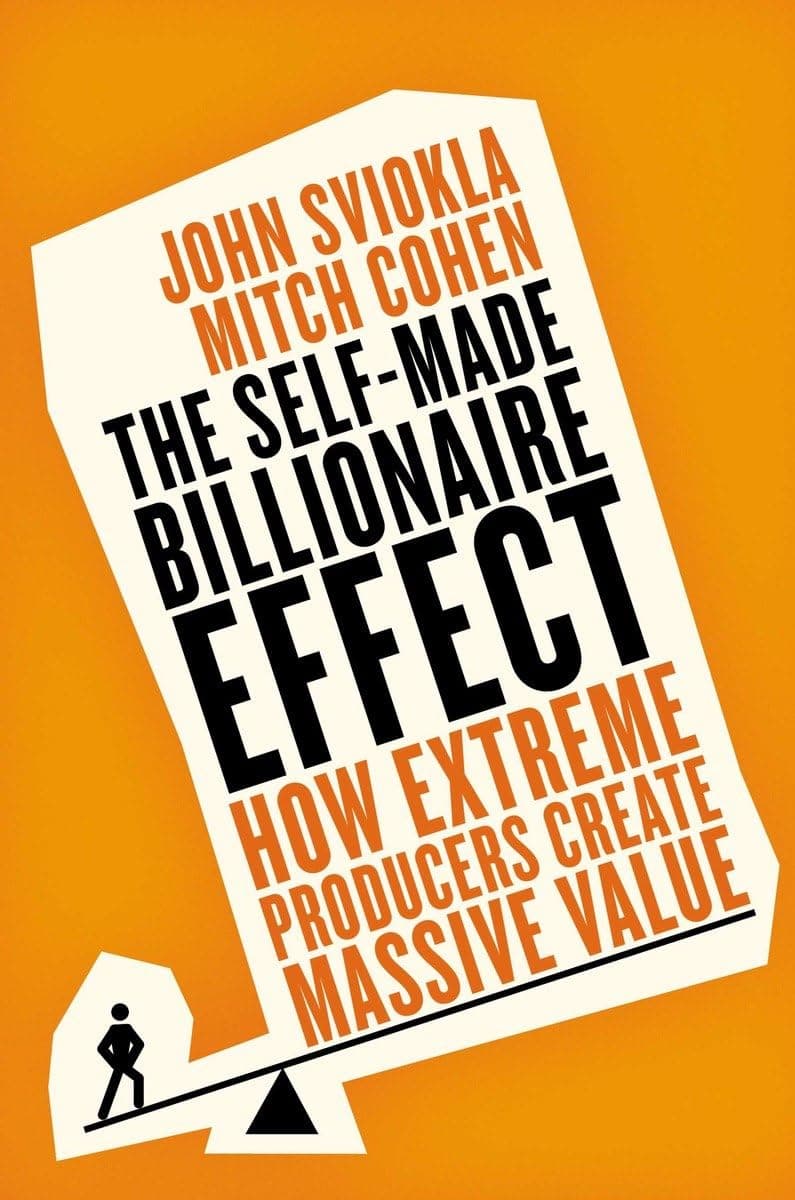
The Self-Made Billionaire Effect
John Sviokla
Free download · 500+ book summaries
What is The Self-Made Billionaire Effect about?
The Self-Made Billionaire Effect reveals the secrets of the world's most successful companies and entrepreneurs. From this book, you will learn that it’s not luck, timing, or external factors that have led some of the richest people in the world to where they are today.
Key ideas of The Self-Made Billionaire Effect
The Producer Mindset
Self-made billionaires hold judgment and imagination together at once, refusing to choose between seeing the world as it is and as it could be.
Five Core Dualities
Producers master five paired tensions: empathetic imagination, patient urgency, inventive execution, a relative view of risk, and leadership partnership.
Myths About Billionaires Debunked
Data from 120 self-made billionaires shows most were over 30, worked in mature industries, and built success through preparation rather than luck.
Read an excerpt from the summary
The Puzzle Nobody Could Explain
Here is a question that should keep every corporate boardroom up at night. The world is full of huge companies stuffed with talented people, deep pockets, and decades of market data. Yet again and again, the people who create truly staggering wealth are not these companies. They are individuals who often started out inside those very same companies, got frustrated, walked out the door, and went on to build fortunes the corporation could never have produced on its own.
Steve Jobs worked at Atari. Steve Case worked at PepsiCo. John Paul DeJoria was actually fired from a hair-care company before he built John Paul Mitchell Systems. Michael Bloomberg came up at Salomon Brothers. Mark Cuban, Mo Ibrahim, T. Boone Pickens, Stephen Ross, Michael Jaharis, all of them spent real time as employees before they became billionaires. So the obvious question is the one John Sviokla and Mitch Cohen set out to answer: why couldn't the corporations that employed these people capture even a fraction of the value those same people went on to create alone?
That is the heart of "The Self-Made Billionaire Effect." Sviokla, who ran global thought leadership at PwC, and Cohen, a PwC vice chairman, decided to stop guessing. In early 2012 their team took the Forbes "World's Billionaires" list, stripped out everyone who inherited their money and everyone who made it in opaque, hard-to-verify markets, and ended up with roughly 600 genuinely self-made billionaires. From that pool they drew a random sample of 120, balanced for geography and industry, and added a long series of interviews. What surprised them most was that nobody had ever done this before. There were memoirs and magazine profiles and contradictory hot takes, but no systematic study of how these people actually think.
Like it?
Continue in the appWho is it for?
- Anyone who wants to understand what separates self-made billionaires from talented corporate employees.
- Anyone who feels frustrated working inside large organizations that resist genuinely new ideas.
- Anyone who leads a company and wants to keep innovative thinkers from walking out the door.
- Anyone who is building or considering their own venture and wants a research-grounded framework for thinking big.
About the author: John Sviokla
John Sviokla led global thought leadership at PwC and spent decades studying how businesses create and capture value. He co-authored this book with Mitch Cohen, a PwC vice chairman, after the two conducted a systematic research study of roughly 120 self-made billionaires drawn from the Forbes World's Billionaires list.
Sviokla has written and spoken widely on strategy, innovation, and leadership, and his work at PwC gave him access to the executive thinking behind some of the world's largest companies.
Read it in 43 minutes
The summary of The Self-Made Billionaire Effect and 500+ more books await in the BookBase app.