 English
 Magyar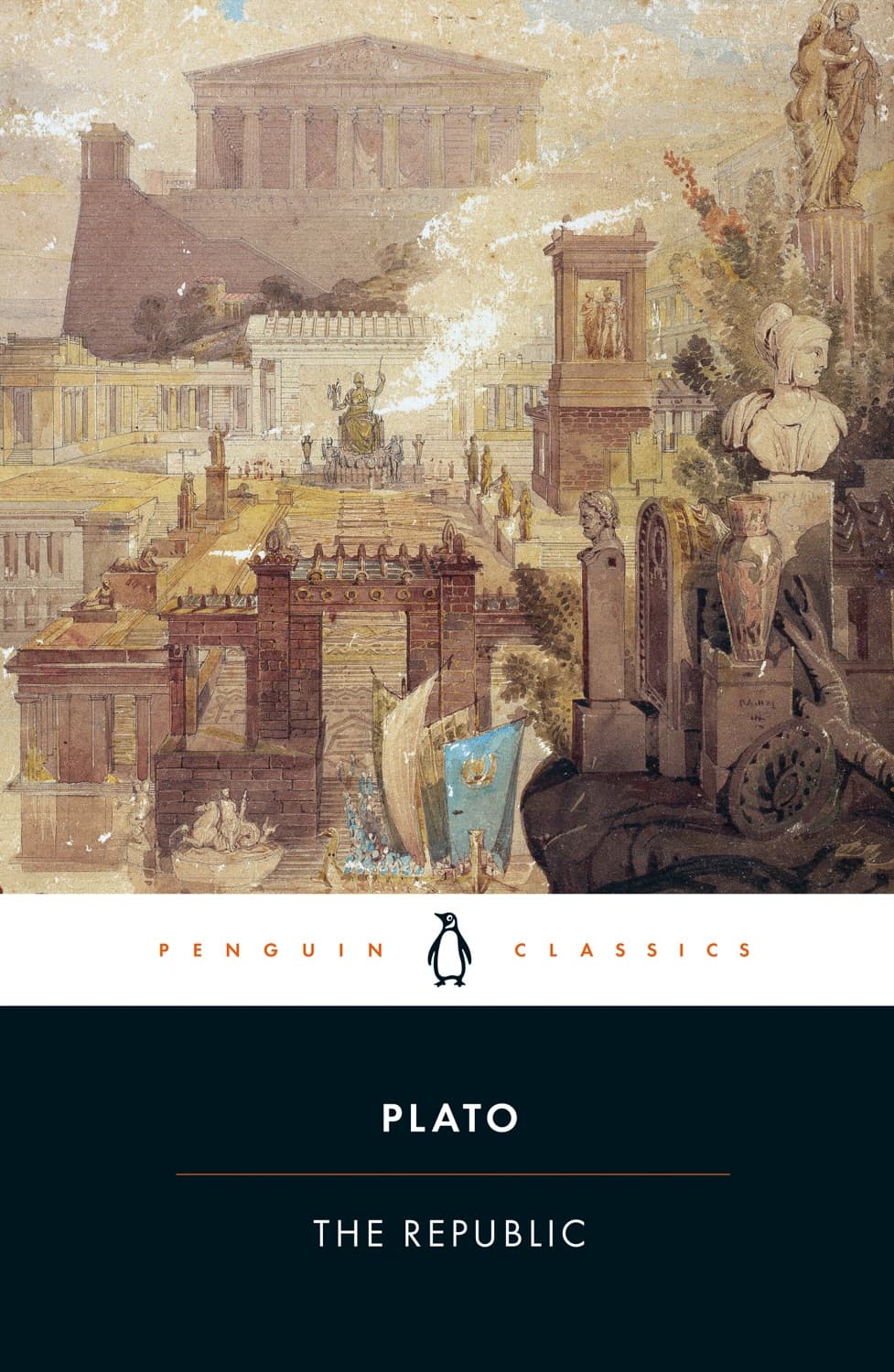
The Republic
Plato
Free download · 500+ book summaries
What is The Republic about?
Plato's foundational dialogue on justice, the ideal city, and the philosopher king. Through Socrates, Plato builds a vision of the just soul mirrored in a just society — exploring education, virtue, the famous Allegory of the Cave, and what it means to live a truly good life. A cornerstone of Western thought.
Key ideas of The Republic
Justice Begins Inside the Soul
A just person is one whose reason, spirit, and appetite are properly ordered, not merely someone who follows rules or avoids punishment.
The Ring of Gyges Problem
Plato asks whether anyone would remain good if they could act invisibly, forcing an honest test of whether goodness is genuine or just reputation management.
Democracy Slides Toward Tyranny
Unchecked freedom without inner discipline produces a society that cannot resist the strongman who promises to fight on behalf of its desires.
Read an excerpt from the summary
The Republic — summary
A shepherd finds a ring and the world breaks open
Picture a young shepherd in the hills of Lydia, somewhere in modern Turkey, more than two and a half thousand years ago. There is a storm. The ground splits open near where his sheep are grazing, and he climbs down into the crack. Inside, he finds a hollow bronze horse with little windows in its sides. He looks through one of the windows and sees a corpse, larger than any human he has ever seen, naked except for a single gold ring on its hand. The shepherd takes the ring and climbs back out.
A few days later, sitting with the other shepherds, he twists the ring on his finger. He becomes invisible. The men around him talk about him as if he had walked off into the trees. He twists it the other way and he is back. The shepherd is named Gyges. Within weeks, he uses the ring to seduce the queen of Lydia, kill the king, and seize the throne. The story is told in The Republic by a young man named Glaucon, and the question Glaucon hands his older friend Socrates is brutally simple. If you had that ring, would you still bother being a good person? And if not, what was your goodness ever really worth?
That question is the engine of The Republic. Plato wrote the book around 375 BC, decades after his teacher Socrates had been executed by the Athenian democracy and his own family had been mixed up in a short, blood-soaked dictatorship called the Thirty Tyrants. He had watched a city he loved tear itself apart and kill the wisest man in it. He sat down to ask, in maybe four hundred pages of conversation, what justice actually is, why we should care about it when nobody is watching, and what kind of person, family, school, and city we would have to build for justice to have any chance.
Like it?
Continue in the appWho is it for?
- Anyone who has wondered whether being honest and fair actually pays off in a world that often rewards cheats.
- Anyone who wants to understand where Western ideas about justice, education, and political power originally come from.
- Anyone drawn to big questions about how to structure a life around what is genuinely good rather than what feels good in the moment.
- Anyone curious why democracy can be fragile and what kind of character a free society actually requires of its citizens.
About the author: Plato
Plato was an Athenian philosopher who lived from around 428 to 348 BC. He was a student of Socrates and the teacher of Aristotle, making him the central figure in the line that shaped the entire Western philosophical tradition.
After the execution of Socrates by the Athenian democracy in 399 BC, Plato founded the Academy in Athens, one of the earliest institutions of higher learning in the Western world. His dialogues, of which The Republic is the most ambitious, use Socrates as the main speaker to probe questions of ethics, politics, knowledge, and the nature of reality.
Read it in 45 minutes
The summary of The Republic and 500+ more books await in the BookBase app.