 English
 Magyar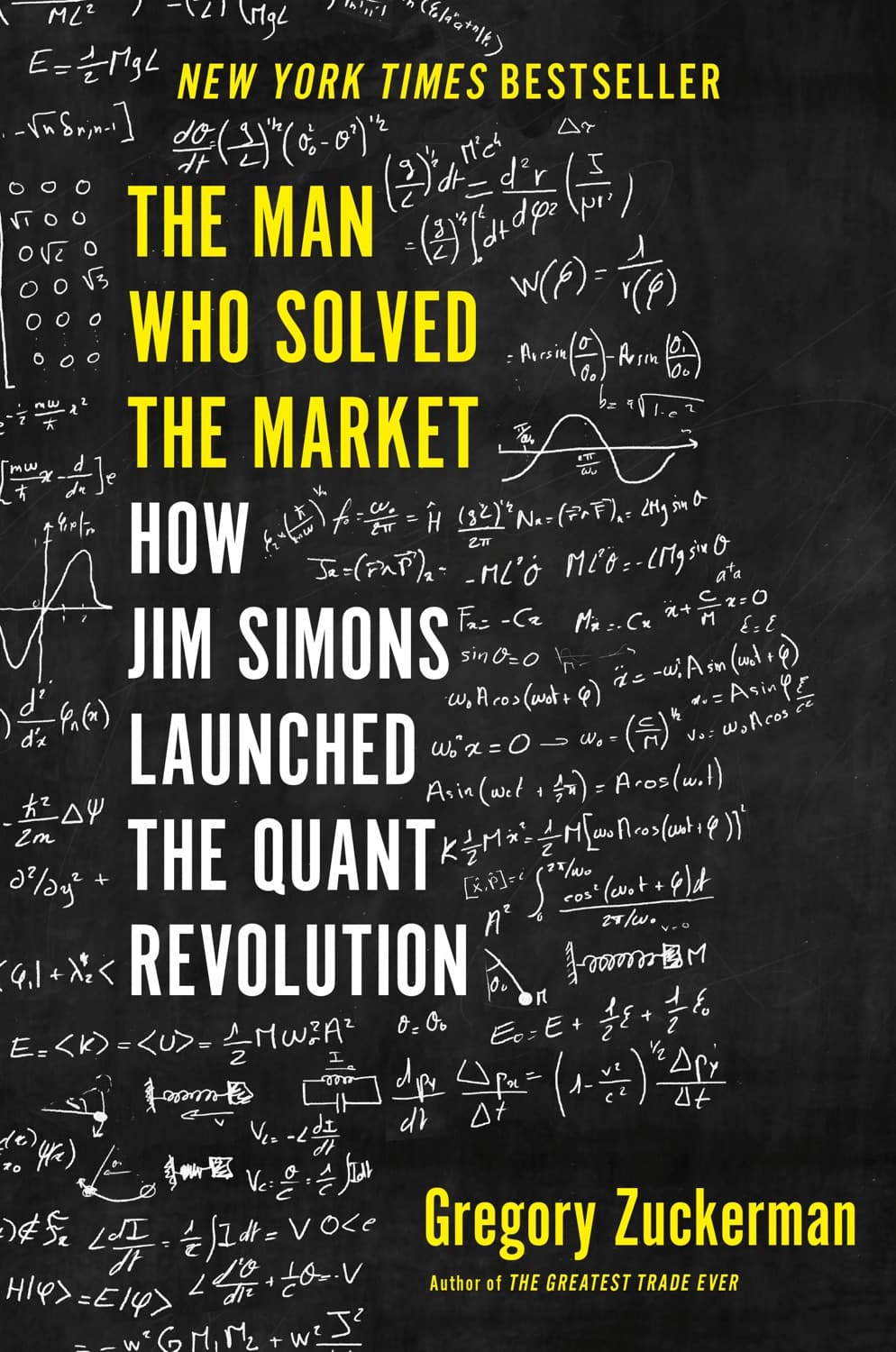
The Man Who Solved the Market
Gregory Zuckerman
Free download · 500+ book summaries
What is The Man Who Solved the Market about?
How Jim Simons and his Renaissance Technologies fund cracked Wall Street using pure mathematics. Gregory Zuckerman tells the story of the most successful quant fund in history, the secretive Medallion strategy, and the physicists, codebreakers, and statisticians who built it. The closest thing finance has to a Manhattan Project.
Key ideas of The Man Who Solved the Market
Empirical signals over theory
Medallion traded statistical price patterns that often had no theoretical explanation, trusting rigorous out-of-sample testing over intuitive narratives.
Systematic discipline beats intuition
Simons learned that overriding models with gut judgment reliably hurt returns, and Medallion's success depended on following the system completely under pressure.
Open culture behind closed walls
Collective bonuses and shared code made internal knowledge-sharing the rational choice, while ironclad NDAs kept everything from leaking outside the firm.
Read an excerpt from the summary
The Man Who Solved the Market
In the spring of 1989, a hedge fund based in a converted building on Long Island was falling apart. The Medallion Fund -- named for the prestigious mathematical prizes its founders had won -- had lost roughly 30% of its value peak-to-trough over its first eighteen months of operation. The model's architect, a UC Berkeley algebra professor named James Ax, insisted the losses were within the expected range of his simulations. He wanted to keep trading. Jim Simons, the 51-year-old mathematician who had founded Renaissance Technologies and who held a controlling stake in the fund, disagreed. He flew in and shut trading down. Ax quit. Simons was left holding a fund that was, by most objective measures, a failure.
It was the low point of one of the most extraordinary turnarounds in the history of finance. The machine Simons would build over the following three decades -- with a succession of codebreakers, speech recognition researchers, algebraists, and game theorists hired from universities and government labs -- would go on to generate over $100 billion in gross trading profits between 1988 and 2018. The Medallion Fund compounded at roughly 66% gross per year, or 39% net after fees that were deliberately set to be punishing: 5% of assets under management and 44% of profits, nearly triple the industry standard. A dollar invested at inception and held for thirty years would have grown to approximately $27,000 net of fees. Gross of fees, the number was closer to $200,000. Warren Buffett, across the same period, compounded Berkshire Hathaway at approximately 20% annually. George Soros, at his best, managed something around 30%. The comparison illustrates not just a difference in degree but a difference in kind.
Like it?
Continue in the appWho is it for?
- Anyone who wants to understand how quantitative finance actually works at its highest level.
- Anyone who is curious why outsider thinking and cross-domain expertise so often breaks open entrenched fields.
- Anyone who struggles to trust a systematic process over their own gut instincts.
- Anyone who wants a serious, deeply reported account of one of the most secretive firms in financial history.
About the author: Gregory Zuckerman
Gregory Zuckerman is a senior writer at the Wall Street Journal and the author of several books on finance and investing. He has spent decades covering hedge funds, traders, and market events for one of the world's leading financial newspapers.
His previous book, The Greatest Trade Ever, told the story of John Paulson's bet against the mortgage market in 2007. Zuckerman spent years tracking down current and former Renaissance employees and reviewing internal documents to produce the most complete account of Jim Simons and his firm that has ever appeared in print.
Read it in 47 minutes
The summary of The Man Who Solved the Market and 500+ more books await in the BookBase app.